fantasy
Celebrating the fantastical. Let your imagination run wild.
From Moradabad to Apple’s Global Stage: Sabih Khan Becomes the New COO of Apple
Apple’s new Chief Operating Officer (COO) Sabih Khan—an Indian-origin executive originally from Moradabad, Uttar Pradesh—has been appointed to oversee iPhone manufacturing, especially in India. After over 30 years at Apple, he succeeds Jeff Williams in a strategic move by CEO Tim Cook. This milestone highlights Apple’s commitment to continuing iPhone production in India amid global trade pressures and ambitions of sustainable growth. Born in Moradabad in 1966, Khan later lived in Singapore and then moved to the U.S. for higher education, earning degrees in mechanical engineering and economics from Tufts University and a master’s from RPI. He joined Apple in 1995 and climbed the ranks—from procurement to Senior Vice President of Operations—playing crucial roles in green manufacturing, logistics, and global supply chain management. Tim Cook praised him as “a brilliant strategist” and trusted his leadership to shape Apple’s future. Apple expects India’s share in its global iPhone production to grow significantly under his leadership. 1. Introduction: A New Era of Leadership On July 8, 2025, Apple announced that Sabih Khan will step into the role of Chief Operating Officer, succeeding longtime operations chief Jeff Williams as part of a carefully orchestrated leadership transition . With a remarkable 30-year career at Apple, Khan’s ascent symbolizes continuity, internal talent promotion, and global ambition amid shifting geopolitical trade landscapes. 2. Early Life & Roots – From Moradabad to Global Education Sabih Khan was born in Moradabad, Uttar Pradesh, India in 1966. During his school years, his family relocated to Singapore, where he completed his early education. Later, he moved to the United States for tertiary studies . His educational journey reflects both technical depth and global exposure: Dual bachelor’s degrees in mechanical engineering and economics from Tufts University A master’s degree in mechanical engineering from **Rensselaer Polytechnic Institute (RPI)** This combination of engineering and economics laid the groundwork for his success leading complex operations at one of the world’s biggest tech firms. 3. Early Career: GE Plastics Foundations Before joining Apple, Khan worked at GE Plastics as an applications development engineer and key account technical leader. This phase helped him build strong analytical and execution skills before transitioning to the high-stakes environment of Apple’s global tech supply chain . 4. At Apple: Joining and Rising Through the Ranks Khan joined Apple in 1995, initially working in the procurement group. Over the decades, his contributions spanned planning, manufacturing, logistics, supplier responsibility, and global fulfillment operations . In 2019, he was promoted to Senior Vice President of Operations, a key leadership role overseeing Apple’s supply chain continuity, product quality, supplier relations, and environmental programs . In this capacity, Khan navigated major challenges including pandemic disruptions, production shifts, and evolving trade policies. 5. Global Impact: Strategy, Sustainability, and Resilience Tim Cook praised Khan as “a brilliant strategist” and one of the central architects of Apple’s supply chain, highlighting his leadership in pioneering advanced manufacturing technologies and expanding U.S. and Indian production footprints . Under Khan's stewardship, Apple intensified its focus on environmental sustainability, achieving over 60% reduction in carbon footprint through initiatives involving green supply chains and responsible supplier practices . His efforts ensured Apple’s ability to scale swiftly and adapt to global challenges, from trade tensions to logistics disruptions . 6. A Crucial Moment: Transition and Trade Pressures Khan assumes the role of COO during a volatile climate. Former U.S. President Donald Trump had warned Apple of steep tariffs if iPhones continued being manufactured outside the U.S., particularly in India . In response, Apple is rapidly expanding iPhone production in India—with roughly 20% of global iPhones assembled there in fiscal year 2025 (~$22 billion in value), up 60% from the prior year . Khan’s promotion signals Apple’s long-term commitment to this shift and its operational readiness to manage geopolitical and logistical complexities. 7. The Transition: Jeff Williams’ Legacy & Role Jeff Williams, who led Apple’s operations for decades, will remain at Apple for the remainder of 2025, overseeing the company’s design team and Apple Watch/Health initiatives. After his retirement, these units will report directly to CEO Tim Cook . Williams spoke highly of Khan: > “I have worked closely with Sabih for 27 years and believe he’s the most talented operations executive on the planet.” His continued involvement ensures a smooth transition of strategic responsibilities and mentorship for Khan. 8. Significance of Khan’s Appointment a. Representation & Inspiration Khan’s journey—from a small-town upbringing in Moradabad to a major executive role at Apple—embodies global opportunity and the rise of Indian-origin leadership in Silicon Valley, joining ranks with CEOs like Sundar Pichai and Satya Nadella . b. Operational Continuity With global operations and supply chains at the center of Apple’s business alongside increasing geopolitical risks, Khan’s deep institutional knowledge provides stability and strategic consistency. c. Sustainability Commitment Under his leadership, Apple has intensified its green manufacturing practices. Cutting carbon emissions and training suppliers on responsible practices emphasize the company’s environmental ethos . d. Manufacturing in India & Future Vision Khan’s Indian heritage and operations experience uniquely position him to manage Apple’s expanding footprint in India—supporting national manufacturing initiatives and global trade realignment. 9. Vision Ahead: What Lies Next? As COO, Sabih Khan will lead Apple’s global operations through an era of supply-chain diversification, sustainability focus, and technological innovation. He is expected to: Oversee the ongoing shift of iPhone production to India Drive advanced manufacturing technologies Cement Apple’s reputation for sustainable global operations Maintain flexibility in logistics amid evolving trade policies His leadership comes at a time when Apple is grappling with balancing production across multiple geographies, ensuring quality, affordability, and resilience. 🔚 Conclusion Sabih Khan’s appointment as Apple’s new COO marks a symbolic and strategic milestone. With a solid engineering and economics education and nearly three decades of operational leadership within Apple, Khan brings the expertise and values needed for the next phase of growth. His Indian origin adds profound significance to this transition, especially as Apple deepens its operations in India. Tim Cook’s praise and Jeff Williams’ endorsement underscore the company's trust in him to lead through complexity with integrity and vision.
By Ikram Ullahabout a year ago in Futurism
AI Matchmaking and the New Path to Finding True Love
Over the past ten years, the landscape of romantic searching has shifted dramatically, with artificial intelligence now steering the change. Algorithms once thought experimental now power most major dating apps, guiding users toward matches that data suggest stand a greater chance of lasting. In this context, AI matchmaking feels less like science fiction and more like a daily routine, turning hopeful singles into participants in a finely-calibrated compatibility test. By analyzing countless signals, the technology reduces guesswork and brings a measure of precision to the search for genuine partnership.
By Stella Johnson Loveabout a year ago in Futurism
Central Texas Communities Grapple with Flood Aftermath
Central Texas Communities Grapple with Flood Aftermath Recent heavy rainfall has left numerous communities in Central Texas grappling with the devastating aftermath of significant flooding. As residents begin to assess the extensive damage and disruptions caused by the torrential downpours, local authorities and organizations are mobilizing their efforts to aid those affected. The long-term repercussions of this crisis underscore critical challenges regarding community recovery and flood management in the region.
By KingFree MaNabout a year ago in Futurism
Love in Three Rooms
Love in Three Rooms Room One: The Studio on 14th Street It was barely a room, really. A studio apartment over a noisy laundromat with a single window that rattled when the buses passed. But when we signed the lease, it felt like the beginning of everything.
By Prince khanabout a year ago in Futurism
Caged Titans I: The Chronomoloch
The Archives' lights didn't just dim; they *shrieked*, a violent, energy-starved sound tearing through the air. Breath-stealing strobes fractured the world into jagged shards before Mila could even register the impossible pressure clamping down. Her terminal, a familiar beacon just moments before, winked out with a sharp, final click, abandoning her to a sudden, bewildering darkness. A cold dread, swift and sharp as splintered bone, pierced her gut - a sickening certainty that fundamental constants were unraveling, leaving a terrifying void where bedrock truths should be.
By Maxim Dudkoabout a year ago in Futurism
From Alchemy to CERN: The 1,200-Year Quest to Turn Lead into Gold; A Tale in Pictures: From Alchemy’s Glow to Particle Science’s Roar
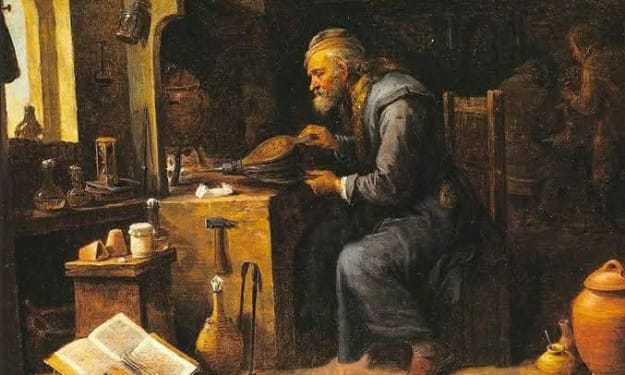
It is Baghdad in the 8th century. The night air carries a cool hush, but deep within one narrow alley, a small room glows under the flicker of oil lamps. Smoke swirls toward the ceiling where its tendrils twine with shadows that dance upon the walls. In the center stands an elderly man, his wise, sharp eyes fixed on his work. His hands move deftly among slender glass vessels, matte brass flasks, and copper bowls. With precision born of long hours and countless repetitions, he drips liquids—sometimes a drop of golden-yellow solution, other times two drops of milky white fluid—into a crucible of curiosity. Mutters escape his lips in Arabic: “قم بالتجارب لكي تكتسب المعرفة...” “Try experiments so that you may attain knowledge...” The night deepens. The lamp’s flame sputters. Smoke clings to the low ceiling, a stifling veil carrying the acrid scent of brimstone, burnt salt, and a hint of sour fruit. The old man’s face is etched with strain; sweat gleams across his forehead. His eyes, red-rimmed from sleepless nights and relentless focus, fix upon a long, curved glass tube—its lower end capped with a small flask. Within that flask, a single ruby-red drop trembles, falls—with the soft plink echoing in the cramped silence. Each drop is an announcement to his racing heart. This is Jābir ibn Ḥayyān, the legendary alchemist-scientist, consumed for the last decade by a singular obsession: the transformation of lead into gold. Jābir believed he could do so with the mythical Philosopher’s Stone or through a precise chemical process. Tonight, the dull, heavy chunk of lead before him remains stubbornly unchanged. The truth is, Jābir never succeeded in turning lead into gold. But his relentless trials pushed him to innovate: he designed new apparatus for distillation—the alembic; improved vessels for evaporation, crystallization, and safe containment of acids and alkalis. He meticulously documented sublimation, dissolution, oxidation, and hundreds of other reactions. These experiments earned him the title “Father of Chemistry.” For centuries, the flame of alchemy spread worldwide. By the 16th and 17th centuries, however, the dawn of empirical modern science dimmed alchemy’s enchantment. The dream of transmuting base metals into gold became recognized as nothing more than an alchemical myth. --- 🚀 And now—1,250 years later—May 7, 2025: Under the Alps, straddling the border between Switzerland and France, lies CERN’s Large Hadron Collider (LHC)—a colossal scientific engine buried deep beneath the earth. The contrast with Jābir’s smoky workshop—and both could not be more profound. Here, the air hums with the breath of supercomputers that analyze mountains of data, while physicists in spotless lab coats sit before console screens. They accelerate beams of protons nearly to the speed of light, steering them into ultra-high-energy collisions. Data graphs bloom on the screens, complex and intricate as constellations. The researchers wait, breath held, until a distinctive signal emerges—a pattern they’ve been searching for all along. A hush descends, then slowly, one scientist’s eyes widen. A hand lifts in silent marvel. Others hurriedly scan their monitors. They are witnessing it: by colliding lead nuclei with tremendous kinetic energy, they have changed the number of protons in atomic nuclei—transmuting lead into gold. In this moment, what Jābir pursued with crude tools in his humble room has finally been accomplished—with exquisite precision and staggering scale. --- 🌟 Continuum of Curiosity In that dimly lit workshop of 1,200 years ago, Jābir whispered: “قم بالتجارب لكي تكتسب المعرفة…” “Try experiments so that you may attain knowledge...” Tonight, deep beneath the earth, the echo of those words resonates once more—less a whisper, more a triumph. From glass flasks to stainless steel accelerators; from copper heating coils to cryogenic superconductors; from a lone man’s intuition to massive international teams… science has evolved, but its heartbeat remains unchanged. Jābir’s experiments laid the foundation. Early chemists refined his processes; medieval scholars classified substances, dedicated alchemical texts, and developed proto-laboratories. Over centuries, the blend of curiosity and precision gave birth to modern chemistry and physics—disciplines grounded in experimentation, measurement, and skepticism. --- 🔬 From Alchemy to Particle Collision Jābir’s Legacy: He invented the alembic, refined vessels for distilling and crystallizing, and formalized chemical terminology. He catalogued substances and reactions like oxidation and desiccation—planting the seeds of systematic chemical science. Scientific Revolution: As empirical methods took root in Europe, alchemy evolved into chemistry. Robert Boyle, Antoine Lavoisier, and others proposed rigorous standards: reproducibility, measurement, skepticism about hidden forces like “vital spirits.” The pursuit of transmutation faded, while focus shifted to atomic structures and molecular composition. Nuclear Transmutation: In the 20th century, Ernest Rutherford cracked the nucleus with alpha particles, discovering protons and pioneering artificial element transformation. Later, particle accelerators generated isotopes and exotic elements at scale. Modern Alchemy—The LHC Way: At CERN, researchers create fleeting new elements, test matter under extreme conditions, and sometimes observe transmutations—turning mercury, bismuth, or lead nuclei into higher elements like gold. Not economically viable, but monumental in human understanding. --- 🌌 A Lab of Dreams and Determination Jābir’s smoky room was powered by nothing but oil lamps and hope. He had no theory of the atom, no periodic table—only observation, intuition, and meticulous documentation. Modern science runs on gigawatts of electricity, millions of lines of code, and thousands of researchers, but it too is built on the same pillars: hypothesis, experiment, observation, and critical analysis. What unites them is simple yet profound: the human spirit’s hunger to know. One small drop falls in Jābir’s flask. One massive collision unfolds in the LHC. Both moments answer an enduring question: What happens when we push nature’s boundaries? In Baghdad’s dusty alley, Jābir heard it slow and close: > “قم بالتجارب لكي تكتسب المعرفة...” In Geneva’s corridors, tens of thousands of equations later, we hear it again. A whisper becomes a roar. --- ✨ Because Curiosity Never Dies Osama scientist or medieval alchemist—across time, cultures, and tools—the impulse to experiment remains the same. Whether mixing reagents or colliding nuclei, we challenge the unknown. Jābir didn’t make gold. Yet his inventions, records, and courage paved a path intellect traveled for millennia. Modern science stands on that foundation, and tonight, under the Alps, human ingenuity has turned the impossible into history. So the next time you hesitate—wondering whether a small experiment, a bold idea, or a simple question is worth the effort—remember: Curiosity is the spark, experimentation is the flame. قم بالتجارب لكي تكتسب المعرفة … “Try experiments so that you may attain knowledge.” And maybe, in your own way, you are building the future—one question, one drop, one collision at a time.
By Ikram Ullahabout a year ago in Futurism
The Transformative Power of Prayers to the Archangels
In uncertain times, many people turn to spiritual practices to find strength, clarity, and protection. One of the most powerful ways to establish this divine connection is through prayer to the archangels. These celestial beings, recognized across various spiritual traditions, serve as messengers of God and guardians of the soul. Each archangel carries a unique energy and mission, and by invoking their presence through focused prayer, we can invite balance, healing, and guidance into our daily lives.
By Sthephanieabout a year ago in Futurism
What Happens if Robots Take Over the World?
In an era defined by rapid technological advancement, one of the most intriguing—and often terrifying—questions looms large: What if robots take over the world? This scenario, once confined to the realm of science fiction, is now being discussed by experts, policymakers, and everyday people alike. As artificial intelligence (AI), machine learning, and robotics evolve at breakneck speed, the line between human and machine capabilities continues to blur. While the benefits of automation are undeniable, the idea of a complete robot takeover forces us to examine the implications from technological, ethical, economic, and existential perspectives.
By Intresting Storiesabout a year ago in Futurism
The Echo Beyond the Stars: Truth They Tried to Bury
In the year 2047, the world had grown quieter—not because of peace, but because of secrets. Technology had reached its peak, communication spanned galaxies, and yet, silence surrounded the one thing that mattered most: the truth.
By Muhammad Umairabout a year ago in Futurism
How do your cells decide which bodily parts to construct? Innovative new technology is assisting us in learning
In just a few days, a single fertilised egg can produce blood, brain, and skin cells. However, how do the earliest cells decide which bodily components to construct? How come certain cells know how to make kidneys while others start making skin right away?
By Francis Damiabout a year ago in Futurism