evolution
The evolution of science, science fiction, and mankind throughout the years.
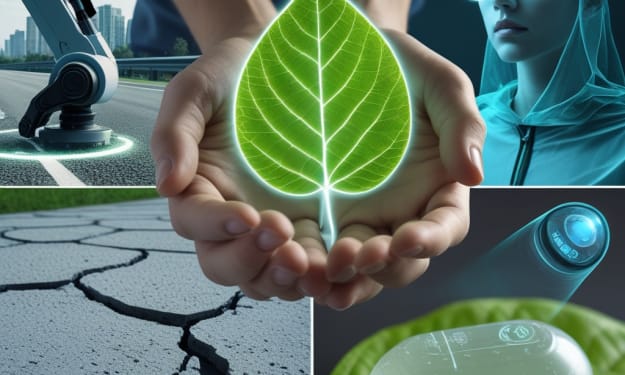
Track 1000: China’s Groundbreaking Leap in Green Transportation
China Surprises the World Once Again — This Time Not in Space, But on Earth! China, known for its groundbreaking advancements in science and technology, has once again astonished the world — but this time, the innovation is not related to space exploration; it's firmly grounded on Earth. The China Aerospace Science and Technology Corporation (CASC), a leading state-owned enterprise in the field of space technology, has successfully tested a revolutionary new system named "Track 1000." This cutting-edge innovation is a liquid hydrogen fuel cell system specifically designed for heavy-duty trucks, enabling them to travel over 1,000 kilometers on a single tank, without requiring any stops for refueling. This system utilizes a 100-kilogram tank of liquid hydrogen combined with high-efficiency fuel cells. The only byproduct emitted from the vehicle is water vapor, making the entire process nearly zero-emission and environmentally friendly. A Game-Changer for Long-Haul Transportation The "Track 1000" system holds the potential to revolutionize long-distance freight transport, especially in the heavy vehicle sector. At present, electric trucks are increasingly being explored as alternatives to traditional diesel-powered vehicles. However, they face several limitations, such as: Long charging times Limited driving range Heaviness and bulk of battery packs In contrast, liquid hydrogen presents itself as a lightweight, energy-dense, and quick-refueling fuel source. These attributes address some of the most pressing issues in electric trucking. Because of its high energy content and lighter weight compared to traditional batteries, liquid hydrogen allows trucks to travel longer distances while minimizing downtime and maximizing efficiency. Environmental Impact: A Breath of Fresh Air Perhaps the most impressive aspect of the Track 1000 system is its environmental performance. Unlike conventional diesel trucks that emit harmful pollutants such as nitrogen oxides (NOx), carbon dioxide (CO₂), and particulate matter, this hydrogen-based system emits only water vapor, contributing virtually nothing to air pollution. In a time when climate change, carbon neutrality, and environmental protection have become global priorities, such green technology offers a sustainable solution. If adopted widely, it could significantly reduce the carbon footprint of the transportation industry, which is one of the leading contributors to global greenhouse gas emissions. Strategic Significance for China This development is also a reflection of China's broader strategy to lead in clean energy technologies. Over the past decade, China has made substantial investments in renewable energy, electric vehicles, solar panels, and green hydrogen. With the successful launch of "Track 1000", China is signaling that it is not only aiming for leadership in space exploration but also in eco-friendly, Earth-based transportation technologies. The move aligns with China's national goals of achieving carbon neutrality by 2060, and such innovations could also provide China with a strong export advantage as countries around the world seek sustainable alternatives for freight transport. What Sets Track 1000 Apart? Several key features make Track 1000 a standout in its category: 1. Extended Range: Over 1,000 kilometers on one tank — a major leap from current battery-electric trucks. 2. Fast Refueling: Liquid hydrogen refueling takes only a few minutes compared to hours of battery charging. 3. High Efficiency: The fuel cells used in this system are highly efficient and reliable. 4. Lightweight Structure: Unlike heavy battery packs, liquid hydrogen systems are significantly lighter. 5. Zero Emissions: The only byproduct is water vapor — a win for the environment. The Road Ahead Although this technology is still in the testing and early adoption phases, its successful demonstration by CASC is a giant leap forward in the evolution of green transport. It opens the door to further research, development, and eventual commercial deployment of hydrogen fuel cell trucks not only in China but around the globe. Several questions remain, such as: How will the hydrogen be produced and distributed sustainably? What will be the cost of adoption for logistics companies? How soon can this technology be scaled? Despite these challenges, the Track 1000 project offers a glimpse into a cleaner, more efficient future for road transport. In conclusion, China has once again shown its capability to lead the world with bold innovation, and this time, it’s doing it not by reaching for the stars but by redefining how we move goods across the Earth — cleanly, efficiently, and sustainably.
By Ikram Ullahabout a year ago in Futurism
“The End of Netflix? Why Streaming’s Golden Age Is Crashing Down”
Just a few years ago, Netflix looked unstoppable. It revolutionized entertainment, crushed cable TV, and sparked a streaming war that reshaped Hollywood. But in 2025, the shine is wearing off. Netflix, Disney+, HBO Max (now Max), Prime Video—every service promised unlimited content for one low price. But now users are paying more, getting less, and asking a dangerous question: “Is this even worth it anymore?” The streaming boom was never sustainable. And we’re now watching it buckle under its own weight. --- Too Many Platforms, Too Much Confusion Remember when Netflix was the place to stream? Now, your favorite shows are scattered across six or more services. Want to watch Stranger Things, The Bear, and The Boys? That’s three different subscriptions. Consumers are frustrated. Streaming was supposed to simplify entertainment. Instead, it’s become cable TV 2.0—just with better UX. A recent survey found that the average American now pays for 4.5 streaming services—and churn (people canceling and switching) is at an all-time high. Loyalty is dead. People just chase what’s trending and cancel when it's over. --- Rising Prices, Declining Quality Netflix’s standard ad-free plan is now $15.49/month. Disney+ raised its price twice in one year. And new tiers keep launching with ads. Meanwhile, content is drying up. Writers' and actors' strikes, budget cuts, and layoffs have slowed production across the board. Shows are getting canceled after one season. Originality is dying under the weight of IP: prequels, sequels, spin-offs, reboots. Viewers feel like they’re paying more and getting less. That’s a dangerous equation in a competitive market. --- The AI Disruption Is Just Beginning Here’s where it gets really disruptive. AI-generated content is starting to enter the pipeline. Studios are experimenting with scripts written or co-written by AI. Voice cloning and deepfakes could make it cheaper to produce shows—without the traditional talent. But will audiences connect with AI-crafted stories? If streaming becomes an endless churn of low-effort content pushed by algorithms, users may tap out entirely. We're already seeing fatigue with formulaic Netflix originals that feel more like content than art. And creators? They’re pushing back. Many fear AI is being used to devalue their work and cut them out of the process. --- The YouTube and TikTok Threat While Hollywood battles itself, a different kind of content is dominating: short-form and creator-driven video. YouTube and TikTok aren’t just platforms—they’re ecosystems. They're where people go to laugh, learn, relax, and escape. Best of all? They’re free. TikTok’s recommendation engine is arguably more powerful than any streaming algorithm. You don’t pick what to watch—it finds you. And Gen Z? They’re not even watching full episodes anymore. Bite-sized content wins their attention span. --- Piracy Is Back Once thought dead, piracy is rising again. Why? Because it’s easier than juggling subscriptions. Many users don’t want to pay for multiple platforms just to watch one show. If it’s not available in their region—or if they’re priced out—they’ll find another way. This is a sign of market failure. When the legal option is too complex or expensive, the black market thrives. --- Streaming Was a Bubble. And It’s Bursting. Investors once treated streaming like a gold rush. Growth at all costs. Now, reality is hitting. Netflix lost subscribers for the first time in 2022. Disney’s streaming division lost billions. Warner Bros. Discovery pulled content from Max to save on taxes. The era of endless content and subscriber growth is over. Now it’s about profitability—and that means less content, more ads, and higher prices. The golden age is fading. --- What Comes Next? So what’s the future of entertainment? Here’s where things might go: Bundling returns: Expect platforms to start packaging services together (again) to reduce churn. Interactive, AI-driven content: Viewers may shape the story in real-time or watch dynamically generated shows. Creator dominance: Individual creators on platforms like YouTube and TikTok could rival traditional studios in influence. Smaller, niche services: Specialized platforms (anime, documentaries, etc.) may survive the shakeout. The streaming wars aren’t over—but the battlefield is changing. --- Final Thought Netflix isn’t dying tomorrow. But the promise of streaming—that it would be simpler, cheaper, and better than cable—is falling apart. Viewers are tired. The excitement is gone. And unless the industry can reinvent itself fast, the crash we’re seeing now may just be the beginning.
By GadgetGroundabout a year ago in Futurism
A World Without Jobs: What Happens When AI Wins?
It started quietly. First, it was the cashiers and warehouse workers. Then, the call center agents, accountants, and marketing assistants. Eventually, even coders, doctors, and teachers found themselves replaced—not all at once, but gradually, in small, efficient waves.
By Kamran Khanabout a year ago in Futurism
I Made Pharaoh in 5 Seconds
They say "history can’t be rewritten". But in 2025, I didn’t rewrite history—I reassembled it. In five seconds flat, a man who died over 3,000 years ago blinked into existence on my screen. Not as a ghost. Not as a god. But as a simulation—crafted by algorithms, shaped by data, and pulsing with a reconstructed human consciousness.
By Keramatullah Wardakabout a year ago in Futurism
Our Potential New Homes in the Universe
In the vast expanse of space, astronomers have been on a relentless quest to find planets beyond our solar system that could support life. Among the thousands of exoplanets discovered, a special group known as “super Earths” stands out. These are rocky planets with masses up to ten times that of Earth, and they could potentially become future homes for humanity. Let’s take a closer look at some of the most intriguing ones.
By Kreative William 254about a year ago in Futurism
What Is 925 Silver? A Complete Guide to Sterling Silver Jewelry
If you've spent any time browsing jewelry online or shopping at boutiques, you've probably come across the terms 925 silver and sterling silver used quite frequently—sometimes even interchangeably. These labels may seem confusing at first, especially when you're trying to make an informed purchase. But don’t worry—we’re here to break it all down clearly and simply.
By James Oliverabout a year ago in Futurism
WoWo Sim Review 2025: Is It the Best eSIM for Global Travellers?
Our modern society requires continuous connectivity during travel because it serves as an essential tool. A phone connection that provides dependable internet access determines the success of foreign experiences for business professionals and leisure travelers, and digital nomads. The service provided by eSIM technology gets its boost through WoWo Sim, which recently made access simpler for everyone.
By James Oliverabout a year ago in Futurism
The Revolutionary Impact of AI: Transforming Key Sectors Across Industries
As organizations increasingly recognize the potential of AI technologies, the demand to hire data scientists and AI specialists has surged dramatically. From healthcare breakthroughs to financial innovations, AI is revolutionizing how businesses operate, make decisions, and serve their customers across diverse sectors.
By Himshikha Chaudharyabout a year ago in Futurism