astronomy
Celestial objects and the phenomena that surrounds them. What lies above the earth forever out of reach. From moons, to stars, galaxies, and beyond.
WHAT IF YOU TRAVELLED ONE BILLION YEARS INTO THE FUTURE?
If you traveled 10,000 years into the future, what would planet Earth look like? Would its surface be dominated by volcanoes, or would it be encased in ice? Now, imagine traveling even further—1 million years into the future. Would the oceans have evaporated completely, or would Earth have transformed into a vast water world? And what about 1 billion years from now? Would humans still exist on Earth, or would they have moved to other parts of the galaxy? This is What If, and here’s what would happen if you traveled 1 billion years into the future. Let’s face it—the odds of humans still being around to welcome you 1 billion years into the future are pretty slim. Humanity faces several major existential threats, and surviving them all would be no small feat. We’ve already struggled to unite during a global pandemic, so how can we possibly endure threats like climate change, overpopulation, global nuclear war, asteroid and comet impacts, natural ice ages, and the Sun becoming significantly hotter? Let’s take a closer look at what the future holds. In just under 10,000 years, humanity will face a challenge known as the Deca-Millennium Bug. By the year 10,000 AD, software encoding the calendar year may fail to process dates with more than four digits. Sound familiar? It’s like the Y2K bug—but this time, hopefully, we won’t panic as much. On the bright side, 10,000 years from now, genetic differences and traits between humans will no longer be regional. Characteristics like skin and hair color will likely be evenly distributed across the globe—perhaps helping humanity find more common ground. By 20,000 years into the future, none of today’s languages will remain recognizable. Future languages will retain only about 1% of the core vocabulary from their present-day counterparts. Fast forward to 50,000 years, and Earth will enter a new glacial period, ushering in another ice age. Niagara Falls will have completely eroded into Lake Erie by then, and intriguingly, a full day on Earth will be one second longer—giving us a little more time for activities! In 250,000 years, the Loihi volcano will rise above the ocean’s surface, forming a new island in Hawaii. Fast forward to 500,000 years, and the Earth may face an asteroid impact with a diameter of over one kilometer. Unless we develop ways to prevent it, this asteroid would create a crater at least 400 kilometers wide, ignite global fires, and render the air unbreathable. So, there’s something to look forward to. If that’s not daunting enough, in 1 million years, Earth will likely experience a supervolcano eruption. This event would eject 3,200 cubic kilometers of ash and produce enough lava to fill 75% of the Grand Canyon. It would rival the Toba eruption, which nearly wiped out humanity 70,000 years ago. Oh, and by this time, the nearby star Betelgeuse will have exploded into a supernova, creating a spectacle so bright it will be visible from Earth, even during the day. By 2 million AD, humanity may have established settlements throughout the solar system. However, if populations on different planets remain isolated, humans could evolve into entirely new species, uniquely adapted to their respective worlds. In 10 million years, a large portion of Eastern Africa will break away, creating a new ocean basin. Fast forward to 50 million years, Africa will collide with Eurasia, closing off the Mediterranean Sea. This collision will give rise to a massive new mountain range, potentially home to peaks taller than Mount Everest. Meanwhile, out in space, Mars will collide with its moon, forming a ring system similar to Saturn's. In 60 million years, the Canadian and American Rockies will have eroded completely, leaving no trace of their towering peaks. By 80 million years, all the Hawaiian Islands will have sunk beneath the waves, disappearing into the ocean. In 100 million years, Earth will likely face another catastrophic asteroid impact, similar to the one that wiped out the dinosaurs 66 million years ago. This asteroid would measure about 10 kilometers in diameter, causing global devastation. Fast forward to 250 million years, and all of Earth’s continents will merge into a single supercontinent, much like Pangaea. This new landmass will be called Pangaea Ultima. However, don’t get too attached to it—between 400 and 500 million years, Pangaea Ultima will begin to break apart once more. In 500 to 600 million years, a gamma-ray burst may occur within 6,500 light-years of Earth. If it strikes our planet, it could severely damage the ozone layer and potentially trigger a mass extinction event. By 600 million years, the Moon will have drifted so far from Earth that total solar eclipses will no longer be possible. Meanwhile, the Sun’s increasing luminosity will raise global temperatures to such extremes that it could halt the movement of Earth’s tectonic plates altogether. In 800 million years, carbon dioxide levels will have dropped dramatically, making photosynthesis impossible. Without free oxygen and ozone, complex life on Earth will cease to exist. By 1 billion years, the Sun’s luminosity will have increased by 10 percent, raising Earth’s average temperature to a scorching 47°C. Our atmosphere will feel like a damp greenhouse, and the oceans will have evaporated, leaving only pockets of water at the poles. When you arrive in your time machine, be mentally prepared for a planet that looks nothing like the one you remember. The human race will likely be gone, hopefully thriving on a distant planet. Due to the intense heat, lack of water, and breathable air, Earth will be completely uninhabitable. So, instead of staying too close to the surface, consider venturing out into the solar system. You might find your fellow humans—or perhaps some form of intelligent life. But that, my friend, is a story for another What If.
By Okike miracle Oluchi2 years ago in Futurism
It's Like Interplanetary Travel When Bacteria and Viruses Spread
Whenever I watch someone sneeze or cough, I think of mankind attempting to settle on another planet. Musk has an ambitious objective. He attempts to develop an effective approach to create a society on Mars. He wants to put the X on extraterrestrials; nevertheless, I’m not sure about his method because all his major pronouncements and antics are unanticipated.
By Muhannad Al-Zanati2 years ago in Futurism
What does it mean to have 2nd lord in 6th house?
When the 2nd lord of a horoscope is placed in the 6th house, the interpretation becomes multifaceted, weaving together themes of wealth, family, speech, values, and health-related matters. The second house, being the first Artha Trikona, signifies wealth accumulation, speech, family lineage, values, and possessions. Conversely, the sixth house, being the first of the Dushthana (malefic) houses, represents challenges such as disease, debts, enemies, competition, and disputes, but also holds the energy of Upachaya, where growth and improvement occur over time.
By Saartha Bhandari2 years ago in Futurism
Planet 187. Runner-Up in Future Fragments Challenge.
It was two thousand fifty, and the technology for universal exploration had just been built. I was on a solo mission to search for a lost pilot, and I was supposed to land on Xenosolaris to search for him and recover his lost spaceship, but a meteorite has stuck my ship and caused me to crash land on an unnamed planet just called planet 187 instead. I’m just glad there was a planet to stand between me and my ascent into nothingness.
By Alex H Mittelman 2 years ago in Futurism
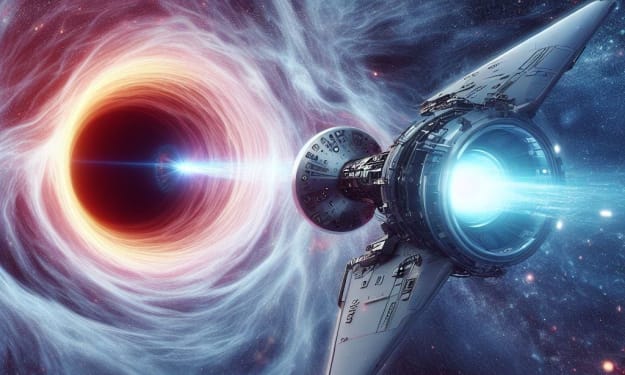
The Wonders of Space-Time. AI-Generated.
Imagine our universe as a grand, four-dimensional tapestry, woven with three dimensions of space and one of time. Together, they form the fabric of reality: space-time. But this isn’t just a static quilt—it’s malleable, bendable, and even tearable. Welcome to the playground of cosmic possibility, where theoretical physics meets the dreams of interstellar travel.
By Georgia M.2 years ago in Futurism