astronomy
Celestial objects and the phenomena that surrounds them. What lies above the earth forever out of reach. From moons, to stars, galaxies, and beyond.
Why Uranus Lies on Its Side: The Curious Case of a Tilted Giant
When it comes to the oddities of our Solar System, Uranus easily ranks near the top of the list. This icy giant doesn’t behave like its planetary siblings. While most planets spin like tops slightly tilted from vertical, Uranus seems to have taken a nap it literally lies on its side. Its axis is tilted at nearly 98 degrees, which means it rolls along its orbital path like a ball that has been knocked over.
By Holianyk Ihorabout a year ago in Futurism
Why Venus Is Hotter Than Mercury — Even Though It’s Farther from the Sun
When we think about the planets closest to the Sun, it seems logical that the one nearest to our star would be the hottest. That’s why most people assume Mercury, the first planet in the solar system, must be the most scorching world out there. But the universe doesn’t always follow human logic. Surprisingly, Venus, the second planet from the Sun, holds the title of the hottest planet in our solar system.
By Holianyk Ihorabout a year ago in Futurism
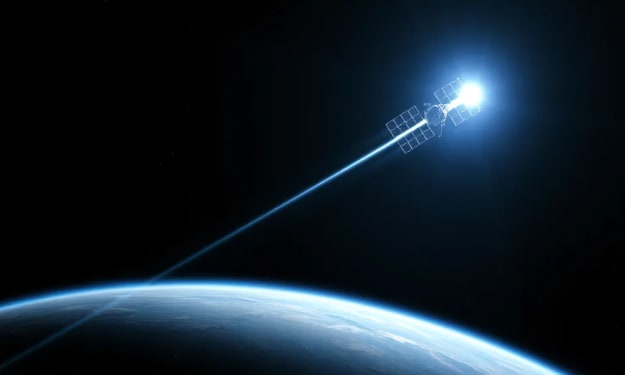
This Billionaire Immigrant Is Racing Elon Musk To Connect Your Phone From Space
Last September, a crowd of seasoned spectators gathered at Cape Canaveral, Florida, to watch as SpaceX’s Falcon 9 rocket took flight for the 373rd time. But it wasn’t carrying yet another of Elon Musk’s Starlink satellites to join the 7,100-plus he has already circling Earth. Onboard instead were five satellites from AST SpaceMobile, a tiny Starlink rival that SpaceX has derided as a “meme stock” in regulatory filings with the federal government. Each was equipped with a 700-square-foot antenna that would unfold in orbit, an early step in establishing a network AST hopes will someday best the incumbent mocking it.
By Muhammad Sabeelabout a year ago in Futurism
How to Tell a Living Planet from a Dead One: In Search of the Breath of Worlds
When we look up at the night sky and see tiny lights scattered across the inky depths of space, it is hard not to wonder how many of those worlds are alive. More importantly, how do we tell a living planet from a dead one? This question has fascinated scientists, astronomers, and dreamers for centuries. It touches on one of humanity’s oldest and most captivating mysteries: are we alone in the universe?
By Holianyk Ihorabout a year ago in Futurism
Rogue Planets: Wanderers Without Stars
When we think about a planet, we usually picture a celestial body orbiting a star. Like Earth, which circles the Sun. But in space, there is a completely different and almost mystical class of planets that breaks this rule. They are called rogue planets or stellar wanderers. These worlds drift through the Universe alone, not bound to any star. They are dark, silent, and mysterious like cosmic ghosts.
By Holianyk Ihorabout a year ago in Futurism
Quantum Teleportation in Space: Is It Possible?
When we hear the word teleportation, our minds often jump to scenes from science fiction movies where a hero instantly moves from a spaceship to a distant planet, leaving behind only a flash of light. However, in reality, teleportation is currently only possible at the quantum level, and even this technology feels almost magical. What if I told you that quantum teleportation has already been tested in space and could play a crucial role in the future of interplanetary communications?
By Holianyk Ihorabout a year ago in Futurism
How Satellites Measure the Sea Level: A View from Orbit on Earth's Health
When we talk about climate change, one of the most alarming indicators is the rising sea level. It’s not just a statistic it’s a threat. Rising oceans can swallow coastal cities, displace millions, sink island nations, and shift global weather patterns. But how exactly do scientists monitor such gradual changes in something as vast and dynamic as the world’s oceans especially when the difference can be measured in millimeters? The answer lies above us, orbiting Earth: satellites.
By Holianyk Ihorabout a year ago in Futurism
Part Two: The Ice Curtain: Secret Space Programs, Extraterrestrial Agendas, and the Forbidden History of Earth
While mainstream academia often dismisses these claims as mere speculation, a different narrative is told behind closed doors. Secret space programs, black budget operations, and public space agencies have reportedly been active in and around Antarctica for decades. Insiders allege that these programs involve advanced propulsion systems, interstellar missions, and even alliances with extraterrestrial beings.
By The Secret History Of The Worldabout a year ago in Futurism
Asteroids with Moons — How Is That Possible?
When you hear the word “moon,” the first image that probably comes to mind is that huge, glowing satellite lighting up the night sky beside Earth. But what if I told you that moons aren’t just reserved for planets? Some asteroids tiny compared to planets can have their own moons too. It sounds like science fiction, but it’s a fascinating scientific reality.
By Holianyk Ihorabout a year ago in Futurism
How Did Time Begin? The Mystery Embedded in Existence Itself
When we glance at a clock, plan our day, or reminisce about the past, we rarely stop to ask: What is time itself? Where did it come from? Does time exist independently, or is it merely a product of our perception? Philosophers, physicists, and cosmologists have long debated these questions. Surprisingly, they have answers though incomplete, they are fascinating.
By Holianyk Ihorabout a year ago in Futurism
Could Our Universe Be Not the First?
The idea that something as vast and magnificent as the Universe might not be the only one, and even more astonishing, that it might not be the first, is hard to grasp. Yet, an increasing number of scientists, philosophers, and cosmologists are seriously pondering this very question. Could our Universe be just one chapter in an endless cosmic saga?
By Holianyk Ihorabout a year ago in Futurism