astronomy
Celestial objects and the phenomena that surrounds them. What lies above the earth forever out of reach. From moons, to stars, galaxies, and beyond.
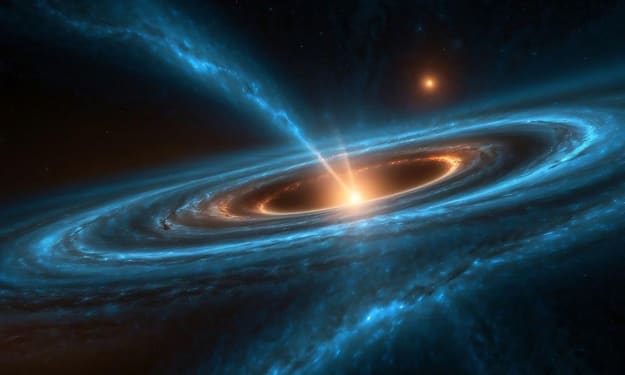
Hellhounds and Hyperspace: Cerberus’ Cosmic Conundrum. AI-Generated.
Greetings, hapless mortals! Allow me to introduce myself: I am Cerberus, the formidable hound of Hades, and today, I take a break from guarding the underworld to embark on a rather curious endeavor—writing about white holes. Yes, you heard it right, white holes, those bizarre cosmic phenomena that defy all logic. But before we dive into the intricacies of these celestial oddities, let me regale you with the peculiar chain of events that led to this unexpected pursuit.
By ScienceStyled2 years ago in Futurism
Celestial Kisses: When Stars Lock Lips in the Cosmic Ballet
In the vast expanse of our universe, a cosmic drama unfolds that rivals the most passionate love stories ever told. Recent astronomical discoveries have revealed that stars, those twinkling beacons of the night sky, lead lives far more complex and intriguing than we ever imagined. From intimate stellar embraces to vampiric relationships, the cosmos is teeming with celestial spectacles that challenge our understanding of the universe.
By Daisy Kebaso2 years ago in Futurism
Unveiling the Lunar Haven
Introduction to lunar exploration Since the dawn of human curiosity, the celestial bodies adorning our night sky have captivated our imaginations. Among these heavenly wonders, the Moon has held a special allure, inspiring generations of explorers to venture beyond Earth's embrace. Lunar exploration has not only quenched our thirst for knowledge but also unveiled the boundless potential of human ingenuity and perseverance.
By Kevin MacELwee2 years ago in Futurism
Title: Unveiling the Cosmic Enigma: Exploring the Great Attractor and Our Galactic Journey. AI-Generated.
**Title: Unraveling the Mystery of the Great Attractor: What Lies Beyond Our Galactic Neighborhood** In the 1970s, astronomers studying the Cosmic Microwave Background, the residual light from the universe's birth, made a startling discovery: our Milky Way galaxy and its vast cosmic entourage are hurtling through space at an astounding 390 kilometers per second. This revelation not only set a milestone in our understanding of galactic dynamics but also sparked a perplexing mystery about why our galaxy moves with such incredible speed. A significant portion of our galaxy's velocity can be attributed to the expansive force of the universe itself, known as the Hubble flow. This phenomenon causes all cosmic objects to drift apart due to the universe's ongoing expansion. Additional gravitational interactions with neighboring galaxies like Andromeda also contribute to our galactic motion. However, even after accounting for these factors, there remained an unexplained deviation in our trajectory, suggesting an external force was at play. Enter the Great Attractor—a mysterious gravitational anomaly pulling not just our Milky Way, but a staggering assemblage of around 100,000 galaxies spanning over 500 million light-years. Initially dubbed the "Great Attractor," this enigma posed a fundamental question: what could exert such a profound influence over such vast cosmic distances? The only force capable of orchestrating the movement of entire galaxies across hundreds of millions of light-years is gravity, governed by mass. To nudge 100,000 galaxies, the Great Attractor must possess a mass so immense that it defies conventional comprehension—a gravitational behemoth unlike anything else known in the universe. Early attempts to directly observe the Great Attractor faced immediate challenges. Situated within the "zone of avoidance," a swath of sky obscured by dense clouds of interstellar dust within our own Milky Way, traditional telescopes proved ineffective. For decades, astronomers were left to infer its presence indirectly, primarily through the gravitational effects it exerted on surrounding galaxies. Approximately located between 150 and 250 million light-years away in the direction of the Norma constellation, the Great Attractor's sheer scale began to emerge. Estimates suggested it harbors mass equivalent to 10 quadrillion Suns, far surpassing any known celestial object in size and gravitational influence. However, recent advancements in radio and infrared astronomy have offered fleeting glimpses into the obscured region, enabling scientists to peer deeper into this cosmic puzzle. These technological strides have illuminated the heart of the Laniakea Supercluster—a colossal structure encompassing not only the Great Attractor but also revealing the intricate web of galaxies in our cosmic neighborhood. The Laniakea Supercluster spans a mind-boggling 520 million light-years and houses approximately 100,000 galaxies, positioning the Great Attractor at its gravitational center. Rather than a discrete entity, it emerges as the gravitational focal point within this vast superstructure—an anchor around which galaxies, including our own, are inexorably drawn. The concept of the Great Attractor challenges our perception of cosmic order, illustrating the universe's intricate large-scale structure known as the cosmic web. This web isn't random but shaped by the gravitational tug-of-war between denser regions and cosmic voids since the universe's infancy. These gravitational dynamics have coalesced galaxies into clusters, superclusters, and beyond, weaving an elaborate tapestry across the cosmos. Despite these insights, the ultimate fate of our journey towards the Great Attractor remains shrouded in cosmic uncertainty. While hurtling towards it at breakneck speeds—approximately 390 kilometers per second—we face an inevitable cosmic irony. The universe's accelerating expansion ensures that despite our trajectory, the distance to the Great Attractor will continue to grow over time. This phenomenon mirrors two ants crawling towards each other on an inflating balloon: no matter their speed, the expanding space between them ensures they will never meet. Similarly, while the Milky Way advances towards the Great Attractor, the universe's expansion ensures we will perpetually fall short of reaching it, forever destined to recede from its gravitational grasp. As we ponder the implications of this celestial ballet, a chilling realization emerges. The accelerating expansion of the universe will not only separate us from the Great Attractor but will eventually sever our view of distant galaxies beyond those gravitationally bound to us. In time, the grand cosmic web we observe today will fade into obscurity, leaving only our local group of galaxies visible in the vast, expanding darkness. In conclusion, the Great Attractor stands as a testament to the universe's grandeur and mysteries, challenging our understanding of gravity, mass, and cosmic structure. While we may never physically reach its epicenter, the journey towards understanding it has illuminated the complex interplay of forces shaping our cosmic neighborhood and beyond. As we continue to probe the depths of space, the enigma of the Great Attractor serves as a reminder of the boundless wonders awaiting discovery in the universe—wonders that defy our imagination and inspire us to unravel the secrets of our cosmic existence.
By Mbeha maliwa 2 years ago in Futurism
NASA Detects Potentially Life-Supporting Atmosphere on Exoplanet LHS 1140 b
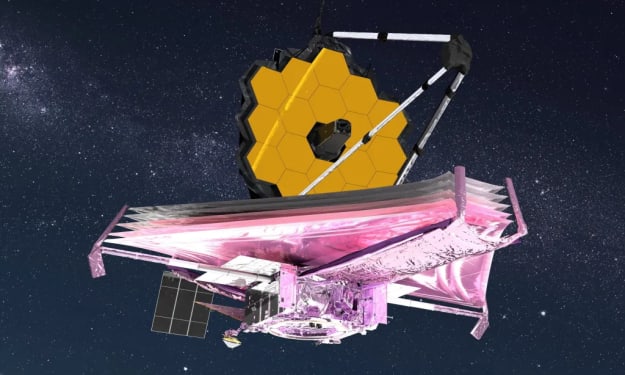
James Webb Space Telescope Unveils Promising Signs NASA’s James Webb Space Telescope (JWST) has made a ground-breaking discovery by detecting what could be distinct signs of life on an exoplanet located nearly 50 million light-years away. The exoplanet, named LHS 1140 b, resides in the constellation Cetus and has been identified as "potentially habitable" by researchers from the Universities of Michigan and Montreal.
By Ravi Singh2 years ago in Futurism
The Visitor from Andromeda
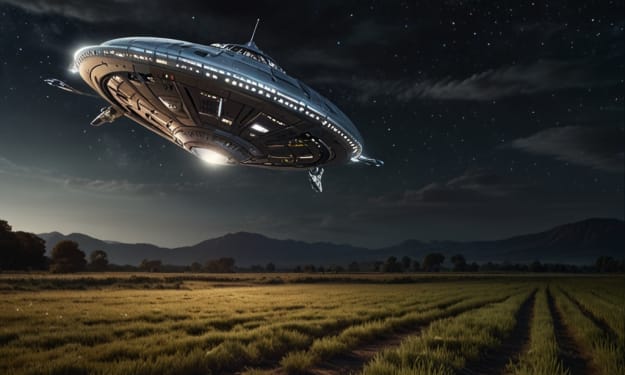
In the quiet town of Maplewood, nestled deep within the countryside, life proceeded with a predictable rhythm. The townspeople went about their daily routines, unaware that their lives were about to change forever. On a cool, clear night, a strange light streaked across the sky, catching the attention of those still awake. It was unlike any meteor or comet they had ever seen.
By gyan prakash upadhyay2 years ago in Futurism