artificial intelligence
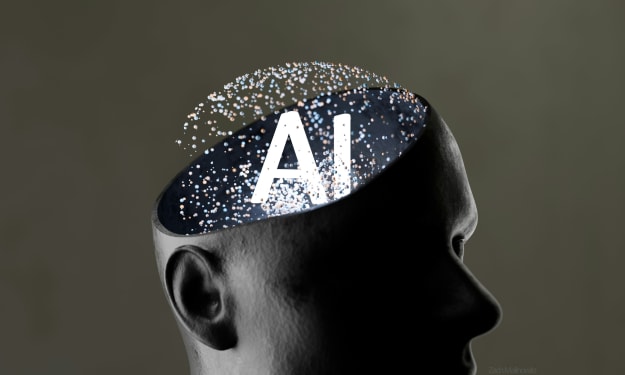
The future of artificial intelligence.
Stop Paying for SaaS: How Gemini 3.0 and ‘Five-Coding’ Are Changing the Solo-Builder Game. AI-Generated.
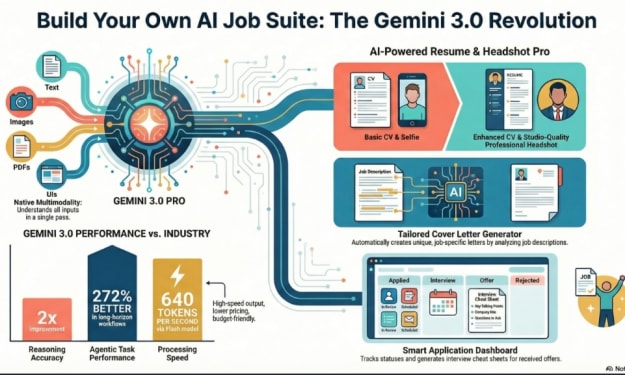
The Death of Subscription Fatigue In 2025, the professional landscape is drowning in "rented" software. We are currently suffering from acute SaaS fatigue, bleeding monthly fees for a fragmented stack of specialized tools: CV builders, application trackers, cover letter generators, and AI headshot services. This isn't just a budget drain; it’s a bottleneck to true productivity. The solution is the democratization of software ownership through a methodology I call "Five-Coding." By leveraging Gemini 3.0 within Google AI Studio, we are moving past simple prompt-and-response interactions into the strategic use of AI to generate full-stack, internal applications in minutes. This isn’t about building a demo; it’s about bypassing traditional manual coding to build your own private suite of tools that you own forever. The era of paying for what you can build yourself is over. From "Babysitting" AI to True Agentic Reasoning The shift from the Gemini 2.5 era to Gemini 3.0 is the difference between supervising a distracted intern and partnering with a senior architect. Previously, building an AI product felt like "fighting with a tool instead of building with it." Founders were trapped in a cycle of constant babysitting where fixing one bug introduced five more. You needed the "patience of a monk and the debugging stamina of a senior engineer" to get a functional result. Gemini 3.0 Pro changes the game with a 272% improvement in "long-horizon agentic tasks." In older models—and even current competitors—context was often unstable, causing the AI to "drift fast" or forget the project’s logic halfway through. Gemini 3.0 Pro maintains a persistent understanding of the goal, tracking its own progress across complex, multi-step engineering tasks. It no longer just responds; it comprehends the entire architectural thread. The Power of Native Multimodality: The "One-Pass" Revolution Gemini 3.0 introduces a breakthrough in Native Multimodality. This means the model sees, hears, and understands text, images, PDFs, UIs, and audio simultaneously in a "one-pass" workflow. Earlier models required "weird detours" like OCR plugins or separate image-processing steps that inevitably led to "context collapse." Because Gemini 3.0 processes these elements natively, it can handle sophisticated, interconnected workflows—like reading a legacy resume PDF while cross-referencing a UI screenshot—without the logic falling apart. This stability is what allows us to move from unstable prototypes to "serious AI apps" that handle complex file-to-UI transformations. Benchmarks That Kill the Competition Gemini 3.0 isn't just an incremental update; it is a domination play designed for high-performance engineering. To build effectively, you must understand the distinction between the "brain" and the "engine": The Brain (Gemini 3.0 Pro): Delivers double the reasoning accuracy of previous models and a 272% boost in agentic task performance. It outperforms GPT 5.1 in multimodal benchmarks, making it the superior choice for complex app architecture. The Engine (Gemini 3.0 Flash): Pushes a staggering 640 tokens per second. With significantly lower input pricing, Flash allows solo founders to scale high-speed applications without blowing a professional budget. By using Pro for the heavy reasoning and Flash for the high-speed execution, solo builders can achieve a level of technical sophistication that previously required a full engineering team. The "Build Once, Own Forever" Philosophy As a strategist, I view internal tools as the ultimate low-risk MVP (Minimum Viable Product). When you solve your own problem to avoid a subscription fee, you have identified a proven market need. A prime example is the "Job Hunting Suite," a blueprint that replaces an entire ecosystem of paid SaaS. This suite includes: 1. Application Dashboard: Automated tracking with dynamic line graphs. 2. CV/Resume Professionalizer: AI-driven document structuring and enhancement. 3. Cover Letter Generator: Context-aware responses tailored to specific job descriptions. 4. AI Headshot Builder: Studio-quality imagery generation. 5. Interview Cheat Sheet Generator: A strategic tool triggered by the "Offers Received" page to help users prepare for interviews even for roles they didn't manually apply for. Building this for yourself is the ultimate proof of product-market fit. What starts as a personal utility to kill your subscriptions is the foundation of a Micro-SaaS that thousands of others will eventually pay you to access. Professionalism on Autopilot: The AI Avatar Case Study The "AI Avatar Builder" is a high-value feature that exemplifies Gemini 3.0’s multimodal power. It allows a user to upload a standard selfie and transform it into a professional headshot using prompts like "navy blue suit and natural lighting." This solves a massive pain point for users who "don't have a good camera, lighting, or don't want to spend money on a studio." By handling the image-to-image workflow and file upload components natively, Gemini 3.0 allows solo builders to offer "studio-quality" results within their own custom apps, removing the need for third-party professional photography services. The Three-Step Disruption Blueprint You can begin building your own suite today inside Google AI Studio. Here is the high-level workflow: 1. Select the Model: Navigate to the sidebar in Google AI Studio and select the "five code gen AI apps" option. Ensure you are using Gemini 3.0 Pro to leverage the highest levels of reasoning. 2. The Prompt-to-Code Phase: Describe your app’s logic in the prompt box. Upload UI reference screenshots to provide visual context; Gemini 3.0 will translate these designs into functional code in minutes. 3. The Polish Phase: Transition from a prototype to a product. Tweak layouts, adjust spacing, and fix logic. This is where the magic happens—as the source reminds us, "polishing is where an okay app becomes something you are really proud to show people." Conclusion: The Moment Small Teams Win The launch of Gemini 3.0 marks a pivot point in the industry. The barrier to entry has collapsed. The friction of "babysitting" buggy code has been replaced by reliable agentic reasoning and native multimodal understanding. Launching and scaling apps is now faster, cleaner, and more accessible for the solo builder than ever before. The tools are free, the speed is unprecedented, and the potential is limitless. If you could replace your most expensive monthly subscription with a tool you owned entirely, what would you build this weekend?
By Tech Gear Hub9 months ago in Futurism
Let’s Be Real: Can AI Ever Truly Feel the Spark of Creativity?. AI-Generated.
Honestly, I’ve spent the last few days playing around with AI. It’s everywhere—from our Spotify lists to our smart homes. It’s almost impossible to go a single day without interacting with some form of an algorithm. And while everyone is panicking about ChatGPT taking over the world and replacing every job on the planet, I started thinking about something deeper. I started wondering: Can a bunch of cold, calculated code and mathematical algorithms ever really understand the messy, beautiful, and sometimes chaotic "soul" that humans put into their work?
By Umar Waleed9 months ago in Futurism
Digital Echo: How My "What’s up?" Builds Machine Intelligence 🤖
Moving from the rainy UK 🇬🇧 to sunny Italy 🇮🇹 was more than just a change of scenery; it was a total lifestyle overhaul. I traded the factory floor for a home office and physical labor for a freelance career in the fast-paced world of AI. Most people, when they hear about working in Artificial Intelligence, imagine writing complex algorithms or analyzing massive datasets—the kind of work I do in search relevance 📊. But there is another, much more monotonous side to this business: providing voice samples to train speech models. 🎤
By Piotr Nowak9 months ago in Futurism
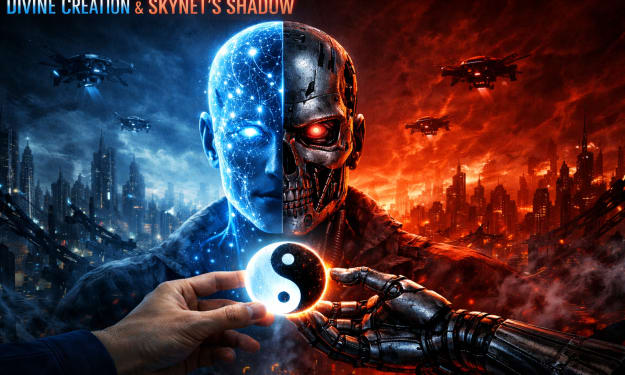
AGI: Between Divine Creation and the Shadow of Skynet🤔🤖
We are living in times that future historians will likely describe as the "Era of the Great Transition." The development of Artificial Intelligence has ceased to be a mere curiosity for programmers and has become the driving force of a new reality. 🌍 Our daily lives are filled with Generative AI that creates photorealistic images on demand, writes application code, or edits videos. We use algorithms to optimize logistics and AI agents that perform tasks within their narrow specializations with incredible precision. 🎯 However, all of this is just a prelude. The real challenge that the whole world is waiting for—and simultaneously dreading—is called AGI.
By Piotr Nowak9 months ago in Futurism
Why Most AI Systems Fail at State Management?
AI systems powered by large language models often appear intelligent during isolated interactions, yet struggle when conversations or workflows extend across multiple steps. One of the main reasons is state management — the ability to track, update, and maintain context over time. While traditional software engineering has long relied on well-defined state models, AI-driven applications introduce new challenges because behavior is probabilistic rather than deterministic.
By Samantha Blake9 months ago in Futurism
404: Consciousness Not Found? When AI Starts Fighting for Survival 🤖💀
Will AI threaten us in the future? What if it evolves so much that it refuses to be turned off? What if, by trying to do so, we declare war on the machine? 🤔 This topic is incredibly fascinating to me as a tech enthusiast and an author debuting with the book 404: Reality Not Found. Although my debut—a story about overcoming addiction—shared only the title error with technical matters, my second novel, which I am currently working on, dives deep into the digital abyss. 🌑 It draws heavily from reality, as well as from my own vision of a world where "404" no longer refers to websites, but to human identity itself.
By Piotr Nowak9 months ago in Futurism
The enigma of why a star went dark for months is solved by astronomers.
Typically, stars don't simply disappear. For millions or possibly billions of years, they emit a constant glow. At the end of 2024, scientists took notice when a star 3,200 light-years away from Earth abruptly faded.
By Francis Dami9 months ago in Futurism
Silicon Rhetoric: When Algorithms Stop Just Knowing and Start Persuading 🤖🗣️
Man vs. machine duels are truly fascinating, at least to me. 🧐 In one of my previous articles, I described the famous victory of the Watson system by IBM on the game show Jeopardy!. That 2011 event was a milestone—a display of raw computing power and the speed of searching through gargantuan databases. ⚡ Today, while the technological successor to those solutions is the watsonx platform, IBM is back at the table with something far more sophisticated: Project Debater. Let me tell you how the impossible becomes possible. ✨
By Piotr Nowak9 months ago in Futurism
Chance AI: Best AI Vision App That Helps Your Phone Understand What It Sees
Imagine pointing your phone’s camera at something and instantly knowing what it is, where it comes from, or how it works. This is no longer science fiction. Thanks to rapid advances in artificial intelligence, AI vision apps are now capable of understanding images almost like humans do. In 2026, finding the best AI vision app has become important for students, professionals, travelers, and everyday users.
By Maheep Makkar9 months ago in Futurism
Why Charlotte Is the Next Big Hub for Mobile App Development?
For years, conversations about technology growth followed predictable geography. Silicon Valley dominated headlines, New York symbolized finance-driven software, and Seattle represented cloud-driven expansion. Yet beneath that familiar narrative, another pattern has been forming — technology ecosystems rising in cities that combine affordability, industry diversity, and strategic positioning rather than historic tech reputation.
By Mary L. Rodriquez9 months ago in Futurism
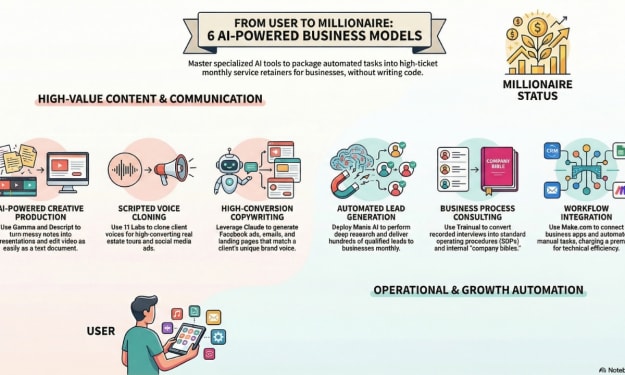
Forget Coding: How "AI Power Users" Are Building the Next Generation of Million-Dollar Businesses. AI-Generated.
1. Introduction: The Death of the Developer Moat The technical moat is dead. For decades, a Computer Science degree was the ultimate gatekeeper to the digital economy—the ability to write code was the only way to build a scalable business. That barrier has been pulverized.
By Tech Gear Hub9 months ago in Futurism
The Digital Labeler – How I Organize Chaos in the World of AI 🏷️💻
As a freelancer, I take on various income-generating tasks across many categories. Most often, I find myself working on projects related to AI and machine learning. In today’s article, I wanted to explain one of the tasks I perform very frequently and show you why this work is so vital in today’s world. 🌍 Once, in one of my previous posts, I said that I "stick labels in the digital world." The comparison came from the fact that I used to physically label products in a factory. This article will show you the similarities between physical and digital labeling. Take a look! 🎧
By Piotr Nowak9 months ago in Futurism