artificial intelligence
The future of artificial intelligence.
A Future Reborn: The Promise of 2050". AI-Generated.
In the year 2050, the world had transformed in ways that seemed unimaginable just a few decades prior. Cities no longer sprawled across endless urban landscapes, choking the planet with smog and pollution. Instead, they floated high above the earth, suspended by the innovations of a new era—an era defined by hope, unity, and ingenuity. At the heart of this transformation was a simple idea that had taken root in the minds of visionaries back in the early 2020s: we must rethink our relationship with the Earth. It had been a time of crisis—climate change, resource depletion, and social unrest seemed to threaten everything humanity had built. But rather than succumbing to despair, the world responded with a wave of innovation. Governments, corporations, and individuals worked together in ways never seen before. It was a revolution, not of violence or upheaval, but of cooperation and shared vision. One of the first breakthroughs came in the form of solar fusion technology—a clean, virtually limitless source of energy. Scientists had spent years struggling with nuclear fusion, and in the 2030s, they had cracked it. By 2040, the world’s energy grid was entirely powered by renewable sources—fusion, solar, and wind, in a symphony of green energy. The long-standing dependence on fossil fuels became a distant memory, and with it, the environmental catastrophes that had once seemed inevitable. But energy was just the beginning. Cities, once vast, sprawling, and choking on traffic and fumes, had become towering metropolises suspended in the sky. Floating platforms, powered by fusion and hovering technologies, replaced the need for concrete jungles. Urban planning had become an art of vertical design, with parks and green spaces cascading down from the clouds. The floating cities were self-sustaining, using advanced agricultural techniques like vertical farming and synthetic biology to grow food in abundance without harming the planet. People could walk through lush parks, not stuck in gridlocked traffic. Skyscrapers were now greenhouses, solar panels, and wind turbines woven together in one elegant dance. In the midst of these innovations, there was a young woman named Lyra who lived in one of the world’s first floating cities, called “Aurora.” She had grown up with stories of the struggles of the past—the pollution, the wars, the scarcity. She had heard of the dark days when people thought the world was lost, and yet, she had always believed that humanity could build a better future. Now, at twenty-five, she was part of a team that worked on the cutting edge of sustainable tech. Her team was designing a new form of communication—one that connected people not through devices, but through neural interfaces. It was a radical idea, one that had sparked debate in the past, but now, in the 2050s, it was becoming a reality. The technology allowed people to share thoughts and experiences in real-time, bypassing language barriers, biases, and misunderstandings. This new form of communication promised to bring people closer together than ever before, creating a world of empathy and collaboration. It was a bold step toward a future in which human connection transcended the limitations of the physical world. One evening, as Lyra stood on the balcony of her high-rise apartment, watching the sunset over the floating city, she couldn’t help but feel a sense of awe. She thought about the thousands of lives that had been shaped by the decisions made over the past few decades—how each innovation had built upon the last, how the world had shifted from one of despair to one of hope. The sky was ablaze with hues of pink, orange, and purple as the clouds parted, revealing the sparkling cities in the distance. Below, the Earth, lush and green, spun slowly, its oceans glistening under the distant stars. A soft chime rang from her wrist device, interrupting her reverie. It was a message from her team, a breakthrough they had been working on for months. The neural communication system was ready for the first live trial. The moment had arrived. As she prepared for the experiment, Lyra’s thoughts drifted back to the old world. She thought about the divisions that once seemed insurmountable—the wars, the inequality, the climate disasters. They hadn’t been solved by force or fear, but by the collective will of people determined to change. The world in 2050 wasn’t perfect, but it was proof that humanity could rise above its own mistakes and create something better. Lyra smiled to herself. She knew that, in this new world, the impossible was no longer out of reach. And as she connected with her colleagues via the neural interface, she felt a deep sense of belonging, not just to her team, but to all of humanity. They were united in a shared purpose, working toward a future where innovation and compassion walked hand in hand. In the year 2050, humanity had found its way. And it wasn’t the end of the story—it was just the beginning.
By Jay Kavaya2 years ago in Futurism
The Future is Now: Science Breakthroughs That Will Blow Your Mind. AI-Generated.
The Future is Now: Science Breakthroughs That Will Blow Your Mind Ever imagine living in a sci-fi movie? Think about it. Clothes made from living cells, chatting with animals (yes, chatting!), or controlling robots just by thinking. Sounds crazy, right? Well, buckle up because these are not far-off dreams. They are happening right now! Science is rewriting the rules of what's possible, and trust me, you want to know all about it.
By Ramani Ramu2 years ago in Futurism
Virtual Reality ADDICTION: Understanding the Risks and Solutions
Virtual Reality (VR) has redefined entertainment, education, and work. However, as this technology becomes more immersive, the risk of addiction has emerged as a growing concern. People may become so absorbed in these digital worlds that they neglect real-life obligations, relationships, and well-being.
By Marveline Merab2 years ago in Futurism
Where to Go If World War III Breaks Out: The Safest Places to Duck and Cover
Where to Go If World War III Breaks Out: The Safest Places to Duck and Cover As tensions rise among global powers, the hypothetical question of World War III looms larger. In such a catastrophic scenario, survival depends on location. While no place on Earth is guaranteed safe, some regions offer better odds than others. Here's an exploration of the safest havens in case geopolitical tensions ignite into global conflict.
By Cherub Kane2 years ago in Futurism
The AI Revolution: Transforming Creativity and Monetization. AI-Generated.
The AI Revolution: Transforming Creativity and Monetization Artificial intelligence (AI) is revolutionizing industries worldwide, and the creative field is no exception. What once required extensive technical skill and months of effort can now be achieved with just a few clicks. From crafting AI-generated music to editing fan-made music videos (fanMVs) of popular TV shows, AI empowers creators to produce and monetize high-quality content faster than ever. For many, this opens up new possibilities for income streams, transforming hobbies into profitable ventures.
By nuel williams2 years ago in Futurism
Nanotechnology Applications: Transforming the Future
Nanotechnology is revolutionizing industries by manipulating matter at the molecular and atomic levels. This innovative field involves creating and utilizing materials and devices on a nanoscale, typically between 1 and 100 nanometers. From healthcare to electronics, nanotechnology has countless applications that are shaping our world. This article explores the most impactful uses of nanotechnology and its potential for the future.
By Marveline Merab2 years ago in Futurism
Mars Colonization Challenges: The Journey to a New Frontier
Mars colonization has fascinated humanity for decades, representing both an incredible opportunity and a formidable challenge. While the idea of settling on the Red Planet promises a new chapter for human civilization, achieving this dream requires overcoming numerous obstacles. This article explores the major challenges of Mars colonization, providing a detailed yet clear understanding of the hurdles scientists and astronauts must face to make this vision a reality.
By Marveline Merab2 years ago in Futurism
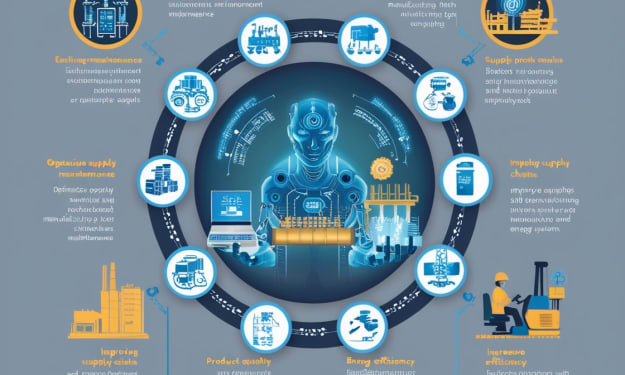
The Role of Artificial Intelligence in Shaping the Future of Manufacturing
Innovation is a huge success determinant in global manufacturing. There probably is no other technology that has dominated the imagination of the industry in the last couple of years as much as AI. While once the stuff of science fiction, AI is fast transforming across many sectors, with manufacturing being no exception. Embedding AI into Manufacturing It's more than just an industrial trend about AI in the manufacturing process-it's re-making how products are designed, built, and delivered. From predictive maintenance to its integration into autonomous robotics, AI has driven the manufacturing process toward smart, efficient, and sustainable manufacturing processes and systems. Rise of AI in Manufacturing Traditionally, this sector was conducted by using labor, manual steps, and mechanical automation on the shop floor. These classical methods have now been enriched through AI-powered systems that are enhancing capabilities within the factory floor in a modern era. It falls in the larger trend toward Industry 4.0, a fourth industrial revolution: a set of technologies in that the manufacturing sector is taking up these newer, highly advanced technologies that include big data analytics, AI, IoT, and cyber-physical systems as part of an ecosystem. Applications of AI in manufacturing are neither one size fits all but actually constitute the wide range of applications-from quality improvement to optimize supply chain processes right to reduce injuries for the employees and energy use. Adopting AI-driven technologies liberates manufacturers to discover possibilities of smarter factories as well as more agile production systems. Transformative Applications of AI in Manufacturing
By J Pavan Kumar2 years ago in Futurism
Digital Immortality and Mind Uploading: Unlocking Eternal Consciousness
Digital immortality and mind uploading, once relegated to science fiction, are now active fields of research. These concepts suggest a future where human consciousness can be transferred to digital systems, potentially allowing us to live forever in a virtual form. This article delves into the science, benefits, risks, and ethical challenges of achieving digital immortality, helping readers navigate the possibilities of eternal consciousness in the digital age.
By Marveline Merab2 years ago in Futurism