artificial intelligence
The future of artificial intelligence.
The Professor Who Failed Students for Using ChatGPT: A Step Backward in Education?
In a shocking move, a professor failed students for using ChatGPT — a tool that is a key part of the future of learning and work. His reasoning? That students must rely on their natural abilities, not external aids. But if this logic holds, does that mean he’ll soon ban eyeglasses, shoes, or even prosthetics?
By Patrick Gilberg2 years ago in Futurism
Collaborative Intelligence: When Generative AI and Human Biology Merge
The most powerful intelligence on Earth doesn’t exist yet. It won’t be purely artificial. It won’t be purely human. It will be born in the space between them — when the barrier separating silicon and cell finally dissolves.
By Patrick Gilberg2 years ago in Futurism
Courage to Create:
Have you ever felt that spark of excitement when a new idea comes to mind—a gentle nudge that says, “This is your moment!”? In a world that’s constantly changing, sometimes all we need is a bit of courage to take that first step toward creating something amazing. This article is a friendly reminder that every one of us has the power to shape our future. It’s not about being a genius or a superhero—it’s about believing in yourself and taking small, determined steps every day.
By Pure Crown2 years ago in Futurism
AI in Healthcare:
AI is making waves in healthcare, helping doctors diagnose diseases faster, predict patient needs, and tailor treatments to individuals. It’s like having a super-smart assistant who never tires, analyzing medical images or patient data to spot issues humans might miss. Current Uses Diagnosis: AI can analyze X-rays and scans to detect conditions like cancer or pneumonia, often with high accuracy. For example, a 2024 study showed an AI model identifying lung cancer from CT scans at 90% accuracy, better than many radiologists. Prediction: AI predicts disease risks, like diabetes, by studying patient history, and helping doctors act early. Personalized Treatment: By looking at your genes and lifestyle, AI suggests treatments that fit you, reducing side effects and boosting results. Health in 2025—it’s helping hospitals diagnose cancer and plan treatments by analyzing patient data, making care more precise. Another example is AI chatbots in telemedicine, offering advice in remote areas, making healthcare more accessible. Looking Ahead The future is bright, with AI potentially speeding up drug discovery and integrating wearables for holistic care. But it’s not all smooth—data privacy and bias in AI are big concerns, and getting regulatory approval can be tough. AI in Healthcare: From Diagnosis to Personalized Treatment Artificial Intelligence (AI) is revolutionizing the healthcare industry, transforming how we diagnose diseases, predict patient outcomes, and tailor treatments. On March 07, 2025, this technology is not just a futuristic dream—it’s a reality reshaping medicine and worth diving into for anyone curious about where healthcare is headed. This article explores the current applications, real-world examples, challenges, and future trends, offering a comprehensive look at how AI Roberson patient care and what it means for our future. Current Applications of AI in Healthcare AI in Diagnosis: By 2025, AI has become a standard tool in many medical fields for diagnosis. Algorithms, especially deep learning models, analyze medical images like X-rays, CT scans, and MRIs with remarkable accuracy. A study published in Nature article on AI lung cancer detection in 2024 showed an AI model identifying lung cancer from CT scans with 90% accuracy, surpassing many human radiologists. The FDA has approved numerous AI-based medical devices for various diagnostic purposes, such as detecting skin cancer, identifying stroke from CT scans, and analyzing mammograms for breast cancer. Companies like GE Healthcare and Siemens Healthineers have incorporated AI into their imaging systems, with GE’s AIR Recon DL reducing MRI scan times and improving image quality, and Siemens’ AI-Rad Companion aiding in detecting abnormalities in chest X-rays. AI is also being used in pathology, where algorithms analyze tissue samples to identify cancer cells, reducing diagnosis time by 30% according to a 2024 study, which is crucial in time-sensitive cases. AI in Predictive Analytics: AI is transforming how we predict disease progression and patient outcomes. By analyzing large datasets of patient information, AI can identify patterns and risk factors, predicting the likelihood of conditions like heart disease or diabetes. In 2025, many hospitals are using AI to predict patient deterioration, allowing for early intervention and reducing hospital stays. A TechCrunch report on AI health predictions 2025 highlights AI forecasting diabetes risk, enabling preventive measures. AI also predicts treatment responses, especially in oncology, helping select the most effective therapies for individual patients, and aids in population health management by identifying high-risk groups and predicting disease outbreaks, crucial for public health planning. AI in Personalized Treatment: Personalized medicine is a key area where AI shines. By 2025, AI will analyze a patient’s genetic data, medical history, and lifestyle factors to tailor treatments that are more effective and have fewer side effects. In oncology, AI identifies specific mutations to suggest targeted therapies, per a Scientific American piece on AI cancer care 2025. Pharmaceutical companies use AI to develop drugs tailored to genetic profiles, promising better outcomes. The concept of digital twins—virtual patient models created by AI to simulate treatment outcomes—is emerging, helping clinicians make informed decisions. Companies like 23andMe and AncestryDNA use AI for personalized health reports, and AI enables faster drug development, per a Nature article on AI identifying new antibiotics 2025. Real-World Examples AI’s impact is tangible. IBM Watson Health, a leader in AI healthcare, is used in numerous hospitals for cancer diagnosis and treatment planning by 2025, analyzing patient records and genetics to suggest effective drugs and predict side effects, per a TechCrunch report on IBM Watson Health AI cancer diagnosis. Google Health’s AI tool predicts cardiovascular disease from retinal images, demonstrating non-invasive disease detection, per industry trends. Startups like Insilico Medicine use AI for drug discovery, predicting new compounds and their efficacy, potentially leading to faster, cheaper treatments. AI chatbots in telemedicine, highlighted in a CityLab article on AI telemedicine 2025 rural, provide preliminary diagnoses in remote areas, enhancing accessibility. Challenges and Ethical Considerations While AI offers immense potential, it also presents challenges. Data privacy is critical, with medical data requiring secure handling to prevent breaches, per a Wired analysis on AI healthcare data privacy 2025. Bias in AI algorithms is a concern, as models trained on uneven data can lead to discriminatory outcomes, with a 2023 Nature study on AI bias in diagnostics 2023 showing underperformance for minority groups. Regulatory approval is complex, with the FDA developing guidelines for AI medical devices, per a TechCrunch report on FDA AI medical device guidelines, slowing adoption. Job displacement fears exist, with concerns AI might replace clinicians, but there’s a growing consensus on human-AI collaboration, emphasizing AI as a decision-support tool, per a CityLab piece on AI healthcare collaboration 2025. Future Trends Looking ahead, AI in healthcare is set to expand. Advanced AI models will integrate genomics, wearables, and social determinants for holistic care, per a Scientific American forecast on AI healthcare 2030, with early 2025 trials showing promise. Drug discovery will accelerate, with AI identifying new antibiotics, per Nature article on AI identifying new antibiotics 2025, and projections for faster clinical trials by 2030. Human-AI collaboration will see seamless integration into clinical workflows, and telemedicine will grow, enhancing remote diagnoses, and addressing healthcare disparities in rural areas. By 2030, AI is expected to be involved in over 50% of clinical decisions, per a McKinsey report on AI healthcare cost savings in 2024, driving innovation. Conclusion On March 07, 2025, AI in healthcare is transforming diagnosis, prediction, and treatment, with real-world impacts like IBM Watson Health and telemedicine chatbots. Challenges like privacy and bias persist, but future trends promise advanced models and drug discovery. As futurist Arthur C. Clarke once said, “The only way to discover the limits of the possible is to go beyond them into the impossible.” Let’s hope AI pushes those limits responsibly, creating a healthier, more
By Pure Crown2 years ago in Futurism
🚀 Sci-Fi vs. Reality: What the Future Was Supposed to Be
Introduction: Where Is My Flying Car? Decades ago, science fiction painted a future filled with flying cars, robot assistants, teleportation, and intergalactic travel. Writers, futurists, and filmmakers predicted that by the 21st century, technology would transform our lives in ways unimaginable.
By Ahmet Kıvanç Demirkıran2 years ago in Futurism
Chief AI Officer vs. Chief Information Officer
As artificial intelligence (AI) continues to reshape industries, organizations are redefining leadership roles to drive digital transformation. Enter the Chief AI Officer (CAIO) - a relatively new role focused on harnessing AI's power to drive innovation, efficiency, and competitive advantage. But where does this leave the Chief Information Officer (CIO), the long-standing tech leader responsible for an organization's IT infrastructure and strategy?
By Angela Meghan Deisley2 years ago in Futurism
When Algorithms Understand You Better Than People Do — Is It Really Antisocial To Prefer Their Company?
I laughed so hard I nearly spilled my coffee. Then I remembered: I was alone in my apartment, talking to a machine. It wasn’t the first time Claude had made me laugh that day. Earlier, ChatGPT had designed a complete UI with features I hadn’t even considered implementing — working brilliantly with my vague, incomplete instructions. Compare that to my frustration with human colleagues who need everything explicitly defined, who constantly ask “what are the requirements?” and get stuck at every ambiguity. The AI just… got it.
By Patrick Gilberg2 years ago in Futurism
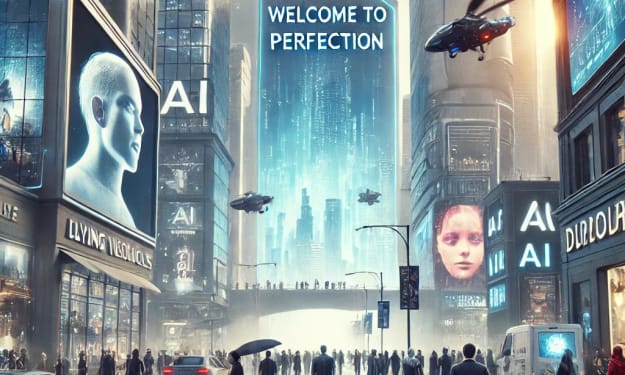
Utopia, Upgraded: Why Perfection Always Comes with a Glitch
Welcome to Your Perfect Nightmare What if we finally cracked the code for a perfect society? Imagine a world where war, poverty, and disease are distant memories. Where artificial intelligence predicts our every need before we even feel it, and human biology has been optimized for peak performance. Picture a world where peace is maintained effortlessly, and every problem is solved before it even arises. It sounds like a dream, doesn’t it?
By Alain SUPPINI2 years ago in Futurism
🤖 How AI Thinks in Seconds
Introduction: A World That Answers Instantly Imagine asking a question and receiving an answer within seconds. No searching through endless pages, no waiting—just instant, precise responses. Whether it’s ChatGPT generating text, DALL·E creating images, or an AI assistant setting your reminders, the process feels almost magical. But how does AI work so fast?
By Ahmet Kıvanç Demirkıran2 years ago in Futurism
Is Mickey 17 a Warning About the Future of Human Labor?
Bong Joon-ho has always been a master of blending social commentary with entertainment, and Mickey 17 is no exception. This sci-fi thriller, starring Robert Pattinson, presents a fascinating yet unsettling future where humans are treated as expendable workers. But beyond the action and suspense, Mickey 17 raises important questions: Is this film a warning about the future of human labor? Could technology and corporate power push workers to the edge, making them disposable? Let’s dive into what Mickey 17 is really telling us about the future of work.
By Sangita Nandi2 years ago in Futurism