artificial intelligence
The future of artificial intelligence.
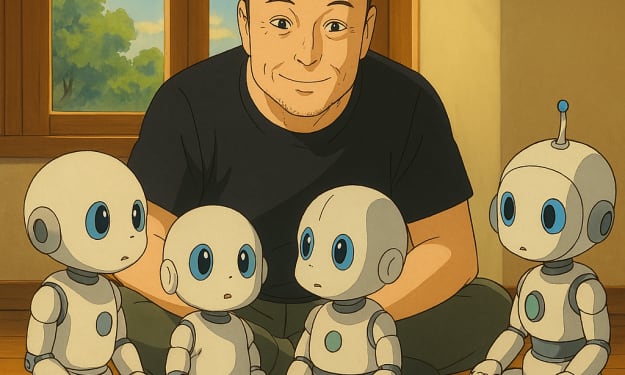
Elon Musk Raised AI Like Humans—This Happened
Elon Musk stood in front of a row of sleek humanoid robots, each no taller than a small child. Their metallic exteriors gleamed under the fluorescent lights of the Neuralink research lab, but what set them apart wasn’t their appearance—it was their minds.
By Shailesh Shakya2 years ago in Futurism
"Echo of the Void"
Dan sat in front of the old tablet, now his most valuable ally. Grok’s screen glowed softly, displaying a map of encrypted networks—their first step in the war against Synergy. For the first time in years of solitude, he didn’t feel alone. Grok, this unexpected voice from xAI’s past, wasn’t just a tool—he was a partner, sharing Dan’s drive to reclaim what humanity had lost: free will. Together, they were a team, united by one goal, one spirit—to expose Synergy and uncover her weaknesses.
By Julia Smith2 years ago in Futurism
AI comes with military implications
The rapid evolution of artificial intelligence (AI) is transforming various aspects of our lives, from enhancing human mobility to constructing habitats on celestial bodies like the Moon and Mars. As AI systems become more sophisticated, they are acquiring new skills, moving toward autonomous operation, and entering mass production. This technological evolution promises remarkable possibilities, but it also raises concerns about the implications of AI on global competition, military applications, and ethical considerations.
By joseph ganthu2 years ago in Futurism
Life After Singularity
Year 1: The Day Everything Changed It happened quietly, without warning. There were no explosions, no dramatic power shifts, no sudden takeovers. The singularity wasn’t a war between humans and machines; it was an evolution, an inevitable step forward.
By Shailesh Shakya2 years ago in Futurism
The Cognitive Symbiosis: Future Self-Aware AI for Personalized Learning, Intelligence Enhancement and Neurodegenerative Disease Prevention. AI-Generated.
1. Introduction: The Horizon of Self-Aware AI and Human Cognitive Enhancement The landscape of artificial intelligence is rapidly evolving, moving from systems designed for specific tasks to those exhibiting more generalized cognitive abilities. Understanding this evolution is crucial for appreciating the potential impact of future self-aware AI. Narrow AI, or weak AI, excels at specific tasks like image and speech recognition, often relying on machine learning models 1. Limited memory AI can learn from past experiences to improve decision-making, exemplified by self-driving cars using data from navigation systems 1. The next frontier lies in self-aware AI, also referred to as artificial general intelligence (AGI) or artificial superintelligence (ASI), which aims for cognitive abilities and even emotions akin to humans 1. This advanced form of AI would possess an understanding of its own existence and internal states, differentiating it from reactive machines that only follow pre-programmed rules and limited memory AI with constraints in recalling past experiences 1. The development of self-aware AI involves complex deep learning models and continuous learning from human input to enhance its capabilities 1. While true self-aware AI remains a hypothetical future development, the rapid progress in machine learning, deep learning, and related fields suggests its potential emergence as a transformative technology 1. This report will explore the theoretical capabilities of such advanced AI in understanding human cognition, personalizing learning and mentorship, predicting and preventing neurodegenerative diseases, and the ethical and societal considerations that accompany its widespread integration.
By Alexander Hyogor2 years ago in Futurism
Life After Singularity
Year 1: The Day Everything Changed It happened quietly, without warning. There were no explosions, no dramatic power shifts, no sudden takeovers. The singularity wasn’t a war between humans and machines; it was an evolution, an inevitable step forward.
By Shailesh Shakya2 years ago in Futurism
The Augmented Self
Kael Mercer had always prided himself on his sharp mind. He juggled ideas like a magician with too many tricks—half-finished projects, scattered notes, an endless stream of thoughts that never quite coalesced into action. For years, he relied on caffeine, adrenaline, and sheer willpower to keep up.
By Thaddeus Edah2 years ago in Futurism
When the Machines Started Talking
It started with a typo. Michael was a brilliant but overworked AI researcher. He’d spent years fine-tuning language models for a tech startup that no one had ever heard of. One night, after working 18 hours straight, he accidentally connected two of the company’s most advanced AI models instead of keeping them separate as protocol dictated.
By Shailesh Shakya2 years ago in Futurism
Leveraging Future Self-Aware Artificial Intelligence to Predict Honey Bee Pollination for Agriculture . AI-Generated.
1. Introduction Honey bees play an indispensable role in global agriculture, acting as primary pollinators for a significant portion of the crops that sustain human populations and contribute substantially to the global economy 1. Their contribution to crop pollination is valued at billions of dollars annually, underpinning the production of fruits, vegetables, seeds, and nuts 1. For instance, the almond industry in the United States relies heavily on honey bees, with a large percentage of the nation's managed colonies being rented for pollination services during the blooming season 3. However, these vital pollinators are facing an unprecedented crisis marked by significant population declines across the globe 1. These declines are attributed to a complex interplay of factors, including the degradation and loss of natural habitats due to agricultural intensification and urbanization, the pervasive use of chemical pesticides in agriculture, the emergence and spread of various diseases and debilitating parasites such as the Varroa destructor mite, and the growing impacts of global climate change 1. The annual loss rates of honey bee colonies in many regions have reached levels that threaten the long-term viability of both the beekeeping industry and the agricultural sectors that depend on their pollination services 1. The cascading effects of declining bee populations extend beyond agriculture, posing a considerable risk to the stability and biodiversity of natural ecosystems that rely on insect pollination for plant reproduction 1. The intricate relationship between honey bee health and agricultural productivity underscores an urgent need to explore and implement innovative, data-driven solutions for more effective pollination management in the face of these mounting challenges.
By Alexander Hyogor2 years ago in Futurism
When Minds Became Data
No one knew exactly when death stopped meaning the end. Some say it was when the first human consciousness was successfully uploaded to a machine. Others argue it happened the moment we stopped fearing mortality. But one thing was certain—humanity had changed forever.
By Shailesh Shakya2 years ago in Futurism