artificial intelligence
The future of artificial intelligence.
The One Platform That Brings Me the Most Vocal Traffic (It’s Not Twitter!)
I thought I knew where my audience was—until a forgotten app outperformed all the big names. If you had asked me last year which platform would send the most readers to my Vocal stories, I would've said Twitter. Or maybe Facebook. At a stretch, Medium.
By Muhammad Sabeelabout a year ago in Futurism
When We Sold Time . AI-Generated.
It was the day Arman had dreamed of his entire life—his wedding day. The sky was clear, the sun warm but gentle, and the city of Neo Karachi shimmered with celebration. Streets were lined with neon banners flashing countdown timers — not for the ceremony itself, but for the Time Market's opening bell.
By Muhammad Riazabout a year ago in Futurism
The Day the Stars Went Offline . AI-Generated.
It began at 2:17 a.m., GMT. The stars vanished. Not faded. Not dimmed. They simply… went offline. As though someone had flicked a cosmic switch. Across the globe, astrophysicists panicked, astronomers stared into pitch-black lenses, and ordinary people rubbed their eyes, thinking clouds had stolen the sky. But there were no clouds.
By Muhammad Riazabout a year ago in Futurism
Supercharge Your Programming in 2025: The AI Code Assistant Revolution
They’re no longer futuristic tools—they’re already rewriting how software is built. AI code assistants like GitHub Copilot, Tabnine, Cursor, and Amazon Q now power over 90% of engineering teams, delivering profound productivity gains—but not without challenges. This article dives deep into why these smart copilots matter, how to adopt them strategically, and what pitfalls to watch out for—so you stay ahead in the evolving landscape of code. 🚀 Why This Shift Isn’t Just Hype Skyrocketing adoption: A recent Jellyfish survey found nearly 90% of teams use at least one AI assistant—and almost half use two or more . Real productivity jumps: Around 62% of developers report at least 25% faster coding with AI, and 8% doubled their output . Impressive academic results: Controlled trials show using Copilot speeds up project completion by 55.8%, while broader adoption adds up to 6.5% productivity gains per team . This isn’t augmentation—it’s transformation. --- What Makes Today Different From 2024 A year ago, AI assistants focused on simple autocompletion. Now: Contextual awareness: Tools like Copilot and Tabnine remember your code style and project context, tailoring suggestions smartly. Tabnine, for example, can run locally, keeping all code private . Cross-language flexibility: Whether it's Python, Java, JS frameworks, or AWS infrastructure scripts, modern assistants handle multi-file logic seamlessly. Diverse tool ecosystem: Beyond Copilot (owned by Microsoft/OpenAI), Amazon Q serves AWS developers, Cursor offers a clean lightweight UI, and Claude Code excels in privacy-focused enterprises . Enterprise integrations: Tools like Parasoft Selenic and Testim streamline Selenium/Playwright test automation, reducing QA cycles by **20–40%** . --- The Spectrum of AI Code Assistants GitHub Copilot – The Ubiquitous Leader Integrated into VS Code, JetBrains, Neovim. Powers 40–43% of submitted code in many environments . Latest feature: AI-powered bug-fixing agent generates patches directly from code feedback . Tabnine – Privacy-Powered Customization Offers local model versions—ideal for sensitive codebases . Learns your team’s patterns and enforces quality standards. Popular in healthcare, finance, and corporate environments . Cursor – Lightweight & Clean A minimalistic code editor with AI chat and code generation support . Often praised by developers who dislike heavyweight UIs. Amazon Q Developer – Cloud-Native Focus Generates AWS pipeline code, ML definitions, and DevOps logic via natural-language prompts . Ideal for direct integrations in AWS-powered development flows. --- But There Are Trade-Offs 1. Productivity BREAKDOWN Surprisingly, experienced devs can lose 19% productivity due to time spent reviewing prompts and AI output—even though they believe they're faster . 2. Hallucinations & Bugs Code that looks good might contain critical vulnerabilities. About 56% of Copilot suggestions may require manual correction . 3. Licensing and IP Risks Some tools train on public repos—posing risk of leaking proprietary license terms . 4. Unequal Gains Junior devs often benefit faster than veterans—but expert architects still report value from speeding up mundane tasks . --- How to Adopt AI Assistants THE RIGHT WAY Phase 1: Choose the Best Fit Start small: Try the free tiers (Tabnine free or Cursor basic). Privacy-sensitive? Use local Tabnine or enterprise Copilot. AWS-focused teams → Amazon Q for native pipelines. Rapid prototyping? User-friendly UI like Cursor or Copilot. Phase 2: Build a Mini Pilot Run a short sprint with a small group. Measure speed, bug count, suggestion acceptance (ideally ~30–40%). Train devs on review discipline and prompt crafting. Phase 3: Integrate & Scale Roll out across teams with documentation & support. Standardize review protocols: check for security, performance, style. Integrate AI-powered testing into CI/CD. Phase 4: Monitor & Improve Track commit rates, number of bugs caught, time spent in review. Adjust prompts and tool configurations regularly. --- Real-World Impact & ROI Google engineers report a 10% productivity boost, with >30% of code generated by internal AI tools like Goose . Teams using AI for testing save up to 40% of QA time . Copilot experiments show that junior developers ramp up dramatically—almost closing the gap with mid-level peers . --- From Code Writer to AI Engineer To thrive, focus on: Prompt engineering: clear, contextual instructions lead to better suggestions. Code review mastery: check AI code for security, style, performance. Hybrid workflows: oversee AI-generated tests and CI alerts. Cross-functional collaboration: share learnings, style guides, prompt libraries. --- Looking Ahead: The Next Frontier Expect to see more: Auto-debugging agents – GitHub already released bug-fix agents . Enterprise-grade local models – open-source deployments tailored for compliance. AI-driven architectural suggestions – not just code-by-code help, but design-level recommendations. --- TL;DR (No Headings, Just Strong Summary) AI code assistants have matured—90% of dev teams use them, and real-world gains include 25–60% faster development with fewer errors. Popular tools like Copilot, Tabnine, Cursor, and Amazon Q provide distinct approaches: Copilot is powerful and mainstream; Tabnine prioritizes privacy; Cursor offers minimalism; Amazon Q integrates deeply into AWS workflows. Yet productivity depends on discipline: mismanaged prompts and hallucinations can hurt more than help. To succeed, pilot smartly, track metrics, standardize reviews, and evolve your team into hybrid AI+human coders. The future is collaboration—not automation. And those who learn prompt engineering and AI validation will be the true innovators.
By MOHAMMED AL-HAJJabout a year ago in Futurism
Goldman Sachs Just Raised the S&P 500 Forecast Again — How It Changes Everything for YOUR Portfolio . AI-Generated.
🧠 Major Press References: Reuters: detailed report on benchmark targets & Fed outlook Goldman’s own platform: updated price targets & rationale Business Insider: analysis of trade resilience MarketWatch: sector strategies and protective moves Financial Times: broader bullish sentiment across Wall Street Barron’s: cautionary scenarios despite record highs
By MOHAMMED AL-HAJJabout a year ago in Futurism
Love Awaits in the Stars: What Tomorrow Holds for Sagittarius, Taurus, and Scorpio Hearts. AI-Generated.
Sometimes, all it takes is a whisper from the universe to make our hearts flutter. Whether you're someone who dreams of candlelit conversations or surprise morning texts, love has a way of wrapping us in its tender magic—especially when the stars have something delightful planned.
By Amber Christina Lohanabout a year ago in Futurism
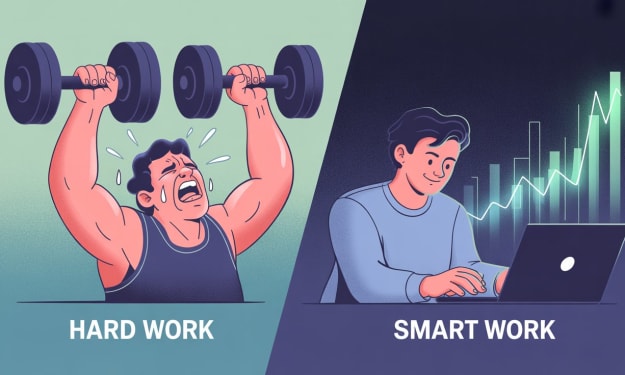
Work Smart, Lead Wisely: Why Strategy Beats Sweat in Today's World. AI-Generated.
“Don’t work hard, work smart.”is It’s a phrase we’ve heard a thousand times. But what does it really mean? Does smart work mean doing less? Is hard work obsolete? And when it comes to leadership, is it better to guide than to command?
By Nowshad Ahmadabout a year ago in Futurism
From Moradabad to Apple’s Global Stage: Sabih Khan Becomes the New COO of Apple
Apple’s new Chief Operating Officer (COO) Sabih Khan—an Indian-origin executive originally from Moradabad, Uttar Pradesh—has been appointed to oversee iPhone manufacturing, especially in India. After over 30 years at Apple, he succeeds Jeff Williams in a strategic move by CEO Tim Cook. This milestone highlights Apple’s commitment to continuing iPhone production in India amid global trade pressures and ambitions of sustainable growth. Born in Moradabad in 1966, Khan later lived in Singapore and then moved to the U.S. for higher education, earning degrees in mechanical engineering and economics from Tufts University and a master’s from RPI. He joined Apple in 1995 and climbed the ranks—from procurement to Senior Vice President of Operations—playing crucial roles in green manufacturing, logistics, and global supply chain management. Tim Cook praised him as “a brilliant strategist” and trusted his leadership to shape Apple’s future. Apple expects India’s share in its global iPhone production to grow significantly under his leadership. 1. Introduction: A New Era of Leadership On July 8, 2025, Apple announced that Sabih Khan will step into the role of Chief Operating Officer, succeeding longtime operations chief Jeff Williams as part of a carefully orchestrated leadership transition . With a remarkable 30-year career at Apple, Khan’s ascent symbolizes continuity, internal talent promotion, and global ambition amid shifting geopolitical trade landscapes. 2. Early Life & Roots – From Moradabad to Global Education Sabih Khan was born in Moradabad, Uttar Pradesh, India in 1966. During his school years, his family relocated to Singapore, where he completed his early education. Later, he moved to the United States for tertiary studies . His educational journey reflects both technical depth and global exposure: Dual bachelor’s degrees in mechanical engineering and economics from Tufts University A master’s degree in mechanical engineering from **Rensselaer Polytechnic Institute (RPI)** This combination of engineering and economics laid the groundwork for his success leading complex operations at one of the world’s biggest tech firms. 3. Early Career: GE Plastics Foundations Before joining Apple, Khan worked at GE Plastics as an applications development engineer and key account technical leader. This phase helped him build strong analytical and execution skills before transitioning to the high-stakes environment of Apple’s global tech supply chain . 4. At Apple: Joining and Rising Through the Ranks Khan joined Apple in 1995, initially working in the procurement group. Over the decades, his contributions spanned planning, manufacturing, logistics, supplier responsibility, and global fulfillment operations . In 2019, he was promoted to Senior Vice President of Operations, a key leadership role overseeing Apple’s supply chain continuity, product quality, supplier relations, and environmental programs . In this capacity, Khan navigated major challenges including pandemic disruptions, production shifts, and evolving trade policies. 5. Global Impact: Strategy, Sustainability, and Resilience Tim Cook praised Khan as “a brilliant strategist” and one of the central architects of Apple’s supply chain, highlighting his leadership in pioneering advanced manufacturing technologies and expanding U.S. and Indian production footprints . Under Khan's stewardship, Apple intensified its focus on environmental sustainability, achieving over 60% reduction in carbon footprint through initiatives involving green supply chains and responsible supplier practices . His efforts ensured Apple’s ability to scale swiftly and adapt to global challenges, from trade tensions to logistics disruptions . 6. A Crucial Moment: Transition and Trade Pressures Khan assumes the role of COO during a volatile climate. Former U.S. President Donald Trump had warned Apple of steep tariffs if iPhones continued being manufactured outside the U.S., particularly in India . In response, Apple is rapidly expanding iPhone production in India—with roughly 20% of global iPhones assembled there in fiscal year 2025 (~$22 billion in value), up 60% from the prior year . Khan’s promotion signals Apple’s long-term commitment to this shift and its operational readiness to manage geopolitical and logistical complexities. 7. The Transition: Jeff Williams’ Legacy & Role Jeff Williams, who led Apple’s operations for decades, will remain at Apple for the remainder of 2025, overseeing the company’s design team and Apple Watch/Health initiatives. After his retirement, these units will report directly to CEO Tim Cook . Williams spoke highly of Khan: > “I have worked closely with Sabih for 27 years and believe he’s the most talented operations executive on the planet.” His continued involvement ensures a smooth transition of strategic responsibilities and mentorship for Khan. 8. Significance of Khan’s Appointment a. Representation & Inspiration Khan’s journey—from a small-town upbringing in Moradabad to a major executive role at Apple—embodies global opportunity and the rise of Indian-origin leadership in Silicon Valley, joining ranks with CEOs like Sundar Pichai and Satya Nadella . b. Operational Continuity With global operations and supply chains at the center of Apple’s business alongside increasing geopolitical risks, Khan’s deep institutional knowledge provides stability and strategic consistency. c. Sustainability Commitment Under his leadership, Apple has intensified its green manufacturing practices. Cutting carbon emissions and training suppliers on responsible practices emphasize the company’s environmental ethos . d. Manufacturing in India & Future Vision Khan’s Indian heritage and operations experience uniquely position him to manage Apple’s expanding footprint in India—supporting national manufacturing initiatives and global trade realignment. 9. Vision Ahead: What Lies Next? As COO, Sabih Khan will lead Apple’s global operations through an era of supply-chain diversification, sustainability focus, and technological innovation. He is expected to: Oversee the ongoing shift of iPhone production to India Drive advanced manufacturing technologies Cement Apple’s reputation for sustainable global operations Maintain flexibility in logistics amid evolving trade policies His leadership comes at a time when Apple is grappling with balancing production across multiple geographies, ensuring quality, affordability, and resilience. 🔚 Conclusion Sabih Khan’s appointment as Apple’s new COO marks a symbolic and strategic milestone. With a solid engineering and economics education and nearly three decades of operational leadership within Apple, Khan brings the expertise and values needed for the next phase of growth. His Indian origin adds profound significance to this transition, especially as Apple deepens its operations in India. Tim Cook’s praise and Jeff Williams’ endorsement underscore the company's trust in him to lead through complexity with integrity and vision.
By Ikram Ullahabout a year ago in Futurism
How AI is Revolutionizing Fintech with a Fintech App Development Company in 2025
Hey, fintech fans! If you’re thinking about diving into the world of financial tech, there’s one buzzword you can’t ignore in 2025: AI. Artificial Intelligence is transforming fintech like never before, and partnering with a Fintech App Development Company is your ticket to harnessing its power. From smarter banking apps to fraud-busting algorithms, AI is reshaping how we handle money. Let’s explore why AI is the hottest trend in fintech and how a Fintech App Development Company can help you ride this wave.
By David Rodriguezabout a year ago in Futurism
The Rise of Artificial Intelligence in Healthcare: Revolutionizing Diagnosis, Treatment, and Patient Care
In recent years, Artificial Intelligence (AI) has evolved from a futuristic concept to a fundamental tool across various industries. Nowhere is this more evident—or more critical—than in the field of healthcare. From diagnostics to personalized medicine and hospital management, AI is rapidly reshaping how healthcare professionals and systems operate.
By Kaitesi Abigailabout a year ago in Futurism