
T Coronae Borealis Could Erupt at Any Moment — And You Might Witness a Once-in-a-Lifetime Cosmic Event
Space

Imagine stepping outside one evening, looking up at the night sky, and noticing a bright new star that wasn't there the night before.
It sounds like something out of science fiction, but it could happen at any time.
Astronomers around the world are closely watching a distant star system known as T Coronae Borealis, which is expected to produce one of the rarest astronomical events visible to the naked eye. If predictions are correct, millions of people could soon witness a "new star" suddenly appear in the constellation Corona Borealis before fading away just days later.
The remarkable part? This only happens about once every 80 years.
For most of us, it will likely be the only opportunity in our lifetime to see such an event with our own eyes.
A Star That Refuses to Stay Quiet
Despite the dramatic headlines describing it as an "explosion," T Coronae Borealis isn't dying.
Instead, it belongs to an exceptionally rare class of objects called recurrent novae.
Unlike supernovae, which destroy their stars completely, recurrent novae survive their eruptions. They brighten dramatically, eject enormous amounts of material into space, and then slowly return to normal—until the entire cycle begins again decades later.
Historical records show eruptions in 1866 and 1946. Since roughly eighty years have now passed, astronomers believe the next eruption could occur at virtually any moment.
No one can predict the exact day, but the countdown has already begun.
A Remarkable Stellar Partnership
T Coronae Borealis is located roughly 3,000 light-years from Earth.
What makes it so fascinating is that it isn't a single star. It's a close binary system consisting of two very different stellar companions.
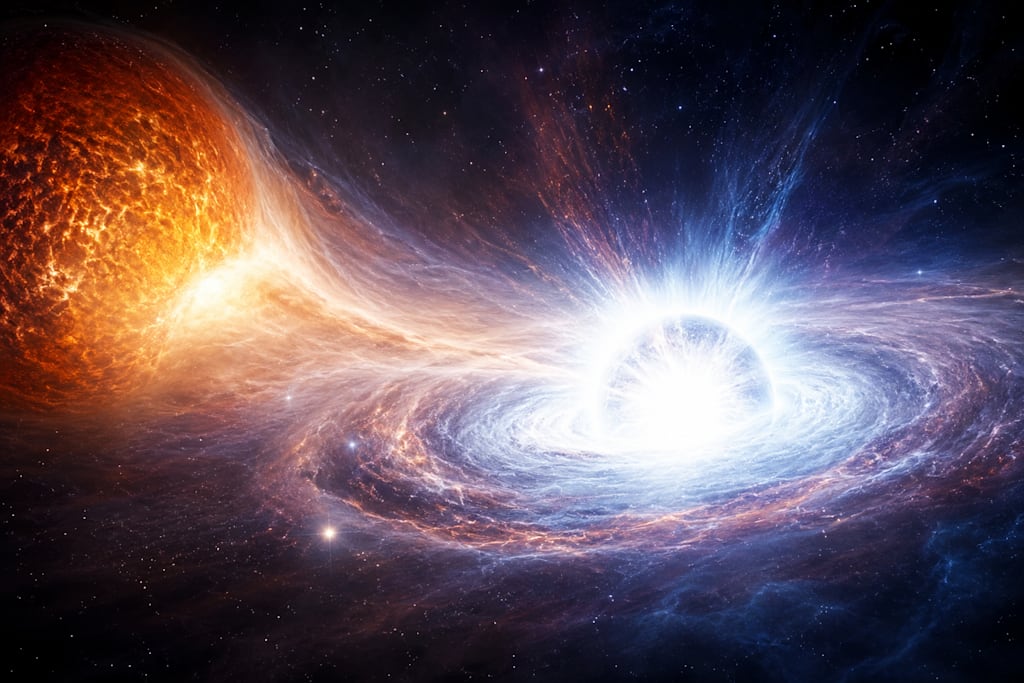
One is a red giant, an aging star that has expanded to many times the size of our Sun.
The other is a white dwarf—a stellar remnant about the size of Earth but containing nearly the same mass as the Sun. It's one of the densest objects in the universe. A teaspoon of its material would weigh several tons on Earth.
Locked together by gravity, the two stars are engaged in a slow but relentless cosmic exchange.
The red giant continuously sheds gas from its outer layers. The white dwarf's intense gravity captures much of this material, forming a swirling accretion disk before the gas settles onto its surface.
That seemingly gentle process eventually leads to an extraordinary explosion.
The Science Behind the Flash
As hydrogen accumulates on the surface of the white dwarf, pressure and temperature steadily increase.
Eventually, conditions become so extreme that the hydrogen ignites in a runaway thermonuclear reaction.
Within seconds, an enormous amount of energy is released.
The accumulated layer of gas is blasted into space at incredible speeds, causing the entire star system to brighten by roughly 1,500 times its normal luminosity.
Unlike a supernova, however, the white dwarf survives.
Once the eruption ends, the process simply starts over again. More hydrogen begins collecting, preparing the system for another eruption decades in the future.
It's less like a star dying—and more like a cosmic pressure cooker releasing built-up energy on a predictable schedule.
Why Astronomers Think the Eruption Is Close
Excitement surrounding T Coronae Borealis has been growing for the past couple of years.
Before its 1946 eruption, astronomers noticed something unusual: the system temporarily became dimmer before suddenly flaring into brilliance.
More recently, scientists observed a remarkably similar drop in brightness.
While that doesn't guarantee an immediate eruption, it matches the behavior seen before the previous event closely enough to capture worldwide attention.
Professional observatories are now monitoring the star almost continuously, while thousands of amateur astronomers regularly photograph the region of the sky, hoping to be the first to catch the eruption.
The next flash could happen tonight.
Or next month.
Or later this year.
Nature doesn't publish a schedule.
How Bright Will It Become?
Most of the time, T Coronae Borealis is far too faint to see without a telescope.
That will change dramatically during the eruption.
Astronomers expect it to brighten to approximately magnitude +2, making it easily visible to the naked eye under reasonably dark skies.
For several nights, it will appear as though a completely new star has materialized among the familiar stars of Corona Borealis.
Then, just as suddenly, it will begin fading.
Within a few weeks, it will once again become invisible without optical equipment, disappearing for another generation.
It's one of the few astronomical events where the night sky visibly changes before your eyes.
Can You See It?
If you live in the Northern Hemisphere, the answer is almost certainly yes.
Corona Borealis is a small semicircle-shaped constellation located between Boötes and Hercules.
During spring and summer evenings, it climbs high enough above the horizon to be easily observed.
When the nova erupts, one additional bright star will suddenly appear within that curved pattern.
No telescope will be necessary.
Simply find a location away from city lights, wait for a clear night, and look up.
Sometimes the universe provides its own spectacular light show.
Is There Any Danger to Earth?
Fortunately, none at all.
Although the eruption will release an astonishing amount of energy, the system lies approximately 3,000 light-years away.
At that distance, the event poses absolutely no threat to our planet.
There will be no harmful radiation, no gravitational effects, and no disruptions to Earth's environment.
The only thing we'll notice is an unexpected bright point of light shining in the night sky.
Why This Matters
Only a handful of recurrent novae are known in our galaxy.
Each eruption offers scientists a rare opportunity to study thermonuclear physics, stellar evolution, and the complex interactions between binary stars under extreme conditions.
This time, researchers will observe the event using some of the most advanced instruments ever built, collecting data across the electromagnetic spectrum—from radio waves to X-rays.
Yet beyond the scientific value lies something even more compelling.
Modern astronomy often relies on giant telescopes and space observatories to reveal the universe's greatest discoveries. Most of us experience those moments only through images on a screen.
T Coronae Borealis is different.
When it erupts, anyone with a clear sky will have the chance to witness a genuine cosmic event unfolding in real time.
For a few brief nights, the night sky will look different than it did before.
Then the extra star will quietly disappear, leaving behind only a memory—and a story few people ever get to tell.
The universe is constantly changing. Most of those changes unfold over millions or even billions of years, far beyond a human lifetime.
Every once in a while, however, the cosmos moves on a timescale we can actually witness.
And the next chapter may begin the very next time you look up.
About the Creator
Holianyk Ihor
Exploring the cosmos and seeking answers to universal questions. Astrophotographer capturing planets and deep sky wonders. Let’s look at the stars together.
Enjoyed the story? Support the Creator.
Subscribe for free to receive all their stories in your feed.
Comments