
Space Tourism is Here—Why It Matters Beyond the Adventure
From technological breakthroughs to economic transformation, space tourism signals a new era of human exploration and business innovation.

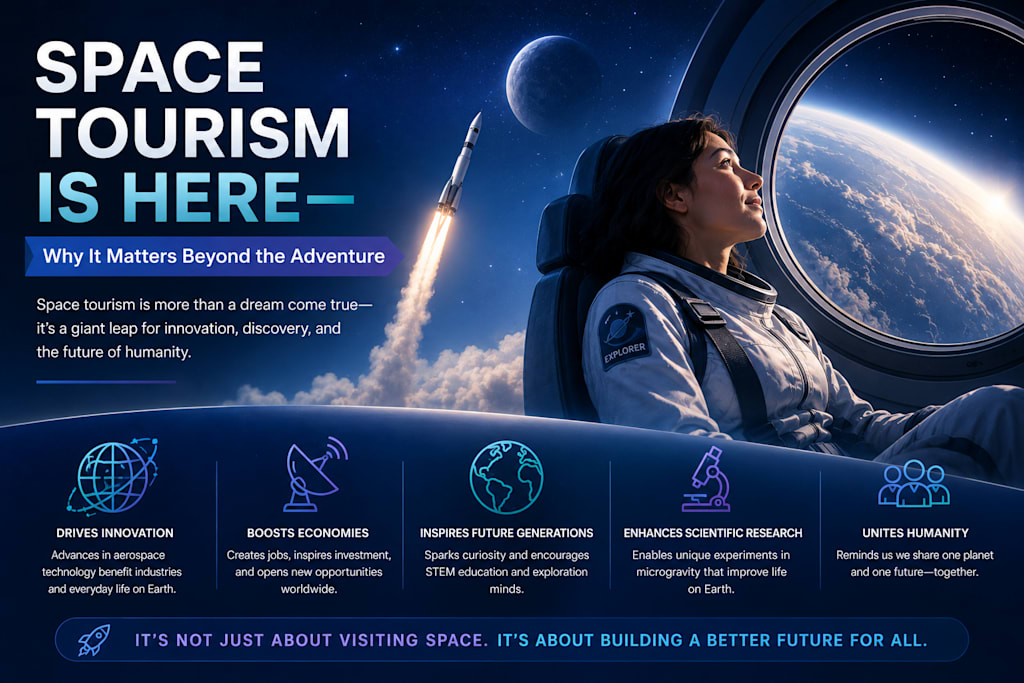
For decades, space tourism existed in the realm of imagination and science fiction. Astronauts were the only humans permitted to venture beyond Earth's atmosphere, selected through rigorous training and elite military or scientific programs. But that changed. In 2021, billionaire Richard Branson flew aboard Virgin Galactic's spaceplane. Days later, Jeff Bezos launched aboard Blue Origin's New Shepard. By 2023, SpaceX had carried private citizens to orbit aboard Crew Dragon. Space tourism is no longer a fantasy—it's a burgeoning reality. Yet beyond the thrill of weightlessness and the view of Earth from space, this industry signals something far more significant: a fundamental shift in how humanity explores, innovates, and builds the future.
The Space Tourism Industry is Already Taking Off
While space tourism still caters to the ultra-wealthy, the economics are becoming clearer and more accessible. A suborbital flight with Virgin Galactic costs around 450,000 dollars. Blue Origin charges similar prices for brief journeys to the edge of space. Orbital trips with SpaceX command multi-million-dollar price tags, but early participants are paying them. These aren't one-off experiments—they're the foundation of a commercial enterprise that industry analysts project could be worth tens of billions of dollars within the next decade.
What's remarkable is the velocity of this growth. The space tourism industry moved from theoretical to operational in less than five years. Companies are already booking flights years in advance. Training programs are being refined. Infrastructure at launch sites is expanding. This isn't speculation anymore; it's capital deployment at scale.
Beyond the Adventure: Why Space Tourism Matters
1. It Drives Technological Innovation
Space tourism demands cutting-edge technology, and that demand accelerates innovation beyond the aerospace industry. Advances in materials science, propulsion systems, autonomous systems, and life support technology developed for space tourism have spillover effects across manufacturing, transportation, and energy sectors. Engineers solving the problem of how to safely carry tourists to space are simultaneously advancing technologies that benefit medical devices, renewable energy, and autonomous vehicles.
2. It Creates an Entirely New Economic Ecosystem
Space tourism isn't just about launch operators. It spawns demand for specialized hotels, training facilities, spaceports, insurance products, and software platforms. Companies building space tourism infrastructure are investing in real estate, hiring engineers, and creating high-skilled jobs. Hotels near launch sites are planning space-themed accommodations. Travel agencies are hiring space tourism specialists. Payment platforms and fintech app development firms are building booking and financing solutions to make space travel accessible to broader audiences. The economic ripple effects extend far beyond the actual space flights.
3. It Expands Our Perspective on Earth and Humanity
Astronauts have long spoken of the 'overview effect'—the profound shift in perspective when seeing Earth from space. It's reported to increase environmental consciousness and a sense of global unity. As more civilians experience this perspective, it could catalyze changes in how we think about climate change, resource conservation, and international cooperation. Space tourism isn't just entertainment; it's potentially a consciousness-raising tool at scale.
4. It Establishes New Legal and Regulatory Frameworks
Space has long operated under international treaties dating back to the Space Race. Space tourism forces governments and international bodies to create new regulations: passenger safety standards, licensing for space hotels, insurance requirements, and space traffic management. These frameworks become the foundation for future space activities—whether mining, manufacturing, or settlement.
5. It Signals a Shift From Government-Centric to Market-Driven Space Exploration
For seventy years, space exploration was primarily the domain of governments and government-funded agencies. Space tourism represents a democratization of space—private companies are now driving the agenda. This shift has profound implications. Market forces create incentives for cost reduction, faster innovation cycles, and creative problem-solving. The companies leading space tourism (SpaceX, Blue Origin, Virgin Galactic) are now determining the trajectory of human spaceflight, not government space agencies.
The Technology Behind the Experience
The software and hardware enabling space tourism are marvels of engineering. Real-time flight systems manage every aspect of the journey—altitude, velocity, cabin pressure, temperature, and passenger biometrics. Autonomous landing systems ensure safe return. Communication systems maintain constant contact with ground control. Safety redundancy is built into every critical system. The software stack powering space tourism rivals the complexity of any enterprise technology system, but with far less margin for error.
Beyond the flight systems, space tourism companies are building sophisticated booking platforms, customer management systems, and data analytics tools to manage demand, optimize operations, and track passenger experiences. These are significant software engineering challenges that attract top technical talent and push innovation in cloud infrastructure, user experience design, and real-time monitoring.
The Broader Implications for Human Civilization
Space tourism is the harbinger of a larger transformation. Once we normalize human activity in space through tourism, the next logical steps—orbital manufacturing, space stations, lunar bases, and eventually off-world habitation—become conceivable in the public imagination and feasible in business plans. Space tourism is the gateway drug to humanity becoming a multi-planetary species.
This transition won't happen overnight. There will be setbacks—failed launches, accidents, regulatory hurdles. But the direction is clear. Within the lifetime of many reading this, space tourism will be more accessible and routine. Within generations, humans will work, live, and build in space. Space tourism is merely the beginning.
Why This Matters Now
We live in an era of legitimate challenges—climate change, political polarization, economic inequality. Against this backdrop, space tourism might seem frivolous. But history shows that transformative technologies often emerge from activities that seem extravagant at first. Aviation began with daredevils, became entertainment for the wealthy, and eventually connected the world. Computing started as a niche curiosity and became the foundation of modern civilization. Space tourism is following a similar arc.
More importantly, space tourism represents optimism about the future. It demonstrates that humanity is still capable of ambitious technological feats, that innovation and enterprise can solve seemingly impossible problems, and that our greatest achievements often emerge from the pursuit of what was once considered impossible. In an age of uncertainty, that's genuinely valuable.
Conclusion
Space tourism is here, and it's far more than an adventure for the wealthy. It's a catalyst for technological innovation, the foundation of a new economic ecosystem, a tool for expanding human perspective, and a signal that the next era of civilization will extend beyond Earth. The first generation of space tourists aren't just experiencing a thrill; they're participating in one of the most significant transitions in human history.
The question isn't whether space tourism will succeed—it already has. The question is how quickly it will evolve, and what extraordinary possibilities will emerge from it. The adventure, in the truest sense, is just beginning.
About the Creator
Arpit Mishra
Arpit Mishra is the SEO Executive at Dev Technosys, a healthcare app development company in US, UK, UAE, New Zealand and India. The company specializes in building custom healthcare applications such as telemedicine platforms,
Enjoyed the story? Support the Creator.
Subscribe for free to receive all their stories in your feed.
Comments
There are no comments for this story
Be the first to respond and start the conversation.