
Smart Textiles Market Accelerates as Wearable Technology and Health Monitoring Transform Global Fabric Innovation
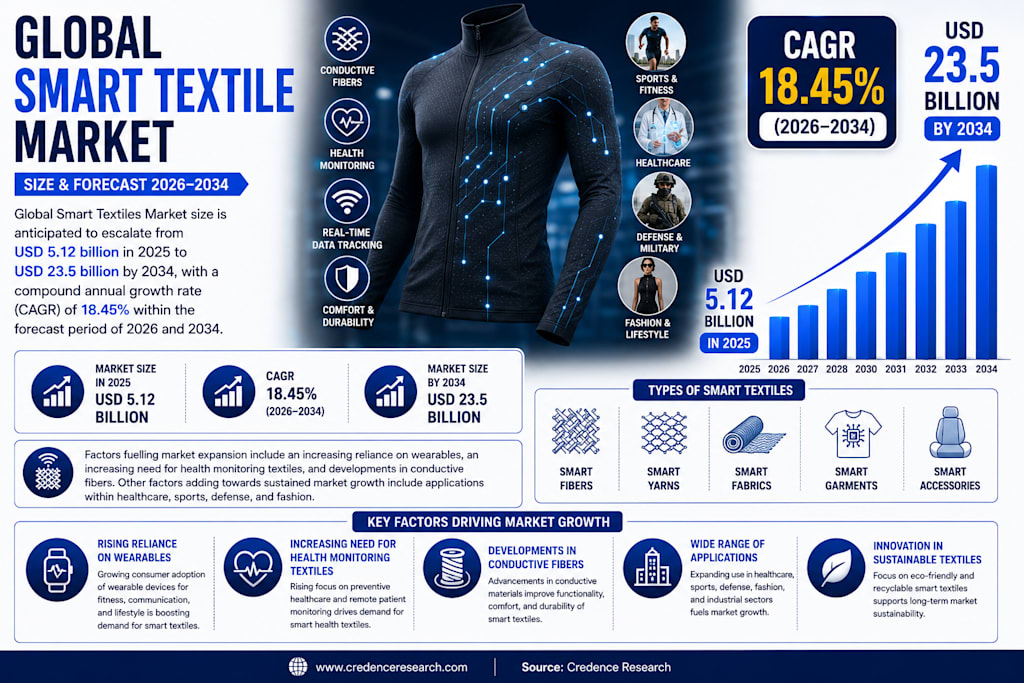
Driven by rising demand for wearable health solutions and conductive fiber innovations, the smart textiles market is set to grow from USD 5.12 billion in 2025 to USD 23.5 billion by 2034 at a CAGR of 18.45%.

Smart Textiles Market Overview
The global smart textiles market is entering a transformative growth phase as traditional fabrics evolve into intelligent, responsive materials integrated with advanced technologies. Smart textiles—also known as e-textiles or intelligent fabrics—are embedded with sensors, conductive fibers, microelectronics, and connectivity features that allow them to detect, react, and adapt to environmental or physiological conditions.
According to Renub Research, the market is projected to expand from USD 5.12 billion in 2025 to USD 23.5 billion by 2034, registering a strong CAGR of 18.45% during 2026–2034.
These textiles can monitor body temperature, heart rate, movement, pressure, and moisture, making them highly valuable across industries such as healthcare, sports, defense, transportation, and fashion. From smart garments and medical wearables to responsive interiors and military uniforms, smart textiles are redefining how fabrics interact with users and environments.
Key Growth Drivers in the Smart Textiles Market
Rising Adoption of Wearable and Health-Monitoring Technologies
The increasing demand for wearable technology is a major driver of the smart textiles market. Consumers and healthcare providers are seeking continuous, non-invasive monitoring solutions for vital health parameters such as heart rate, respiration, and body temperature.
Unlike traditional wearable devices, smart textiles integrate sensors directly into fabrics, enabling long-term and comfortable monitoring without the need for external gadgets. This makes them particularly useful in healthcare applications such as patient monitoring, elderly care, and preventive medicine.
In June 2025, Samsung Electronics announced plans to develop a digital health hub that enables users to share real-time health data with physicians, highlighting the growing integration of smart textiles with digital healthcare ecosystems.
Technological Advancements in Materials and Electronics
Rapid advancements in material science and electronics are significantly enhancing the performance of smart textiles. Innovations in conductive fibers, flexible sensors, microelectronics, and energy-harvesting technologies are improving durability, comfort, and functionality.
Miniaturization of electronic components allows seamless integration into fabrics without compromising flexibility or aesthetics. Additionally, wireless connectivity enables real-time data transmission, making smart textiles more efficient and user-friendly.
In 2023, Schoeller Textil AG introduced its “Re-Source” sustainable fabric range, incorporating recycled materials and bio-based fibers, reflecting the growing emphasis on sustainability and performance in smart textiles.
Expanding Applications Across Industries
The application scope of smart textiles is expanding rapidly across multiple industries. In healthcare, they are used for monitoring vital signs and supporting rehabilitation. In sports, they enhance performance analysis and injury prevention.
In defense and military applications, smart textiles enable soldier tracking, environmental sensing, and protective clothing. The fashion industry is also adopting smart fabrics for interactive and customizable apparel experiences.
Collaborations between research institutions and industry players are accelerating innovation. For instance, Troop Comforts Limited and IIT Delhi partnered to develop smart protective clothing for defense applications, showcasing the growing importance of smart textiles in national security.
Challenges in the Smart Textiles Market
High Costs and Limited Scalability
The integration of electronics and sensors into textiles makes production more complex and expensive compared to traditional fabrics. High manufacturing costs limit large-scale adoption, particularly in price-sensitive markets.
Mass production technologies are still evolving, and until costs decrease, smart textiles may remain a premium product category.
Durability, Washability, and Data Privacy Concerns
Durability and washability are significant technical challenges for smart textiles. Ensuring that embedded electronics remain functional after repeated use and washing is critical for consumer acceptance.
Additionally, smart textiles collect and transmit sensitive personal data, raising concerns about data privacy and security. Ensuring secure data transmission and compliance with regulations is essential for market growth.
Segment Insights in the Smart Textiles Market
Active Smart Textiles
Active smart textiles can both sense and respond to environmental or physiological changes. They are widely used in medical applications such as rehabilitation garments and compression clothing, as well as in sports for temperature regulation.
Sensing Smart Textiles
Sensing textiles are equipped with sensors that monitor physical and environmental parameters such as heart rate, movement, and temperature. These textiles are increasingly used in healthcare, sports, and occupational safety.
Thermoelectric Smart Textiles
Thermoelectric textiles can generate or regulate heat, making them ideal for temperature-controlled clothing, outdoor gear, and medical applications. This segment is gaining traction as demand for energy-efficient and self-powered solutions grows.
Defense and Military Applications
Smart textiles are widely used in defense for monitoring soldier health, enhancing safety, and providing adaptive camouflage. Governments are investing heavily in these technologies to improve operational efficiency and survivability.
Transportation Applications
In transportation, smart textiles are used in vehicle interiors to enhance comfort and functionality. Applications include seat fabrics that monitor posture, temperature, and stress levels, improving passenger experience.
Regional Insights in the Smart Textiles Market
United States
The United States leads the smart textiles market due to strong innovation, high R&D investment, and widespread adoption of wearable technologies. Applications in healthcare, defense, and sports are driving growth.
United Kingdom
The UK market is expanding with a focus on sustainable materials and wearable health technologies. Research institutions and industry collaborations are accelerating innovation.
India
India is emerging as a high-growth market due to its large textile manufacturing base and increasing adoption of wearable technologies. Government initiatives such as Tex-RAMPS are supporting innovation and competitiveness in the sector.
Saudi Arabia
Saudi Arabia’s market is developing as part of broader digital transformation initiatives. Applications in defense, healthcare, and climate-responsive clothing are driving demand.
Market Segmentation
The smart textiles market is segmented by type, functionality, end use, and geography. Types include passive, active, and ultra-smart textiles, while functionalities include sensing, energy harvesting, thermoelectricity, and aesthetics.
End-use industries include defense, sports, transportation, architecture, fashion, and medical sectors. Geographically, the market spans North America, Europe, Asia-Pacific, Latin America, and the Middle East & Africa.
Key Companies in the Smart Textiles Market
Leading companies in the market include Adidas AG, DuPont de Nemours Inc., Gentherm Incorporated, Google LLC, Texas Instruments Incorporated, Toray Industries Inc., Ohmatex A/S, and Schoeller Textil AG. These players are driving innovation through advanced materials, wearable technologies, and strategic partnerships.
Final Thoughts
The smart textiles market is reshaping the future of fabrics by combining technology, functionality, and design. From healthcare monitoring to smart fashion and defense applications, intelligent fabrics are becoming an integral part of modern life.
With strong growth projections, continuous technological advancements, and expanding applications across industries, smart textiles are poised to play a transformative role in the global innovation landscape.
About the Creator
Enjoyed the story? Support the Creator.
Subscribe for free to receive all their stories in your feed.
Comments
There are no comments for this story
Be the first to respond and start the conversation.