
Seven new species of leafhoppers have been discovered in Africa.
The new species' frog-like look

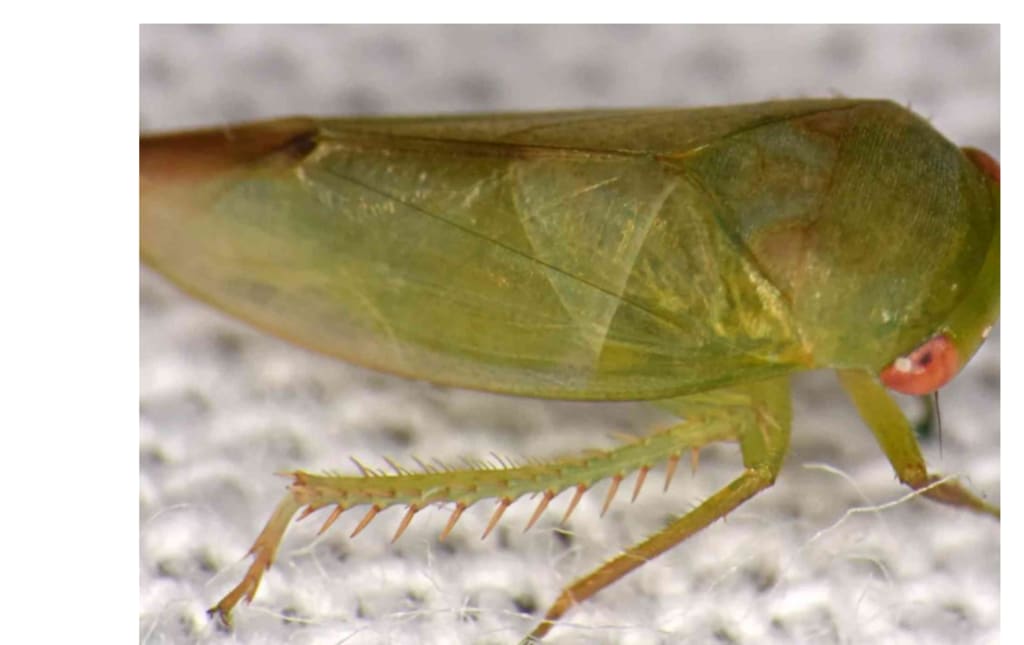
Seven insects from Uganda's rainforest that resemble frogs have now been identified as novel species. The discovery puts a stop to this group's decades-long silence in African records, and one new name pays homage to the scientific record.
Seven strikingly identical hoppers among trays of insects lured to light in Uganda's Kibale National Park turned out to be unidentified species. Dr. Alvin Helden, an entomologist at Anglia Ruskin University (ARU), discovered that each of those specimens constituted a distinct species.
The discovery required time because their colours and shapes varied so little. At first sight, the insects' distinctions were not apparent. There may yet be more species in the jungle than can be discovered by a cursory study, according to this hidden variety.
The new species' frog-like look
The species' squat body, big eyes, and lengthy rear legs that are closely folded at their sides give them a frog-like look. They use their strong back legs to quickly catapult themselves off leaves when they are disturbed.
Because they dwell on vegetation and make abrupt leaps, biologists refer to these tiny insects that feed on plants as leafhoppers. Even though it can be difficult to distinguish one species from another, leafhoppers' body layout makes them easier to spot in action.
Evidence that is too little to notice
Since these insects had nearly identical green shapes across species, their outward appearance was unable to resolve the issue. Instead, researchers analysed small reproductive organs, where dependable borders are created by minute variations in hooks, curves, and plates.
These structures are important because even minute variations within a species remain constant, providing researchers with proof that body colour In addition to adding five previously identified members of the group to Uganda's record, the ARU report described seven new species.
In total, Kibale found 13 Batracomorphus leafhoppers, a higher number than one park might indicate. Since 1981, no additional African members of this group have been identified. The most intimate name in the study belonged to a specific species, Batracomorphus ruthae.
The discovery gained significance beyond a mere species count because of the combination of scientific history and personal significance.
Night light retrieval
Despite their size and camouflage, night collecting in rainforests above 4,900 feet attracted these insects to light traps. Researchers can collect organisms that are almost inconspicuous during the day because many leafhoppers are attracted to lamps after dark.
Light traps, however, only capture species that fly in their direction, undercounting insects that are quieter or less mobile. This suggests that the seven new names might only be the beginning of Kibale's hidden hopper fauna.
The midpoint of the food chain
Leafhoppers feed by puncturing plant tissue and extracting sap, in contrast to many insects that chew leaves. Certain cousins become agricultural pests when they proliferate on crops, and this feeding can stress plants.
According to Helden, "their presence is a sign of a healthy ecosystem, and they are an important source of food for birds and other insects." When viewed in this light, these microscopic herbivores reside close to the center of a living chain, absorbing and transferring plant energy.
An inheritance record
Batracomorphus ruthae was unique among the seven since it was named after Helden's late mother. Helden stated, "Ruth was a scientist who worked in a hospital laboratory." He continued by saying that mother supported his early interest in science and purchased his first microscope.
That line illustrates how family influence can endure in scientific nomenclature by transforming an ARU species paper into a record of heredity.
The significance of the names
Since unidentified organisms are difficult to compare, protect, or revisit, giving a species a name is not required. Each description in taxonomy, the discipline of identifying organisms, establishes a benchmark that can subsequently be tested by other scholars.
In biodiverse woods, where many insects appear to be identical until they are sorted, that is important. After such names are established, surveys in the future can enquire about each species' habitat, prevalence, and threats.
The forest's secrets
Given that one collection effort has already revealed significantly more diversity than anticipated, Kibale still most likely contains more undiscovered species. Despite making up a large portion of the forest's daily life, tiny insects frequently get overlooked in more comprehensive wildlife surveys.
It may be possible to determine whether these seven are regional anomalies or a component of a larger pattern by conducting similar research in other African woods. One of the reasons tiny species articles can be so important is because that unresolved question keeps the discovery open-ended.
This is more than just an accounting exercise, with seven new species, five first national records, and one very personal name. According to the findings, the jungle nevertheless conceals a dense layer of life that can only be seen if one looks closely enough.
About the Creator
Enjoyed the story? Support the Creator.
Subscribe for free to receive all their stories in your feed.
Comments
There are no comments for this story
Be the first to respond and start the conversation.