
Scientists believed they understood what might be at the center of our galaxy. However, they might have been entirely mistaken the entire time.
Is dark matter the alternative to the supermassive black hole at the center of the Milky Way galaxy?

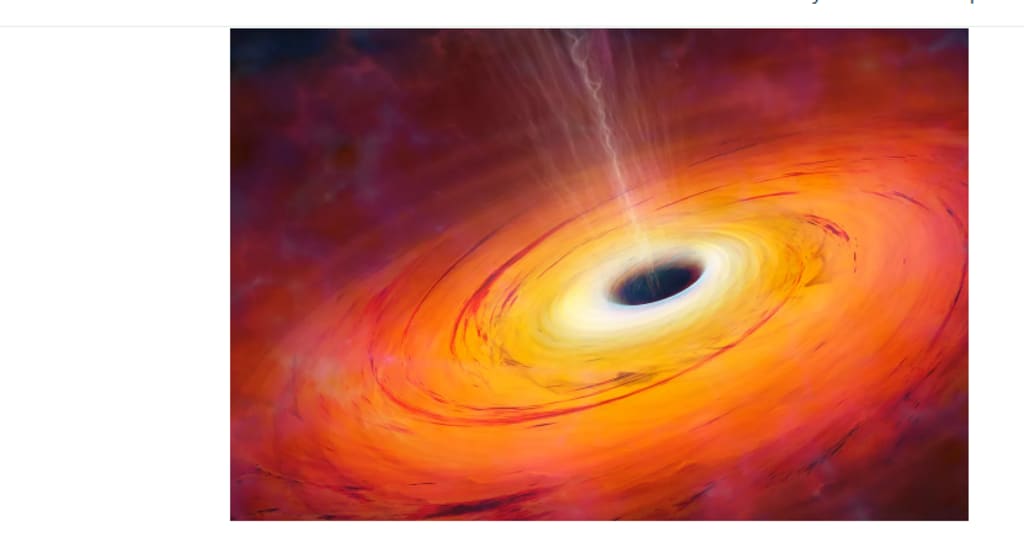
In the summer, the constellation Sagittarius is shining as you look south. Its wandering stars take on a variety of forms, such as a spoon and a teapot. The Galactic Center, the Milky Way's core, is located just next to the teapot, near the point where steam would emerge from its spout.
This vast celestial metropolis includes the Sun and every star visible in the night sky. Similar to how planets orbit the Sun, a population of hundreds of billions of stars swirls around this core mass. Astronomers were certain for decades that they understood what each of these bodies was orbiting.
The discovery has even won a Nobel Prize. However, recent studies are challenging the theory, which may lead to a better understanding of our home galaxy.
Gazing at the center of our galaxy
On either side of Sagittarius, the Milky Way extends like a dusty river. This dust is so abundant that it prevents us from seeing the Galactic core in visible light. Astronomers must employ longer light wavelengths that can pass through the dust in order to see what's happening there.
It wasn't until the 1990s that radio astronomers started using infrared telescopes mounted atop Hawaii's massive volcanoes to look through the dust, even though they had been detecting signals as early as the 1950s that suggested something intriguing was happening in the center of our galaxy.
Valentina Crespi of the Institute of Astrophysics La Plata in Argentina states, "There are observations of stars orbiting around the center of our Galaxy – the so-called S-stars – and from their motion we can infer there is a very massive and compact object there."
Astronomers were able to determine the mass of this enigmatic core object based on the orbital time and distance of these S-stars. At an astounding four million Suns, it tipped the scales. However, their gravitational master had to span less than a third of the Solar System in order for the stars to keep their stable orbits and avoid being eaten.
The theory of supermassive black holes
A gigantic black hole was the only theory that made sense at the time. Massive stars typically die to create black holes, but no single star could create a monster this size. Rather, this black hole, known as Sagittarius A*, was probably a remnant of our galaxy's birth.
Our grand spiral home was constructed by mergers that piled up smaller galaxies, and each of these dwarf galaxies may have had a smaller black hole of its own. All of these enormous creatures eventually came together to form a single core giant.
However, another mystery had been simmering for almost a century during all of this. The orbits of stars considerably farther out in the galaxy have been inconsistent since the 1930s.
Carlos Argüelles of the Institute of Astrophysics La Plata says, "Stars in the outer regions are moving too fast for the visible matter alone to hold them." At first, the Milky Way appeared to be an enormous replica of the Solar System. The stars in Sagittarius A* resembled planets revolving around the Sun.
However, it didn't seem like the stars followed the same laws as the planets. A planet in our Solar System circles more slowly the distant it is from the Sun. The nearest planet, Mercury, completes a full orbit of the Sun in a lightning-fast 88 days. Conversely, Neptune takes a tortoise-like 165 years.
Stars near the Sun and farther out toward the Galaxy's edge seemed to be travelling at comparable speeds as those far closer to the Sun when scientists started monitoring their motions. They were actually travelling so quickly that they ought to be able to leave the galaxy completely and travel into intergalactic space. But they obviously weren't.
Let us introduce dark matter.
Dark matter is a mystery element that is typically used to explain this "rotation problem."According to Argüelles, dark matter functions as an extra gravitational component. "It’s what keeps the stars in the outer regions bound to the Galaxy."
Although stars and gas make up the majority of the galaxy's visible mass, a large amount of invisible material is dispersed throughout the galaxy and acts as an extra gravitational glue.
A team lead by Crespi and Argüelles came up with a radical new theory when considering this dark matter: what if Sagittarius A* is actually another form of dark matter rather than a supermassive black hole?It is not necessary to place a black hole in the center, according to Argüelles. "Everything is a component of This hypothesis is based on "fermionic" dark matter, a specific kind of dark matter.
Examining the theory
Astronomers have been looking for dark matter particles for almost a century, but they have never found any. This may be due to the fact that dark matter particles are significantly lighter than anticipated.
Crespi and Argüelles propose that these lighter particles might both form a compact object at the center of our galaxy and disperse into a more diffuse halo, which would account for the spin of the remaining Milky Way stars.
Their model is able to match stellar speed measurements made by the extremely accurate Gaia spacecraft of the European Space Agency. Importantly, the Event Horizon Telescope's 2022 direct view of Sagittarius A* is consistent with the dark matter theory.
In actuality, the image is a photograph of the surrounding light rather than the center object. The hot gas that spirals toward the center glows because it has been heated to millions of degrees.
Gravity bends the light's path as it approaches the core mass, creating a structure that resembles a ring. The area where light is either absorbed or diverted away from us is indicated by the dark center, often known as the "shadow."
This interaction between incandescent gas and distorted light is what gives black hole photos their distinctive look. However, Crespi and Argüelles can also provide an explanation.An picture with a ring of emission surrounding the central dark region is produced by the dark matter core. quite comparable to what is anticipated from a black hole, according to Argüelles."At the level we can currently measure, both scenarios can produce very similar observational signatures," Crespi continues.
Orbits will provide the solution.
Although they all call for sophisticated measurements that we are now unable to perform, astronomers may be able to separate the two alternatives in certain ways.The orbital precession shows the main distinction, according to Crespi. "In a dark matter core, the stars would precess differently than around a black hole." The slow rotation of an orbit's orientation brought on by gravitational forces is known as precession.
It is a lyrical echo of another argument from more than a century ago, when the measured precession of Mercury's orbit around the Sun supported Einstein's general theory of relativity over Isaac Newton's original theory of gravity. This argument is being used to test the "black hole versus dark matter" issue.
Unfortunately, we now lack sensors that can accurately observe S-star orbits, although facilities are being developed that could be able to do so. These include the Extremely Large Telescope, which is scheduled to begin operations in 2030, and the GRAVITY+ upgrade, which is now underway on the Very Large Telescope Interferometer at the European Southern Observatory.
Argüelles has also discussed upcoming improvements to the Event Horizon Telescope with its team.We anticipate being able to differentiate between these situations as the Event Horizon Telescope advances with more resolution and more observations," he says.
What if they are correct?
What do other astronomers think of Crespi and Argüelles' idea while we wait for these instruments to become available?Harry Desmond, a senior research fellow in cosmology at the University of Portsmouth, says it's an intriguing concept. "It would really pin down the microphysics of dark matter, which would be huge."
The discovery would also demand a significant reevaluation of how galaxies function if the Milky Way is not unique and other galaxies likewise lack supermassive black holes.
"It would have a big knock-on effect on the energy budgets of galaxies, which are dominated by black hole feedback in the standard picture," he says.Some alternative mechanism would need to be discovered because black holes could no longer control gas intake throughout the galaxy or quench star development.
Extraordinary claims demand extraordinary evidence, as is always the case in science. However, if Crespi, Argüelles, and their group prove to be correct, we might have to challenge some of the most basic presumptions in contemporary astrophysics.
About the Creator
Enjoyed the story? Support the Creator.
Subscribe for free to receive all their stories in your feed.
Comments
There are no comments for this story
Be the first to respond and start the conversation.