
Mary felt sure that the ticket-bot would know who she really was, but when they boarded the automatic tram, it simply said
“Welcome to Auto Travel, Ms Anderson, enjoy your journey.”
She almost whistled with relief as they sat down in the shared carriage.
They only had one holdall bag each, having left most of their worldly possessions behind. They decided to engage in as little conversation as possible in case they accidentally used their real names. Mary nestled her head on Jon’s shoulder, in need of comfort. She realised that she missed her mother terribly and wondered what she would have thought of this? She had no idea where they were going but she knew she trusted her husband so she didn’t even need to ask. With the new ID being picked up perfectly and the fact that they were meant to be away, she knew they would be safe for a few days at least. This temporary safety made her relax and feel suddenly extremely tired, as if the tension of the last couple of days was ebbing its way out of her body. The movement of the tram as it sped along made the feeling too difficult to resist and she drifted off to sleep like a baby being rocked.
At the Seaside
She was awoken by Jon gently nudging her.
“Marie”, he whispered, using her false name which was thankfully familiar to her own, “We are here.”
She sat up, feeling a slight backache from being slumped in his arms, rubbed her eyes and blearily looked out of the window. It was still afternoon so she hadn’t been asleep for more than an hour or two. The smell of salt water had already permeated her nostrils before they had even disembarked the carriage. She could see sand dunes, ‘smart’ adjustable deck chairs and stalls selling candy floss which was arguably always fake even before they simulated it. The seaside! They really had come to the sea!
Groggily she stood up and glanced at grandma, a rising anxiety welling up within her. Going to the sea had been an excuse to get away and save grandma from certain death. She hadn’t expected to actually go there and it made her think about the hospice again. She shivered as if from cold, although the weather was fine.
Grandma fumbled around in her handbag and pulled out an old fashioned paper hankie which she shoved into Mary’s palm on the pretext of wiping off a makeup smear. It said ‘Mindfulness, watch your thoughts.’
Of course, it would be dangerous to think of the hospice since this could be picked up by an advertising board and grandma’s new identity ‘Lucy’ did not have a death warrant.
They got off the tram while she inwardly practised the techniques she had been taught and she breathed in the sea air to centre herself. Apparently there used to be birds at the seaside called seagulls. They would nest on the cliffs and fish from the ocean and their squawks were an integral part of a day out at the beach. Now the skies were silent since all the birds and fish had been killed off by wifi radiation. Good job, said the authorities, since seagulls were pests that used to bother sunbathers for their sandwiches.
“We’re going to go on the tour bus”, said Jon, interrupting Mary’s thoughts as she stared up at the sky, wondering what it would be like to see birds there instead of satellites, “If we make our way to the stop, it leaves in 10 minutes.”
She looked at him and guessed they weren’t going for the sightseeing, nodded and dutifully followed. They would have got there earlier if grandma hadn’t spotted a hotdog stand on their walk and tugged on her sleeve like an excited child.
“Oh, I just have to have a hotdog, I’m famished and they smell so good!”
Jon screwed up his nose in disapproval.
“Those things are disgusting, if it weren’t for the added vitamins they’d have absolutely no nutritional value whatsoever!”
He was right, not only did they have no nutritional value in their own right, even the junky junk hotdogs of the past were gone. Now there were simulated hotdogs made in the lab using a combination of animal cells and chemicals. ‘Lab grown meat’, they called it. When it was first introduced, it was marketed as a solution to both animal cruelty and land shortages. If you could just grow your meat in a lab and not have to kill an animal then you prevented animal suffering and you didn’t need to use as much land for grazing. This preserved space for building development and was an answer to overcrowding. The downside was, it was devoid of natural vitamins and these had to be added. Initially, the taste was also rather synthetic but over time they had perfected this and now, no one could tell the difference. As more and more elderly people were tidied into graves, there was almost no one who remembered the taste of real meat anyway.
Grandma jumped up and down on the spot as if she were five instead of 75.
“Don’t care”, she said, “I just really want one.”
Jon looked at his smartwatch and deduced that they had just enough time since there was no queue. He didn’t factor in the slow speed at which grandma walked to the stop, not because she was infirm but because she was trying to bite into the hotdog without spilling out all the fried onions that were bursting out of the hotdog roll. She also kept stopping to wipe mustard from her chin. As a consequence, they arrived just as the bus was about to pull away, but managed to hail the driver who glared at them disrespectfully. Tardiness was a social sin that was punishable by reductions in your credit.
“As you’re on holiday I won’t report you”, said the driver, “but if you’re late on the return journey I will go without you.”
‘Good’, thought Jon privately, using his mindfulness technique. That was exactly the outcome he was banking on.
The driver, a rather brusk man who wore his shirt buttoned up to the neck, handed them a programme. Today they headed uphill, first to discover the monuments that lined the streets there and then to look at the amazing view of the sea from the cliff top. After that, if tourists wished they could go to the funfair, which was a lot more fun after they abolished social distancing. In the past, humans had been made to stand six feet apart and not congregate in groups of more than six, in case they became infected with viruses. They were also forced to wear masks whenever they went outdoors. This meant that trying to run a bar or a restaurant or a club or anything remotely entertaining became almost impossible. That was how they sold genetic engineering of humans to the public, who were all too eager to throw aside their masks and hug their friends again. If they were made resistant to disease, they were told, all these restrictions could be lifted. Now that illness was so rare, funfairs were back in again.
When they arrived at their destination, the driver turned on the computerised guide voice, which told them about the statue of Gill Bates, a man born in the 20th century who had invented not only the world’s best computer programme but also the very first microchips that he called digital certificates. These had revolutionised the way people shopped, said the guide, as it was far more convenient not to have to take cash or remember your pin number, as previous generations did.
Moving on from Gill Bates, they came to the statue of Dillon Tusk, the inventor of the world’s first sky internet who discovered how to connect the human brain to computers, a feat, the guide said that turned humans into a superpower capable of anything. Next up was a statue of a woman, Jennalyn Toldna, the person who discovered how to edit DNA strands and made genetic engineering of people possible. Funnily enough, the guide pointed out, the last three letters in her surname were D N A. Lastly, they stopped at the statue of Cardew Woods, the inventor of IVF babies, without whom disease-resistant humans never would have been born.
After gathering around all the statues and doing their best to look enthusiastic, they filed back onto the bus to be driven up the cliff to enjoy the panoramic views.
“David, sit down!”, a woman passenger attempted to instruct her toddler, who was climbing all over the seats and trying to wriggle out of her arms. The child, a boy of about three, had stocks of curly red hair and a face full of freckles. His arms and legs were still chunky with ‘puppy fat’ despite his obvious energy. His mother, a slight woman in her twenties, also with red hair, looked tired and a little exasperated. Mary guessed he kept her on her toes all day long and she wished that one day soon her life might be filled with the patter of a little one’s feet. She gazed longingly at the child, wanting to scoop him up and squeeze him, but of course she couldn’t. As she looked at him, she noticed that two rows behind sat another mother and a child exactly the same as this child. He had the same red hair, the same freckles, the same colour eyes. Even the way he kicked his legs while sitting in his seat was the same gesture made by the child in front of him.
Mary realised that he wasn’t just similar, the child was identical aside from his clothing. There was a chance, of course, that he was a twin but she thought not. He had referred to the woman next to him as ‘mama’. More likely that they were both products of the same cryogenics agency. There were rules in each agency that specified only one embryo of a certain design could be made within several hundred miles so that children would be ‘unique’ in their area. This didn’t take into account that people travelled, however, so if anyone went on a trip to the sea there was always a chance they could bump into someone that was their doppelganger. It had happened before when Mary had gone away and back then she didn’t even think about it. She wasn’t sure why. Since having her eyes opened by grandma’s impending execution and the denial of her own right to get pregnant, she suddenly saw everything in a new and entirely abhorrent light. She tried not to look horrified by the two clones and averted her eyes, but she was too late. The woman in front had seen her shocked expression and hurriedly turned her child away from Mary’s gaze and the other child behind him, putting a jacket on him.
“We’re nearly there”, she told him in a purposefully loud voice so she would be overheard, “We can get off this stuffy bus away from these stuffy people.”
She shot Mary a steely glare. If someone did notice a doppelganger, it was good public form not to react and Mary had not been able to disguise her feelings, feelings that she considered were entirely hypocritical since she had once fully intended to use a cryogenics company to have a baby, not knowing any other choice. She shuffled awkwardly in her seat as the bus halted to a stop and the affronted mother bustled her way to the front so she could get off first.
“Please make sure you’re back at 3pm”, said the driver, “You have some free time to try the cream tea cafes before we make our way to the funfair.”
He made a point of looking at Jon when he said that.
They alighted and watched as the bus pulled away, then Mary turned to her husband.
“Now what?”, she asked.
He merely smiled and took her hand and the three of them strolled down a steep cobbled road, lined with tea shops on either side, interspersed with arcades featuring virtual reality headsets so you could pretend to hunt sharks or surf. Mary wondered why this was necessary when the real beach was right there.
Robots served people sitting outside at tables, bringing them simulated drinks or cream scones and wiping down used tables. All manual or service jobs were now done by robots, a move the authorities said would create equality by ending the working class and giving everyone a middle to upper class lifestyle. In reality, many of the millions who lost their jobs did not have sufficient aptitude for another type of career and ended up languishing on state credit, a situation entirely preferable to the government. After all, who would bite the hand that fed them?
The Under World
When Mary, Jon and grandma reached the bottom of the very long road, instead of choosing a tea shop, Jon veered down a side street that was almost deserted. It was dotted with boarded up buildings and was now home to the public toilets. On the right hand side of the road was a fenced off area with a large, disused colliery in the distance. No one had mined here for years since the introduction of bio waste fuels and the area was set for regeneration, possibly as a museum, but this hadn’t happened yet. At this time it was a blot on the landscape. Jon ignored the electronic signs asking people to keep out and tugged open the rusting gate. Mary looked nervously around her to determine if anyone was watching and when she had established that they were alone, she and grandma followed him to the rear of the colliery building.
He swung open a door to reveal an antiquated lift shaft. This time grandma looked nervous.
“Are you sure that is still safe?”, she asked, “and I’m claustrophobic.”
Her feet seemed rooted to the spot. Jon put his hand to his mouth to remind her to keep quiet and gently nudged her forward into the lift. Mary didn’t need any encouragement. For the first time in her life she felt alive and excited to be walking towards her freedom. She imagined that they would enter some kind of tunnel and travel through into a fabulous city full of sparkling lights, where she would run through the streets with gleeful abandonment.
They descended into darkness, with grandma clinging onto Mary until they reached the bottom of the shaft. It was so dark they could see nothing at all so they just stood, disorientated, not knowing what to do, until a torch light shone in front of them.
“What now?”, Mary whispered, for the second time that day.
They squinted and took a moment to acclimatise. A tall, willowy man in rugged workwear clothing swam into view.
“Hello, I’m Peter, the guardian of the entrance here. Joshua told me to expect you this afternoon. I can hear whenever the lift is tampered with so we either lock everything down or I am sent to greet new arrivals. Thankfully we have never had an incident yet, although we thought we might have to leave several times when they were debating demolishing the place.”
Mary was puzzled, as he had spoken as if he lived here and that surely could not be right?
He led them with the aid of his flashlight through another small doorway that had been concealed by rocks. It was so small they all had to crouch in order to fit though. From there they walked through several more underground corridors and doors, holding onto each other to prevent falling in the almost total darkness. At the final door, a flood of light streamed through as it was opened and they all squinted again from the sheer brilliance of it.
As Mary looked around, she could see a large group of people had come to welcome them, men, women and children. There was even a small dog, a rare sight indeed since most of them could not withstand the radiation. There were lamps embedded into the rock walls and colourful wall hangings. Mary could see that beyond this reception area was a warren of paved pathways, all leading off to different rooms, the pathways made up of different coloured mosaic tiles. She gasped at the sheer vastness of it. The colliery was big, but from the outside one would never have guessed that a whole village lay underneath.
A young woman carrying a tiny baby stepped forward and extended a hand.
“Hello”, she smiled, “I’m Martha and this is John”.
She glanced at the baby in her arms.
Jon beamed.
“What a great choice of name”, he said.
“I’m in charge of settling in the new arrivals”, she explained, “and I’ve come to show you to your quarters and give you a run down of everything that goes on here.”
She gestured to them to follow her, and after going down what felt like a rabbit hole of corridors, they reached a door with ‘Freeman’ written on it. Martha reached into her pocket and extracted a key.
“Keys?”, asked Grandma, “How vintage!”
“Yes”, said Martha, “We obviously can’t use our microchips at this level and all of us have fake ID’s anyway so it makes sense to use keys. This is your apartment.”
She led them through to a spacious lounge area, again, with lamps fitted into the walls, the only source of light since there were no windows. It looked fairly gloomy from the lack of natural light but Mary could see two large futons, a shelf filled with books of the paper kind and a solid looking coffee table that looked as if it came from a 19th century farmhouse. Tapestries decorated the otherwise bare rock walls.
Mary wandered through the room and poked her head around the door, where she saw a table and six chairs.
“That’s in case you want to have friends over”, explained Martha.
There was no kitchen anywhere to be seen.
The colony grew all their own food indoors with the aid of UV light lamps and raw plant based meals were handed out in a canteen, as cooking was impossible here. Lamps were taken away to be recharged and then returned so that people never ran out of light to grow food or light their rooms. People could eat in the canteen with others or they could eat in the privacy of their own apartment if they wished. Since there was no signal so far under the ground, there was real privacy. There were no television sets, computers or simulations so the food was real and the entertainment was basic.
Mary looked into the two bedrooms provided but noticed that there were no toilet facilities, only basins with no taps. She glanced at Martha with a worried expression on her face.
“Don’t worry”, said Martha, having been through the drill before with previous couples, “We have shared septic tank toilets as there’s no sewerage system here and it would have been too complicated to make one for each apartment, so we have three tank toilets at the far end of the complex. They are not emptied terribly frequently, I’m afraid, but we don’t want too many comings and goings to draw attention to ourselves.”
Mary looked aghast.
“How many people live here?”, she asked.
“There’s around a hundred at any one time, give or take a few either way.”
She tried not to shudder. A hundred people and only three toilets?
“I see there’s no taps or bath?”, she pressed, almost dreading what the response would be.
“Yes, obviously this is a disused colliery so we don’t have a water supply or plumbing but as our population changes quite often, we have people bringing bottled water in and taking out empty bottles. Each family is given an allowance for washing in and drinking but we don’t have a way to heat it so we have to put up with it being cold.”
Martha walked over to Jon and Mary’s bed and placed a suitcase on it.
“Here are some clothing items for you both and I’ve left a case on Mrs Freeman Senior’s bed, too. There’s also a programme of activities and an important class that everyone must attend, without exception. I’ve left it on the dresser for you.”
Martha smiled again and looked down at her baby, who was just beginning to rouse.
“Well, I’ll be off. John needs a feed. If you need anything, just ask. My place is four doors down on the left. Dinner will be at six o clock.”
She dropped some keys into Mary’s hand and left, closing the door behind her.
“Oh well, this is nice”, said Grandma, “I think I will feel right at home here.”
Mary sat down on one of the futons and put her head in her hands.
“Nice?” she repeated scornfully, “There’s no flushing toilets, no bath or showers, no hot water and no windows!”
Then she shot Jon a reproachful look.
“We’re underground! How can we live here? How am I supposed to raise a child here? I can’t! You never told me it would be like this!”
Jon was normally a calm and level headed person, but now his hackles were raised. How could his wife think of her creature comforts when Grandma’s life was in danger?
“May I remind you I risked my life to save grandma and so that we could have the baby you want so badly! A lot of planning went into this, and a lot of people have put themselves on the line to save others and you’re worried about the loos?”
Grandma flinched, looked upset and said
“I think I will go and unpack.”
Then she went into her room and closed the door. Mary suddenly felt guilty and realised how childish she was being. She looked up at her husband sheepishly, not knowing what to say.
“This will not be our permanent home”, he said, “It’s a stop gap, a safe house, modelled after the Chislehurst Caves in Kent. After the aerial bombardment of the area during world war two, the disused mine was turned first into an air raid shelter and later, an underground city for 15,000 inhabitants.”
He paused
“Although despite that being more than 230 years ago, we have less facilities than they did as it is too dangerous for anyone to make many adaptations when it’s our own government who would execute us.”
Mary felt ashamed and a silent tear trickled down her cheek. Jon sat down beside her and put his arm around her.
She lay her head on his chest and listened to the drumming of his heart for a few minutes, before speaking.
“Where will we go afterwards, then? If this is not permanent?”
“Somewhere entirely different”, he said vaguely, “But it depends on learning some things to help us get there, some science, and not everyone has been able to do it. Josh says there’s been people here that have been here for years because they can’t master the technique. There’s a class we have to go to.”
Hearing Josh’s name made Mary reflect on their secret life and on the fateful ministry letter that had led them to this point.
“Jon”, she whispered, “Can I ask you something?”
“Anything”, he replied.
“Why were you prepared to have a baby via a cryogenics company, knowing what you do? We went to the doctor. You were prepared for our child to be a clone.”
Jon sighed.
“I knew if we had a natural child, then I would have to stop helping Josh and I wanted to save as many people as possible. You seemed happy enough and I knew I would love any child we had.”
He had given up his mission in life to save his grandma and have a child with the woman he loved.
At six they headed down to the canteen to get a plateful of salad each and a cup of juice. Martha and her husband were seated at one of the tables, along with grandma who had arrived earlier and was engaged in deep conversation with them. Mary sat down next to them, tentatively biting a fork full of salad. She was surprised by the crunchy texture and the varied flavours that were somehow different from the simulated varieties that she had tasted.
Grandma Feels Young Again
Grandma, who was cuddling baby John on her knee, paused from her chat and looked up as an elderly gentleman entered the room. He was balding and what little hair he had left was white. He had a pot belly and was wearing a shirt that didn’t quite fit. Despite this, grandma could see that he would have been handsome in his younger days, had a well defined jaw bone and good facial structure. His eyes seemed piercing, but not in a way that made her uncomfortable. She was mesmerised. Unable to tear her gaze away, she stared at him like a teenage girl. He smiled broadly and strode over to sit at their table.
“Hello, I’m Alfie”, he held out a hand, “You’re new here, aren’t you?”
Grandma felt heat flushing her cheeks and was sure she had blushed. She shook his hand. It had been years since she’d seen such a fine specimen of a man. Her own husband had been gone for decades, she supposed he was dead. He had just failed to come home from work and any enquiry with the authorities was met with threats of fines and prison time. It happened to a lot of families. She had grieved at first, but then busied herself helping to raise her grandson and now found great solace in living with Jon and his wife. She had never thought she would even feel attracted to a man again, especially in the final years of her life, but here she was, pulse racing, looking at Alfie in admiration.
“I’m Lily”, she said, “But everyone calls me grandma.”
“Say what?”, shouted Alfie, “I’m a bit deaf in this ear and gene therapy didn’t fix it, so my number was up!”.
“LILY!”, she said again, louder this time.
“Lily? Well, that’s a pretty name. It suits you.”
Jon and Mary were staring at her from their spaces at the table. Was she actually being chatted up at her age?
When Alfie had gone to fetch his food, grandma declared
“I was right about this place, it’s going to be brilliant! Alfie has invited me to bingo already!”
There was no money in this cashless society, so the bingo prizes were food. She passed a programme to Mary.
“There’s so much to do, I’ll be sorry to leave!”
“Grandma”, said Mary cheekily, “Are you going on a date? We’ve only just arrived!”
This time grandma definitely blushed.
“Give over, child. Just look at all the things there are to do. They’ve got bible study, too, if you’re interested.”
Bible study? Mary was shocked. The bible was on the list of banned books and most copies had been burned. Religion, any religion, had been banned since 2020. To start with, they used infection control as an excuse, arresting priests who tried to open their churches. After that, they said that belief in something bigger was extremism and could lead to terrorism. All religious texts were removed, places of worship turned into warehouses and people who uttered anything spiritual were carted off for interrogation.
She looked carefully at the programme and saw that the one mandatory lesson she was expected to attend was quantum physics. This was what humankind had mastered to make teleportation of small objects possible, with a process of particle entanglement that Einstein had referred to as ‘spooky action at a distance’. It was possible to teleport a letter or a small gift, but not anything as large as a human being. She wondered what these science classes would have to teach her that she didn’t already know and how that could possibly help them escape?
Five Days Later
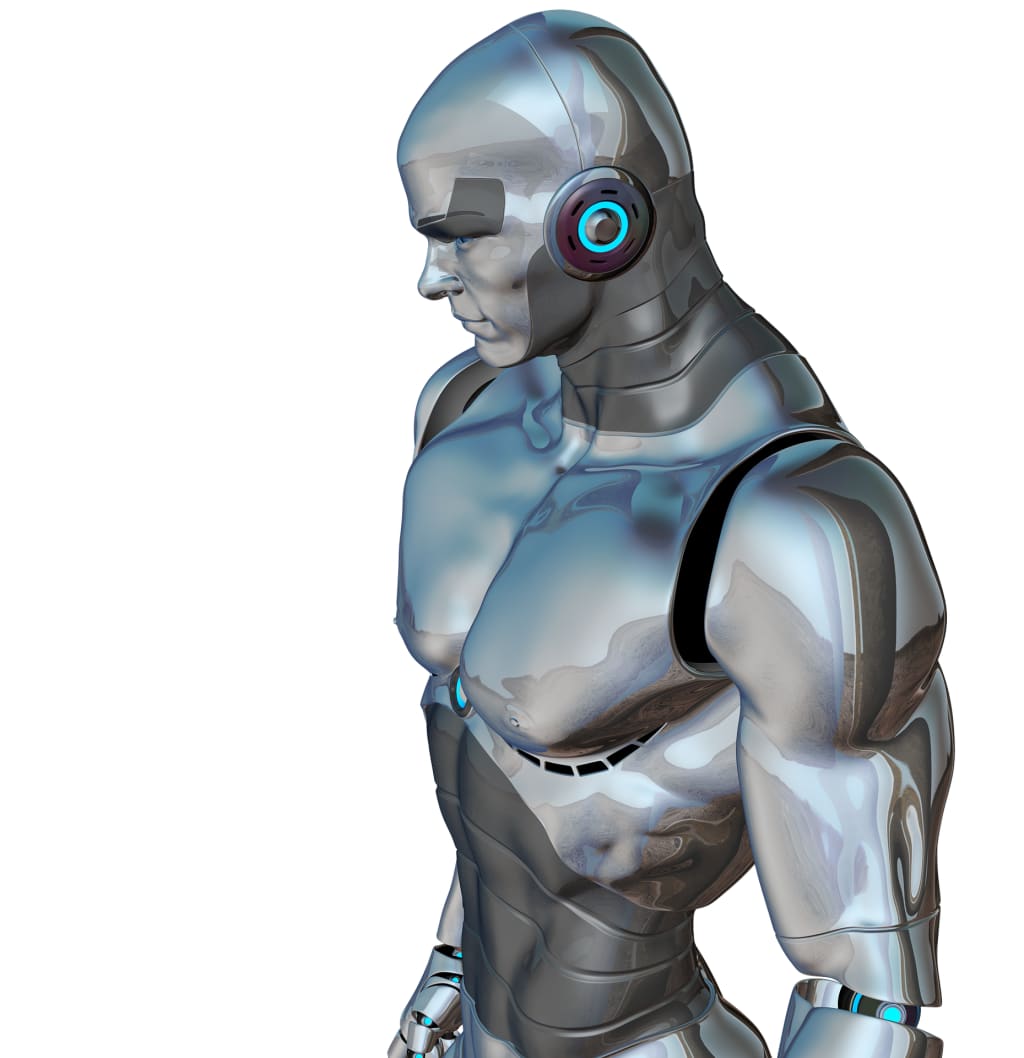
George was putting artificial flowers up around the house. He had tidied everywhere and put the kettle on in preparation for his owner’s arrival home. He knew that humans were complicated and he expected Mary to be stressed after the death of Grandma, something he surmised, that a cup of tea might help.
During his upgrade he had chosen to download several new skills that he thought elderly people might have, so that he could replace grandma as family matriarch. He had learnt story telling, had several sponge pudding recipes added to his resume and had a whole new simulated gardening plan under his belt. He could also knit at high speed.
When he had finished all of his duties, he sat in grandma’s armchair and waited for them to return. They were a little late, but it was not unlike humans to be tardy. As the minutes ticked by, he began to feel redundant so he switched to sleep mode for a snooze, not in the same way that people did, of course, but it meant he could stop analysing everything.
Some time later, he was jolted out of sleep mode by the sound of the TV set ringing. A video call was coming in. He was trained not to answer his owner’s calls unless he had been authorised, so he didn’t answer, but the person left a message that he could not help but overhear.
“Hello. This is the Dignity Plus Hospice Centre. We were expecting a Mrs Freeman Senior to be admitted today for euthanasia but she has failed to attend. Can you please get back in touch to reschedule? May I remind you, this is a legal requirement and if you don’t contact the centre within 24 hours, we will be forced to notify the police.”
George narrowed his eyes and stared at the TV set. Then he looked out of the windows and noticed that it was already dusk. He knew, then, that his owners were not coming back and exactly what he had to do about it.
About the Creator
Enjoyed the story? Support the Creator.
Subscribe for free to receive all their stories in your feed.
Comments
There are no comments for this story
Be the first to respond and start the conversation.