
Proton Therapy Market Accelerates as Precision Oncology Gains Global Momentum
With rising cancer cases and demand for highly targeted treatments, the proton therapy market is projected to grow from US$ 2.51 billion in 2025 to US$ 5.65 billion by 2034, registering a CAGR of 9.44% from 2026 to 2034.

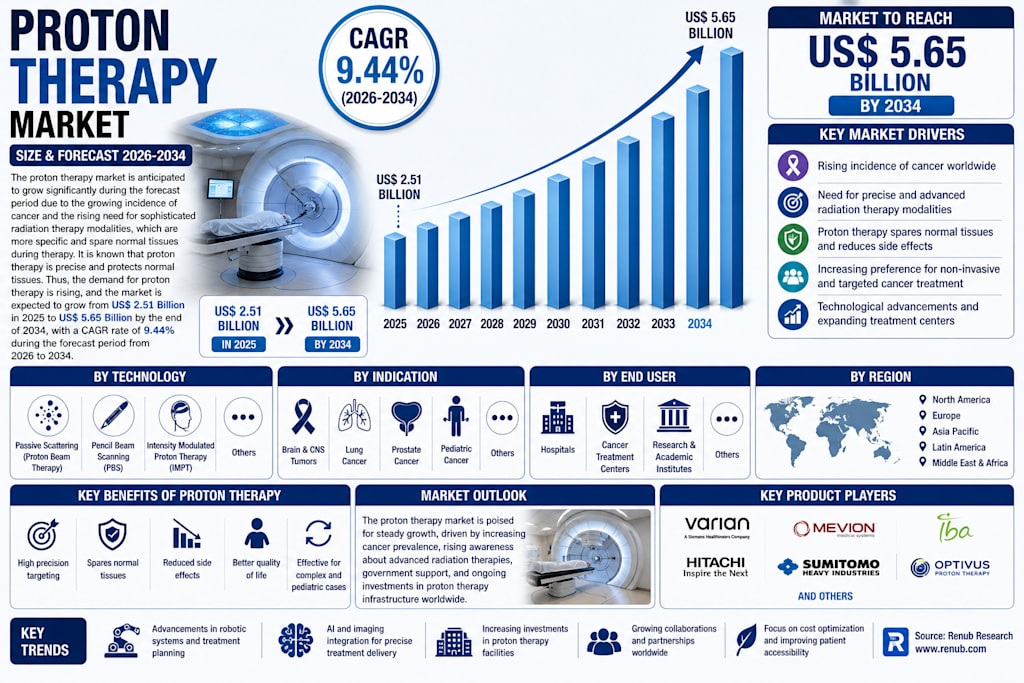
The global proton therapy market is entering a transformative growth phase, driven by the urgent need for safer, more precise cancer treatment solutions. As healthcare systems worldwide grapple with a rising cancer burden, advanced radiation therapies like proton therapy are gaining significant traction. Known for its ability to deliver highly targeted treatment while minimizing damage to surrounding healthy tissues, proton therapy is increasingly being positioned as a cornerstone of modern oncology.
According to Renub Research, the proton therapy market is expected to grow from US$ 2.51 billion in 2025 to US$ 5.65 billion by 2034, reflecting a compound annual growth rate (CAGR) of 9.44% between 2026 and 2034. This growth reflects both technological progress and the increasing global demand for patient-centric cancer therapies.
At its core, proton therapy represents a significant advancement over traditional radiation therapy. Instead of using X-rays, it utilizes high-energy proton beams that deposit most of their energy directly at the tumor site. This unique physical property—often referred to as the Bragg peak—allows clinicians to precisely target cancer cells while sparing surrounding healthy tissues. The result is fewer side effects, improved treatment outcomes, and enhanced quality of life for patients.
Rising Global Cancer Burden Driving Demand
The increasing incidence of cancer worldwide is one of the most powerful drivers of the proton therapy market. Cancers such as brain tumors, prostate cancer, lung cancer, and pediatric cancers are becoming more prevalent, requiring advanced and effective treatment solutions. Traditional radiation therapies, while effective, often expose nearby healthy tissues to radiation, leading to complications and long-term side effects.
Proton therapy addresses this limitation by delivering highly localized radiation. This is particularly beneficial for tumors located near critical organs such as the brain, spinal cord, heart, and eyes. As awareness of these benefits grows, both patients and healthcare providers are increasingly opting for proton therapy as a safer alternative.
Global statistics further emphasize the urgency of advanced cancer treatments. Millions of new cancer cases are diagnosed annually, and the number is expected to rise significantly in the coming decades. With an aging population and lifestyle-related risk factors contributing to cancer prevalence, the need for innovative treatment modalities like proton therapy will continue to grow.
Technological Advancements Enhancing Accessibility
Technological innovation is playing a crucial role in expanding the adoption of proton therapy. Early proton therapy systems were large, complex, and extremely expensive, limiting their availability to a handful of specialized centers. However, recent advancements are changing this landscape.
Compact proton therapy systems, pencil beam scanning technology, and improved imaging integration have significantly enhanced treatment precision while reducing infrastructure requirements. These innovations are making proton therapy more accessible to mid-sized hospitals and cancer centers.
In addition, advancements in treatment planning software and real-time imaging are improving accuracy and patient outcomes. Automation is also helping reduce treatment times and operational complexity, making proton therapy more efficient and cost-effective.
A notable development occurred in June 2025, when Ion Beam Applications (IBA) launched the Proton Therapy Academy in collaboration with leading institutions. This initiative aims to provide global training and education, addressing the skill gap and supporting wider adoption of proton therapy technologies.
Growing Importance in Pediatric and Precision Oncology
One of the most significant applications of proton therapy is in pediatric oncology. Children are particularly sensitive to radiation, and minimizing exposure to healthy tissues is critical for preventing long-term complications. Proton therapy’s precision makes it an ideal choice for treating pediatric cancers, helping preserve normal growth and development.
The therapy is also gaining importance in precision oncology, where treatments are tailored to individual patient needs. Proton therapy’s ability to deliver customized radiation doses aligns well with the goals of personalized medicine.
Healthcare providers are increasingly recognizing the value of proton therapy in improving patient outcomes and quality of life. This has led to growing investment in proton therapy facilities and research, particularly in developed healthcare markets.
Challenges Hindering Market Expansion
Despite its advantages, the proton therapy market faces significant challenges. The most prominent barrier is the high cost associated with establishing and operating proton therapy centers. Building a facility requires substantial investment in specialized equipment, infrastructure, and radiation shielding.
Operational costs are also high, including maintenance, staff training, and technology upgrades. These expenses limit the adoption of proton therapy to large hospitals and advanced cancer centers, particularly in developed regions.
Another challenge is limited accessibility. There are relatively few proton therapy centers worldwide, making it difficult for patients in many regions to access treatment. Long waiting times and travel requirements can further complicate patient care.
Additionally, while proton therapy has demonstrated clear benefits for certain cancers, ongoing research is needed to establish its superiority over advanced photon therapies in all indications. Expanding clinical evidence will be essential for broader acceptance and reimbursement support.
Expanding Applications Across Cancer Types
The proton therapy market is witnessing growth across multiple cancer indications, each benefiting from the therapy’s precision and safety profile.
Head and Neck Cancer
Tumors in the head and neck region are particularly challenging due to their proximity to critical structures. Proton therapy allows precise targeting, reducing side effects such as difficulty swallowing and dry mouth. This improves patient comfort and quality of life.
Prostate Cancer
Proton therapy is increasingly used for prostate cancer, offering targeted treatment that minimizes exposure to surrounding organs like the bladder and rectum. This reduces complications and enhances treatment outcomes.
Lung Cancer
For lung cancer patients, proton therapy provides precise radiation delivery while protecting healthy lung tissue. This is especially important for patients with compromised lung function or those requiring re-treatment.
Pediatric Cancer
Proton therapy is widely recognized as one of the best options for treating pediatric cancers due to its ability to minimize radiation exposure and long-term side effects.
Single-Room Systems
The rise of single-room proton therapy systems is making the technology more accessible. These systems require less space and lower investment compared to multi-room setups, enabling more healthcare providers to adopt proton therapy.
Regional Insights Reflect Global Expansion
The United States leads the global proton therapy market, supported by advanced healthcare infrastructure, strong investment in oncology, and a high number of operational proton therapy centers. Continuous research and clinical trials are expanding treatment applications and driving innovation.
The United Kingdom is also making progress, with government-backed initiatives to establish proton therapy centers and improve patient access. The National Health Service plays a key role in supporting advanced cancer treatments.
India is emerging as a promising market, driven by rising cancer incidence, increasing healthcare investment, and growing awareness of advanced treatment options. While high costs currently limit widespread adoption, ongoing infrastructure development is expected to improve accessibility over time.
Saudi Arabia is developing its proton therapy capabilities as part of its healthcare modernization strategy. Government initiatives and international collaborations are supporting the establishment of advanced cancer treatment facilities, positioning the country as a growing market in the Middle East.
Competitive Landscape and Key Players
The proton therapy market is highly specialized, with a limited number of companies dominating the space. Key players include IBA, Varian Medical Systems, Hitachi Ltd., Mevion Medical Systems, and Mitsubishi Electric Corporation.
These companies are focusing on innovation, strategic partnerships, and global expansion to strengthen their market positions. Investments in research and development are driving the introduction of more compact, efficient, and cost-effective proton therapy systems.
Collaborations between healthcare providers, research institutions, and technology companies are also playing a crucial role in advancing proton therapy and expanding its global reach.
Final Thoughts
The proton therapy market is poised for strong growth as the global healthcare industry shifts toward precision oncology and patient-centered care. With its ability to deliver highly targeted treatment while minimizing side effects, proton therapy represents a significant advancement in cancer treatment.
Renub Research’s projection of US$ 5.65 billion by 2034 underscores the growing importance of this technology in modern oncology. As technological advancements continue to reduce costs and improve accessibility, proton therapy is expected to become more widely available across healthcare systems worldwide.
About the Creator
Enjoyed the story? Support the Creator.
Subscribe for free to receive all their stories in your feed.
Comments
There are no comments for this story
Be the first to respond and start the conversation.