
Paul Dirac: The Genius Who Spoke One Word an Hour
The extraordinarily quiet physicist whose equation predicted antimatter
Introduction
Some brilliant scientists dominate a room through their personality, conversation and confidence. Paul Dirac achieved the opposite because he could enter a room, remain almost completely silent, and still become its most remarkable person.
Dirac disliked unnecessary conversation and rarely used several words when one would provide a complete answer. His colleagues at Cambridge University eventually invented a humorous unit for measuring conversation. One “dirac” meant one spoken word per hour.
The story is sometimes exaggerated into one word per day, although the original Cambridge joke referred to an hour. Even that version captures the extraordinary contrast between Dirac’s public silence and the activity occurring inside his mind.
While other people struggled to make conversation with him, Dirac was developing some of the most beautiful ideas in modern physics. His work united quantum mechanics with Einstein’s special relativity, explained the behaviour of the electron and predicted the existence of antimatter before anybody had observed it.
An Unusually Quiet Childhood
Paul Adrien Maurice Dirac was born in Bristol during 1902. His father, Charles Dirac, was a strict Swiss-born teacher who insisted that Paul speak French with him during meals.
Dirac later indicated that these uncomfortable exchanges contributed to his habit of remaining silent. If he could not express himself correctly in French, saying nothing was often the safest choice.
His early education concentrated upon engineering, mathematics and technical drawing. Dirac studied electrical engineering at the University of Bristol before moving towards mathematical physics.
This engineering background influenced his later thinking. He preferred scientific descriptions that were economical, precise and beautifully constructed. A theory should contain everything required, but nothing unnecessary.
His conversation eventually followed the same principle.
One Word Per Hour
Dirac’s silence became legendary among his fellow physicists. Colleagues joked that the smallest practical unit of conversation was one “dirac”, meaning one word spoken during an hour.
He was not incapable of speaking, and he could lecture clearly about physics. However, casual conversation, social pleasantries and vague questions seemed pointless to him.
When somebody made a statement rather than asking a direct question, Dirac might remain silent because he saw no reason to respond. When asked whether he preferred tea or coffee, he was likely to choose one without explaining his preference.
One story concerns the physicist Niels Bohr, who was struggling to complete a sentence in a scientific paper. Bohr complained that he did not know how to finish it.
Dirac reportedly replied that he had been taught never to begin a sentence without knowing how it would end. The remark was concise, logical and unmistakably Dirac.
The Birth of Quantum Mechanics
Physics changed dramatically during the 1920s. Classical physics could describe planets, machines and electrical circuits, but it failed to explain the strange behaviour of atoms.
Werner Heisenberg developed a theory based upon mathematical tables called matrices. Erwin Schrödinger created a different approach based upon waves.
These theories appeared different, although both described quantum behaviour successfully. Dirac recognised their underlying connection and developed a more general framework that brought them together.
His work helped establish transformation theory, which demonstrated how different versions of quantum mechanics could represent the same physical reality. This was a major step towards creating a consistent language for the new science.
Dirac also introduced a concise notation for describing quantum states. Physicists still use his system throughout quantum mechanics, quantum computing and particle physics.
The Problem With Schrödinger’s Theory
Schrödinger’s wave equation successfully describes many quantum systems moving at speeds much lower than the speed of light. However, its original form was not compatible with Einstein’s special theory of relativity.
Dirac wanted a theory that treated quantum mechanics and relativity consistently. He also wanted it to preserve the normal quantum interpretation of probabilities.
This was an extremely difficult challenge because the existing theories had been constructed in very different ways. Dirac searched for a mathematical structure that would satisfy the requirements of both.
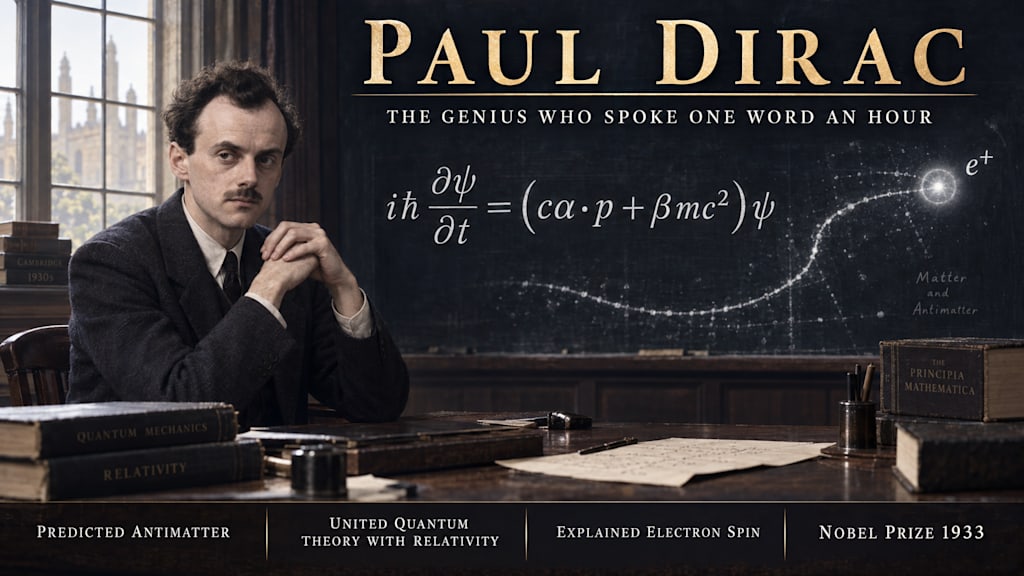
His eventual solution became known as the Dirac equation. It described the electron while respecting Einstein’s rules for objects moving at very high speeds.
The equation was not created by adjusting known results until they fitted the available evidence. Its mathematical structure produced several important properties of the electron automatically.
The Electron’s Spin
Scientists already knew that the electron possessed an unusual property called spin. The name suggests a tiny rotating ball, although that picture should not be taken literally.
Spin is an intrinsic quantum property that affects how a particle behaves inside a magnetic field. Earlier theories had to introduce electron spin separately or describe it using additional assumptions.
Dirac’s theory produced the correct spin naturally. It also predicted the electron’s magnetic behaviour with remarkable accuracy.
This was an important indication that his theory contained something physically real. Dirac had not merely reorganised existing observations because his work explained properties that previously seemed disconnected.
However, the same theory produced another result that initially appeared impossible.
The Problem of Negative Energy
Dirac’s theory allowed electrons to possess ordinary positive energies, but it also produced solutions involving negative energies. These additional solutions appeared physically meaningless.
An ordinary electron might be expected to lose energy and fall into increasingly negative states. If that happened, stable matter could not exist in its familiar form.
Many scientists might have rejected the unwanted answers as a mathematical mistake. Dirac believed that a beautiful and consistent theory should be taken seriously, even when its consequences appeared strange.
He eventually proposed that the negative-energy solutions indicated the existence of a new particle. This particle would possess the same mass as an electron but carry the opposite electrical charge.
Nobody had observed such a particle when Dirac proposed it. His mathematical reasoning was predicting something entirely new within nature.
The Discovery of Antimatter
During 1932, American physicist Carl Anderson studied the tracks created by cosmic rays inside a cloud chamber. Charged particles travelling through the chamber left visible trails that curved inside a magnetic field.
Anderson observed a track produced by something with approximately the electron’s mass but the opposite electrical charge. The new particle became known as the positron.
Dirac’s extraordinary prediction had been confirmed. Antimatter was no longer an unwanted consequence of an unusual theory because it had become an experimentally observed part of the universe.
Scientists now understand that every fundamental particle has an associated antiparticle. Matter and antimatter can annihilate when they meet, converting their mass into other forms of energy.
Dirac had revealed an entirely new side of nature through mathematical reasoning.
The Nobel Prize
Paul Dirac and Erwin Schrödinger shared the 1933 Nobel Prize in Physics for developing new and productive forms of atomic theory. Dirac was only thirty-one years old when he received the award.
He reportedly considered refusing the prize because he disliked publicity. Ernest Rutherford advised him that refusing would probably attract even more attention than accepting it.
Dirac attended the ceremony and received the award. His reluctance was entirely consistent with a man who preferred quiet thought to public celebration.
The Nobel Prize recognised work that had already transformed physics, although Dirac’s influence continued for decades afterwards.
Building Quantum Electrodynamics
Dirac made essential contributions to quantum electrodynamics, which describes how electrically charged particles interact with electromagnetic fields.
He helped establish the idea that electromagnetic fields must themselves be treated quantum mechanically. Light could therefore be understood as consisting of quantum particles called photons.
Dirac also helped explain how particles could be created and destroyed during physical interactions. This became an essential feature of modern quantum field theory.
His work provided part of the foundation later developed by Richard Feynman, Julian Schwinger and Shin’ichirō Tomonaga. Quantum electrodynamics eventually became one of the most accurately tested theories in science.
The Dirac Delta Function
Dirac also introduced a useful mathematical idea now called the Dirac delta function. It represents something concentrated entirely at one position, such as a perfectly localised force, charge or impulse.
The function has an unusual character because its value is treated as zero everywhere except at one exact point. Nevertheless, its total effect remains finite.
Mathematicians later placed the idea upon a more rigorous foundation through the theory of distributions. The Dirac delta function is now used throughout physics, engineering, signal processing and control theory.
Many engineers encounter Dirac’s influence without realising that the same quiet physicist also predicted antimatter.
Magnetic Monopoles
Dirac investigated whether an isolated magnetic pole might exist. Ordinary magnets always possess both north and south poles, even after they are repeatedly divided.
A magnetic monopole would possess only one magnetic pole. No such particle has yet been conclusively detected.
Dirac demonstrated that the existence of only one magnetic monopole anywhere in the universe could help explain why electrical charge occurs in fixed units.
This work created a profound connection between electromagnetism, quantum mechanics and the mathematical structure of charge. The possible existence of magnetic monopoles remains an important subject within modern physics.
Mathematical Beauty
Dirac believed that fundamental physical laws should possess mathematical beauty. He sometimes trusted an elegant theory more than an untidy interpretation based upon limited experimental evidence.
This approach could be dangerous for a less disciplined scientist, but it produced extraordinary results in Dirac’s hands. His prediction of antimatter remains one of the greatest examples of mathematics revealing something about nature before experiments found it.
His textbook, The Principles of Quantum Mechanics, became one of the most influential scientific works of the twentieth century. Its writing reflected Dirac’s personality because every sentence was controlled, economical and carefully placed.
Dirac did not decorate his ideas with unnecessary explanations. He expected the structure of the argument to carry its own authority.
The Quietest Revolutionary
Dirac’s silence sometimes made him appear cold or detached, although people who knew him described a more complicated personality. He could display humour, loyalty and kindness, but he rarely expressed himself conventionally.
His reputation for saying one word per hour should not reduce him to an amusing scientific character. The silence was memorable, but the work completed within that silence was revolutionary.
Dirac helped construct quantum mechanics, united it with special relativity, explained electron spin and predicted antimatter. He also advanced quantum field theory and introduced mathematical tools that remain indispensable.
Few scientists have changed so many areas while saying so little about themselves.
Conclusion
Paul Dirac demonstrated that brilliance does not always announce itself loudly. His colleagues measured his conversation in single words, while his ideas changed our understanding of matter and the universe.
The famous “dirac” represented one word per hour, although an hour of Dirac’s silence might contain ideas that other scientists would spend years attempting to understand.
His theory predicted antimatter before experiments discovered it, and his scientific language continues to shape quantum physics today.
Dirac may have spoken less than almost any other famous scientist, but very few people have ever said more through their work.
About the Creator
Alan Spencer
Have been an author and writer for over 20 years. Have been a journalist, editor, proofreader, and a designer and presenter of training courses. Have written over 100 articles, two books, and around 20 training courses.
Enjoyed the story? Support the Creator.
Subscribe for free to receive all their stories in your feed. You could also become a paid subscriber, letting them know you appreciate their work.
Comments
There are no comments for this story
Be the first to respond and start the conversation.