
On Mars, the Curiosity rover discovers the components of life.
Uncommon compounds discovered on Mars

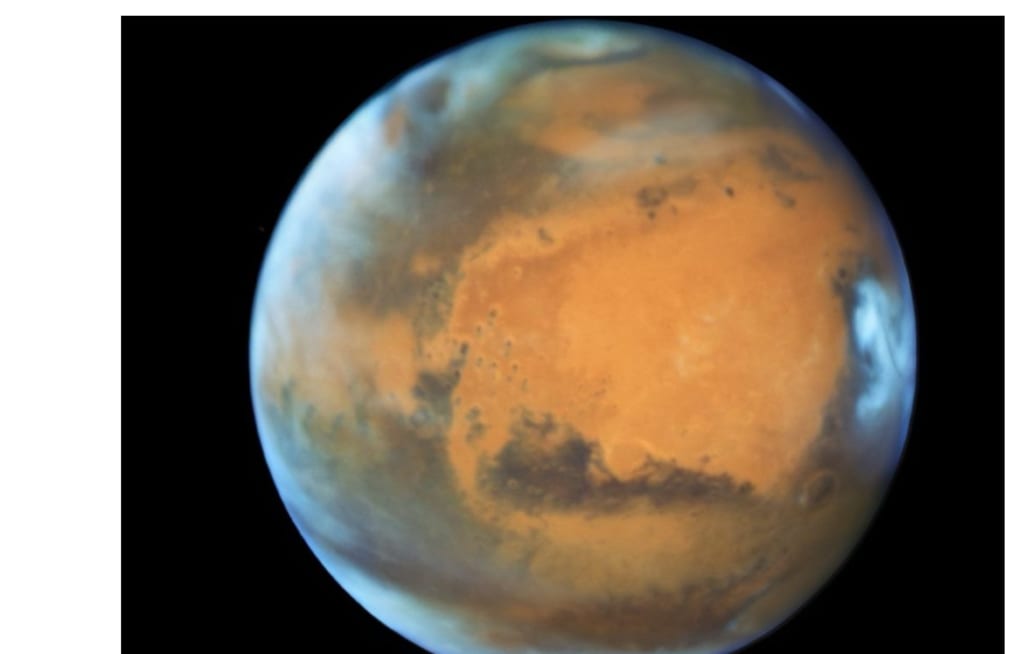
Mars has always appeared to be a harsh, dead planet. Radiation strikes the surface with no defence, and dust storms rush across it. That image is now beginning to change. On Mars, researchers have discovered seven new carbon-based chemical compounds.
Although there is still no confirmation that life ever existed on the planet, the discovery adds to the mounting body of evidence suggesting it previously had the ideal conditions for life.
Mars rock retains biological traces
In 2020, Curiosity began by drilling a rock. The lower slopes of Mount Sharp, which formerly had lakes and streams, are where the sample, known as Mary Anning 3, originated. Over time, water came and went, changing the terrain. Layers rich in clay were left behind by the cycle.
Clay possesses a unique talent. Even in challenging circumstances, it can capture and shield organic molecules. That's important on Mars. For billions of years, the planet's surface has been exposed to radiation, which tends to disintegrate complex molecules. Nevertheless, 21 distinct carbon-containing compounds were found in this single rock on Mars. Seven of these had never been found on Mars previously.
Uncommon compounds discovered on Mars
Among the new molecules, one stood out. We refer to it as a nitrogen heterocycle. A ring of carbon atoms with nitrogen mixed in is part of this structure. Similar structures are involved in the synthesis of DNA and RNA, the molecules that carry genetic information, on Earth.
According to Amy Williams, the primary author of the study from the University of Florida, "that detection is pretty profound because these structures can be chemical precursors to more complex nitrogen-bearing molecules." "Nitrogen heterocycles have never been verified in Martian meteorites or discovered on the Martian surface before."
Benzothiophene, another chemical, also attracted notice. It has been discovered in meteorites and contains both sulphur and carbon. These kinds of meteorites may have contributed to the dispersal of early chemistry's components throughout the solar system, according to some experts.
Curiosity has its own laboratory.
Curiosity is more than a rover. It contains a small laboratory called Sample Analysis at Mars, or SAM. Rock samples can be heated in this method, and the gases they emit can be studied. The rock is drilled into, ground into a powder, then fed into SAM by the rover. The material is heated inside by an oven.
The sample releases gases as it warms. The molecules contained in the gases are then identified by instruments. Wet chemistry is a more complicated test that SAM can do. In this instance, a liquid solution is combined with the sample. Tetramethylammonium hydroxide (TMAH), a potent chemical, was used in this investigation.
It aids in the disintegration of bigger molecules into smaller, more detectable fragments. The first sample analysed in this manner on Mars was the Mary Anning 3 sample.
A comparison between meteorites and Mars
Researchers used the same procedure on a well-known meteorite discovered on Earth to ensure the results made sense. This meteorite, known as Murchison, is rich in organic compounds and is more than 4 billion years old. Benzothiophene and other compounds comparable to those found in the Martian sample were released by the meteorite when it was treated with TMAH.
That outcome implies something significant. It's possible that even bigger, more complicated substances broke down to produce the chemicals found on Mars. Put differently, it's possible that Mars contains deeper chemical layers that scientists haven't yet fully discovered.
Why this is important for Martian life
The finding does not establish the existence of life on Mars. On that point, scientists are unambiguous. Both biological and non-biological activities can result in the formation of these molecules.
However, the results support the hypothesis that the chemistry of ancient Mars was correct. There was water. There were organic molecules. Despite being exposed to radiation, some of them endured for billions of years.
"This is our team and Curiosity at its finest. Ashwin Vasavada of NASA's Jet Propulsion Laboratory stated, "It took dozens of scientists and engineers to find this site, drill the sample, and make these discoveries with our awesome robot." "This collection of organic molecules once again increases the prospect that Mars offered a home for life in the ancient past," he continued.
Getting ready for the upcoming Mars testing
It is difficult to obtain this type of data from Mars. Complete lab systems had to be reduced in size by engineers in order to fit inside a rover. Additionally, they had to construct it to handle complex chemistry while using a limited amount of electricity.
Charles Malespin of NASA's Goddard Space Flight Center remarked, "Just figuring out how to conduct this kind of chemistry for the first time on Mars was an accomplishment." "But now that we've had some experience, we're ready to conduct similar experiments on upcoming missions."
The next phase has already begun. The European Space Agency's Rosalind Franklin rover will carry a next-generation SAM. NASA's Dragonfly mission will send another comparable device to Titan, the moon of Saturn.
About the Creator
Enjoyed the story? Support the Creator.
Subscribe for free to receive all their stories in your feed.
Comments
There are no comments for this story
Be the first to respond and start the conversation.