
On its 36th anniversary, Hubble records the Trifid Nebula's growing star birth.
Decades later, revisiting a nebula

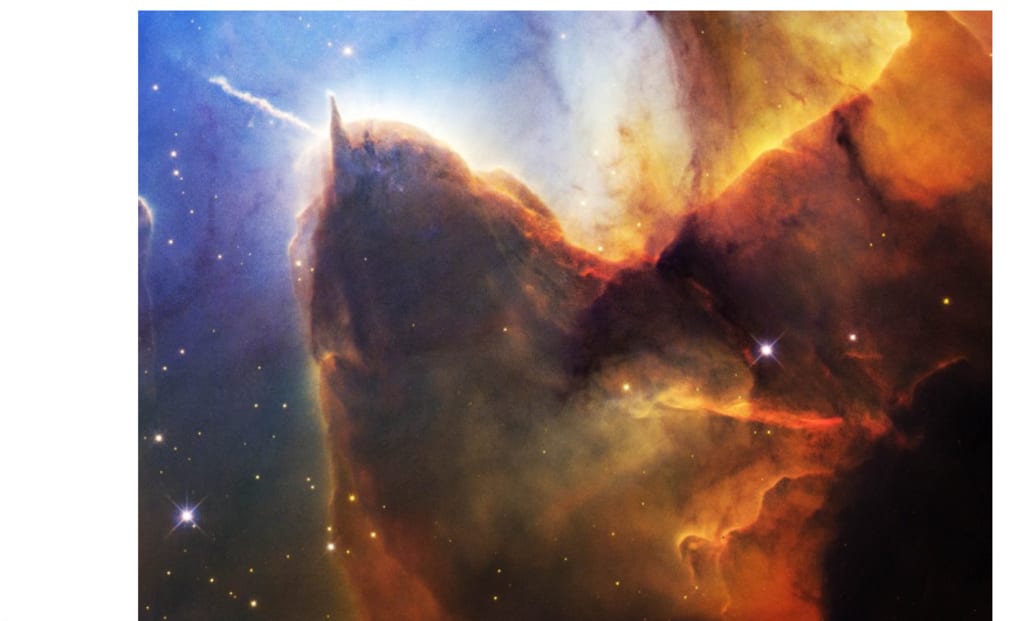
The Trifid Nebula, a star-forming region roughly 5,000 light-years from Earth, was recently photographed up close by Hubble. The view seems to be moving, as though the gas and dust are changing in front of your eyes.
The picture commemorates Hubble's 36th year in space, which was accomplished on April 24. It displays gas and dust clouds that have been sculpted for at least 300,000 years by powerful stellar winds.
Massive bubbles are created and materials are packed together as the winds push and sculpt across space. New stars are created as a result of that pressure. Although it may appear quiet at first, a lot is happening.
Decades later, revisiting a nebula
This similar area was first captured on camera by Hubble in 1997. It has reappeared with sharper instruments and a broader perspective nearly thirty years later. This time, the telescope's improved camera detects minute alterations that were previously invisible.
Today, scientists monitor the movement of gas flows and jets throughout the nebula. This is significant because it reveals how young stars develop and engage with their environment. Observing the same location over time transforms a still image into something more narrative.
A cloud that looks like a sea slug
This new image centers on an odd, curving cloud that looks like a sea snail. It was dubbed the "Cosmic Sea Lemon" by scientists. The cloud is composed of dense dust and gas, with a long, wavy body and a spherical head. A nascent protostar emits plasma jets from inside that structure.
On the left side of the cloud, one of these jets extends from what appears to be a horn. For millennia, it has been exploding in spurts. Jagged streaks are left behind by a matching counterjet on the other side.
monitoring the star's activities over time. Near the cloud's right side is another young star. It is more difficult to spot, however it can be identified by a small jet and a faint red dot.
A green arc surrounding it suggests that the surrounding disc is gradually being stripped away by powerful radiation from neighbouring stars. This activity indicates that the star's creation is almost complete.
Indications of covert activities
Not all of the action is seen. A crisp, angled streak moves between observations close to the image's center. That movement most likely originates from a different jet that was fired by a star that is still covered in dust.
A slender pillar of gas and dust stands its ground off to the left. Its densest core is still there, but a large portion of its material has already been blown away. These areas of resistance frequently indicate potential sites for the formation of new stars.
The far-right corner has the darkest region. Most of the visible light is blocked there by dense dust. There are several stars that show up in front of this area, but they might not even be part of the nebula. They might just be closer to Earth, coincidentally lining up.
A vibrant but austere setting
The image's colours show how the area is shaped by radiation from large stars. Where intense UV radiation has removed electrons from gas, blue tones predominate near the upper left. This procedure removes surrounding dust and produces a luminous look.
In other places, where radiation strikes denser material, yellow streams rise. This continuous exposure gradually disintegrates gas clouds. A large portion of the nebula will eventually be erased by this gradual process. A cluster of fully formed stars will be all that's left.
Stars that have already cleared their environs are indicated by bright orange dots strewn around the picture. In an area that is still being built, they stand out as completed goods.
A telescope that consistently produces
This kind of comparison is made possible by Hubble's lengthy existence. It has gathered over 1.7 million observations over the course of 36 years. Over 23,000 scientific publications have been produced by nearly 29,000 astronomers using Hubble data. Nearly 1,100 studies used Hubble's data in 2025 alone.
The purview of the telescope extends beyond visible light. In order to give scientists a more comprehensive understanding of space, Hubble also investigates ultraviolet and near-infrared wavelengths. Details that ground-based telescopes are unable to see are revealed by that range.
Collaborating with the upcoming generation
Hubble is no longer operating independently. Since 2022, astronomers have been combining its data with observations from the James Webb Space Telescope. Webb uses infrared light to examine the universe, revealing features that the Hubble Space Telescope is unable to see.
Large portions of the sky will soon be scanned by the Nancy Grace Roman Space Telescope. Its camera is large enough to take a single picture of the whole Trifid Nebula. Such coverage has the potential to uncover previously undetectable things.
With a bigger mirror and the capacity to investigate other types of light, the planned Habitable Worlds Observatory would go much farther. The goal of the mission is straightforward but ambitious: Look for planets similar to Earth and see if life could exist there.
A shifting perspective on the cosmos
More than just a beautiful scene can be seen in the most recent photograph of the Trifid Nebula. It records time, motion, and energy during work. Radiation transforms everything in its path, gas flows change, and stars expand.
Space is not frozen, as demonstrated by Hubble's return to this area. Change never stops, even over great distances. And it gets a little easier to recognise that shift with every new observation.
About the Creator
Enjoyed the story? Support the Creator.
Subscribe for free to receive all their stories in your feed.
Comments
There are no comments for this story
Be the first to respond and start the conversation.