
No Wi-Fi? No Problem. I Used Light to Transmit Data
A young innovator from rural Pakistan develops a Li-Fi system that transmits data through light — faster and safer than Wi-Fi.

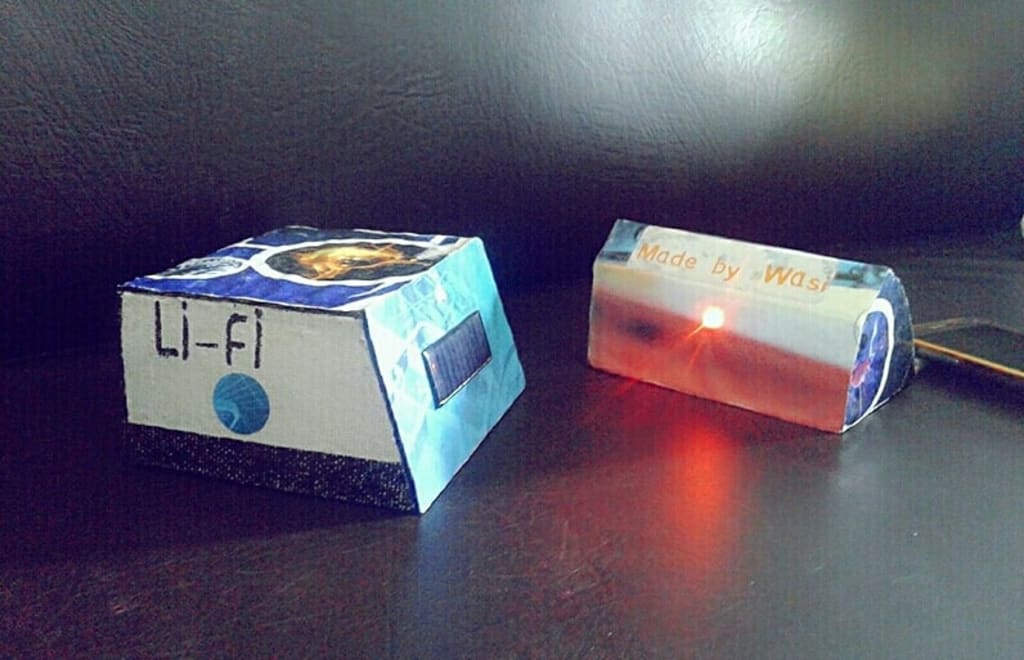
I Brought Internet Through Light — From a Rural Village in Pakistan
In a world chasing 5G and satellite internet, I built something different — not from a lab in Silicon Valley, but from a small village in Swat, Pakistan. No broadband, no fancy routers. Just light.
Yes — light.
Let me tell you how I used Li-Fi technology to send data through an LED bulb — and why that matters more than ever.
From Where I Come: The Struggles of a Tech Dreamer
I live in Malam Jabba — a stunning but underdeveloped part of northern Pakistan. The internet is slow. Resources are limited. Most people here haven’t heard of Li-Fi.
But that’s never stopped me before.
I first built a working prototype of Li-Fi (Light Fidelity) — a technology few knew about in my community. Later, I designed the Smart Shoe for the Blind, which gained international media attention and was presented at national platforms.
These projects taught me something powerful: we don’t have to wait for the future to reach us. We can build it.
With passion, persistence, and a few broken gadgets, I started learning about Li-Fi (Light Fidelity) — a revolutionary wireless communication system that uses light instead of radio waves.
What Is Li-Fi — and Why Should You Care?
Imagine you’re in a room with an LED bulb. Now imagine that bulb not only lights the room, but also provides ultra-fast internet.
That’s the magic of Li-Fi.
It works by rapidly switching the LED light on and off — too fast for the human eye to notice — and transmitting data as these pulses. A simple photodiode (light sensor) on the receiving end picks up the signal and decodes the data.
This isn’t science fiction. It’s real — and I built a working prototype with it.
How I Built a Li-Fi Prototype — with Limited Tools
My setup was simple but clever:
A basic LED bulb as the transmitter
An audio jack and microcontroller to send data signals
A solar panel or photodiode as the receiver
A speaker or computer to output the decoded sound
I connected it all, tested signals, and... it worked.
Light carried data.
Sound came out.
My eyes widened with the realization — I had created internet through illumination.
Why This Matters
In many parts of the world, including mine, Wi-Fi is limited or blocked by walls. It also suffers interference in sensitive places like hospitals or airplanes.
Li-Fi offers something radical:
Speed: It can be over 100 times faster than Wi-Fi.
Security: Light can’t pass through walls — meaning hackers outside can’t snoop in.
Low Health Risks: No electromagnetic radiation like traditional signals.
Dual Purpose: Lights can illuminate and transmit data at the same time.
In rural areas or disaster zones, where wireless internet fails, Li-Fi could be a game-changer.
What I Learned — And What Comes Next
This project wasn't just about technology. It was about possibility. It taught me:
You don’t need perfect tools to build something powerful.
Innovation is not about location — it’s about motivation.
Light — a symbol of knowledge — can literally carry information now.
Next, I want to:
Improve the data range and clarity of my Li-Fi system
Experiment with video transmission
Explore solar-powered receivers for areas with limited electricity
And maybe one day, turn this idea into a full-fledged startup focused on rural connectivity and secure data transfer.
Final Thoughts — Let’s Shine Brighter
If you’re someone building in silence, learning from slow internet and secondhand parts — keep going.
You’re not just chasing technology.
You’re building the future.
One light beam at a time.
Featured Media: Just like my Smart Shoe for the Blind, this Li-Fi innovation also caught the attention of national and international media — proving that even in resource-limited settings, impactful tech solutions can emerge.
About the Creator
Wasi Ullah
Student Innovator | Building Tech for Social Good
Enjoyed the story? Support the Creator.
Subscribe for free to receive all their stories in your feed.
Comments
There are no comments for this story
Be the first to respond and start the conversation.