
NASA SETS ITS SIGHTS ON ARTEMIS III FOLLOWING ASTRONAUTS' HISTORIC MOON FLYBY
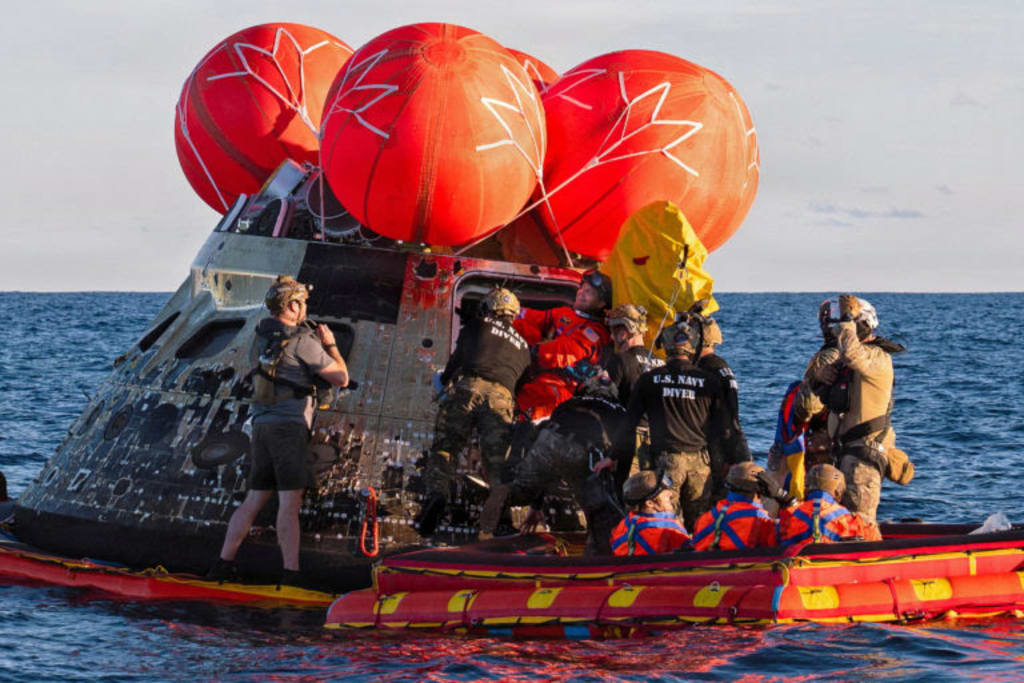
The cheering in Houston has barely died down, and the Artemis II capsule is still dripping wet from the Pacific Ocean. But behind the closed doors of the space agency, the relief is already evaporating. The practice run is over. Now comes the terrifying reality of actually putting boots back in the lunar dust.
For about forty-eight hours, the people who run the American space program allowed themselves to breathe.
They watched the parachutes open. They watched Commander Reid Wiseman, Victor Glover, Christina Koch, and Jeremy Hansen walk out of a scorched capsule and hug their families. They threw a massive, deafening party inside the hangar at Ellington Field to celebrate the fact that they just threw four human beings 250,000 miles into the void and actually got them back alive.
But in the aerospace industry, celebrations have a very short shelf life. Because the moment the Artemis II crew safely hit the water, a massive, invisible clock started ticking down in the halls of NASA.
Artemis II was an incredible, history-making achievement. It was also just a dress rehearsal. The crew flew out there, looked at the Moon, took some spectacular photos, and used gravity to slingshot right back to Earth. They didn't stop. They didn't park. And most importantly, they didn't attempt to land.
That violently dangerous job belongs to Artemis III. And the people in charge know exactly what kind of nightmare they are walking into.
You can hear the heavy, exhausted reality of it when you listen to the upper management at NASA. Amit Kshatriya, the agency's Associate Administrator, didn't sound like a guy who was just riding the high of a victory lap this weekend. He sounded like a man who understands the brutal, unforgiving math of rocket science.
For Kshatriya, the hardest part of this entire endeavor isn't the engineering or the orbital mechanics. It is the deeply uncomfortable human element. You spend years working with these astronauts. You get to know them. You eat dinner with them. You watch their kids grow up. And then, you strap them to the top of a multi-million-pound bomb and blast them into a vacuum that actively wants them dead.
During that terrifying thirteen-minute re-entry on Friday night, when the capsule was wrapped in 5,000-degree plasma and all radio contact was dead, Kshatriya wasn't just watching a telemetry screen. He was standing in the room right next to the spouses and children of the crew. He was watching them hold their breath, waiting to see if they still had a husband, a wife, a father, or a mother.
"You know what's at stake," Kshatriya confided quietly after the mission was over. "It's going to take risk to explore, but you have to make sure you find the right line between being paralyzed by it and being able to manage it."
That single quote is the entire thesis of the Artemis program right now. Finding the line between acceptable risk and total paralysis.
Because Artemis III is going to demand a level of risk that we haven't seen since the height of the Cold War. Going back to the Moon in 2027 isn't going to look anything like the grainy footage of Neil Armstrong and Buzz Aldrin hopping around in the sunlight. Apollo landed on the lunar equator—flat, well-lit, and relatively safe.
Artemis III is targeting the lunar South Pole.
This is a place of absolute extremes. The terrain is jagged and violently carved by billions of years of meteor impacts. The sun sits incredibly low on the horizon, casting shadows that stretch for miles and pitch-black craters where sunlight hasn't touched the bottom in over two billion years. The next crew isn't just going down there to plant a flag and take a golf swing. They are going down into that freezing darkness to look for ancient water ice.
It requires a brand new lunar lander. It requires two spacecraft successfully docking in lunar orbit while traveling thousands of miles an hour. It requires a flawless descent sequence into a rocky, shadowed canyon where a single miscalculation means hitting the side of a mountain.
The people who are going to fly that mission were sitting in the audience on Saturday.
When Commander Reid Wiseman stood on the stage in Houston, finally declaring his own mission complete after holding his two daughters, he didn't talk about his own legacy. He looked straight past the cameras and the politicians. He locked eyes with the rows of active NASA astronauts sitting in their blue flight suits. The men and women who are currently fighting for a seat on that Artemis III lander.
Wiseman pointed right at them. He knows what they are about to face. He knows the sheer terror and the immense physical toll that is waiting for them in the dark.
"It is time to go and be ready," Wiseman yelled to his colleagues, his voice cutting through the hangar. "Because it takes courage. It takes determination, and you all are freaking going. And we are going to be standing there supporting you every single step of the way in every possible way possible."
The victory lap is officially over. The data is being crunched. The hardware for the next rocket is already being welded together. Artemis II proved that the road to the Moon is finally open.
Now, NASA just has to prove they can survive the landing.
About the Creator
Wellova
I am [Wellova], a horror writer who finds fear in silence and shadows. My stories reveal unseen presences, whispers in the dark, and secrets buried deep—reminding readers that fear is never far, sometimes just behind a door left unopened.
Enjoyed the story? Support the Creator.
Subscribe for free to receive all their stories in your feed.
Comments
There are no comments for this story
Be the first to respond and start the conversation.