
NASA's next-generation Mars helicopter blades smash through the sound barrier.
Helicopter testing for Mars

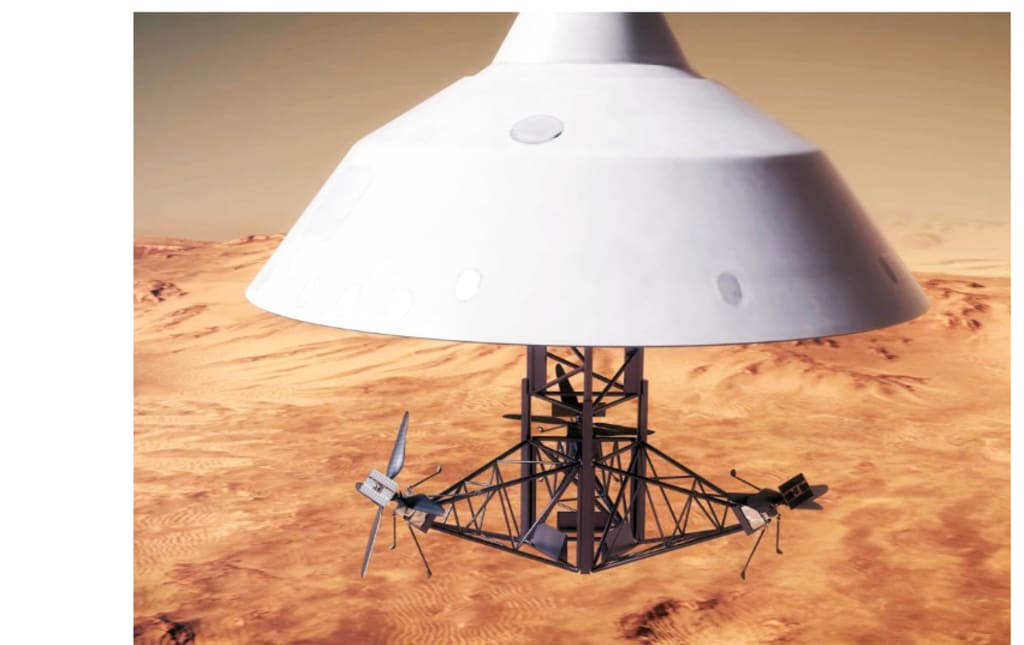
It has long seemed nearly impossible to fly on Mars because, in many respects, it is. Aircraft find it difficult to stay in the air due to the planet's extremely thin atmosphere. Spinning blades that are already working close to their limitations must have every bit of lift extracted from them.
NASA engineers have now pushed those boundaries even farther. Rotor blades intended for future Mars helicopters broke the sound barrier without disintegrating during recent tests in California. That matters because NASA wants future aircraft on Mars to do much more than Ingenuity, the tiny helicopter that made history in 2021.
Though it lacked scientific instruments, ingenuity demonstrated that powered flight might function on a different planet. It is anticipated that the next generation of Mars planes will be equipped with cameras, sensors, batteries, and other devices that could enable robotic explorers and astronauts to examine areas that are difficult for rovers to reach.
Helicopter testing for Mars
At NASA's Jet Propulsion Laboratory in Southern California, the experiments took place within a huge chamber. Engineers used fake Martian winds to spin experimental rotor blades at ever-increasing speeds while simulating the thin, carbon dioxide-rich atmosphere of Mars.
NASA is confident that future helicopters will be able to provide significantly greater lift thanks to the research. "We are asking these next-generation aircraft to do even more at the Red Planet, but NASA had a great run with the Ingenuity Mars Helicopter," stated Al Chen, manager of JPL's Mars Exploration Program.
It's not a simple request. Flying on Mars is the hardest thing you can accomplish, even if everything about the planet is difficult. This is due to Mars's extremely thin atmosphere, which makes it difficult to create lift despite the planet's strong gravity.
Mars's atmosphere is only around 1% as dense as Earth's. Helicopter blades there cannot rely on thick air to create lift. Engineers must make up for this by either enlarging the blades or spinning them extremely quickly.
This leads to an additional issue. Airflow becomes erratic and unpredictable when rotor tips get closer to the speed of sound. Pilots and engineers have been dealing with these effects for decades on Earth, but because sound travels differently on Mars, there are additional challenges.
The speed of sound is approximately 540 mph in the chilly Martian atmosphere, which is significantly slower than the approximately 760 mph at sea level on Earth. NASA engineers maintained the helicopter's rotor speeds below 2,700 revolutions per minute throughout Ingenuity's 72 flights.
In the event that Martian winds unexpectedly forced the rotor tips into supersonic region, they desired a safety buffer. “If Chuck Yeager were here, he’d tell you things can get squirrely around Mach 1,” said JPL’s Jaakko Karras, the rotor test lead.
In order to prevent the rotor tips from going supersonic in the event of a Martian headwind, we designed Ingenuity's flights to maintain the rotor blade tips at Mach 0.7 without any wind. However, we want our next-generation Mars aircraft to perform better. We had to be certain that our rotors could operate at a higher speed without risk.
Helicopter rotors in conditions similar to those on Mars
The experiments were conducted in the historic 25-Foot Space Simulator at JPL, a room designed to replicate harsh space conditions. At pressures comparable to those on Mars, engineers substituted carbon dioxide for the air inside. After that, they installed AeroVironment prototype rotors and began spinning them.
In case the helicopter blades broke during testing, the researchers even coated sections of the container with sheet metal. Fragments floating around at supersonic speed were not what anyone wanted.
Engineers steadily increased the rotors' force over 137 test cycles. Speeds climbed to 3,750 rpm, with blade tips reaching Mach 0.98 before headwinds were added. The group then created increasingly powerful gusts inside the chamber.
The blades of a Mars helicopter reach Mach 1.08
In the end, the helicopter blades attained Mach 1.08. That gave the aircraft about 30 percent more lift capability – enough to support heavier scientific equipment and larger batteries for longer flights. A second rotor design related to NASA's proposed SkyFall mission concept was also tested.
They attained comparable near-supersonic speeds at lower rotational rates because those blades were marginally longer. According to Shannah Withrow-Maser, an aerodynamicist from NASA's Ames Research Center and a part of the test team, "the successful testing of these rotors was a major step toward proving the feasibility of flight in more demanding environments, which is key for next-generation vehicles." "On our most recent runs, we reached Mach 1.08, but we thought we'd be lucky to hit Mach 1.05."
The way we explore Mars is about to alter.
In December 2028, NASA's planned SkyFall mission would transport three cutting-edge Mars helicopters to the Red Planet. Lessons learned from these new rotor testing are already included into the mission design.
Scientists see helicopters as one of the best ways to explore terrain that wheeled rovers struggle to cross. Steep canyon walls, rocky lava fields, deep craters, and cliffs could all suddenly become accessible.
Additionally, aircraft can gather data from locations that no spacecraft have ever visited and scout paths ahead of astronauts or rovers. At first, it was anticipated that Ingenuity would only fly a few times. Rather, it became one of NASA's most successful technology demonstrations and continued to operate for almost three years.
The helicopter demonstrated that it was feasible to fly on Mars. The next generation may be able to do much more than just make quick hops across dusty terrain, according to these recent blade testing.
About the Creator
Enjoyed the story? Support the Creator.
Subscribe for free to receive all their stories in your feed.
Comments
There are no comments for this story
Be the first to respond and start the conversation.