
My Blood Has a Live Feed
A coin sized patch reads my blood every five minutes and tells my body what it feels before I do. This is the cyborg future, already taped to my arm.

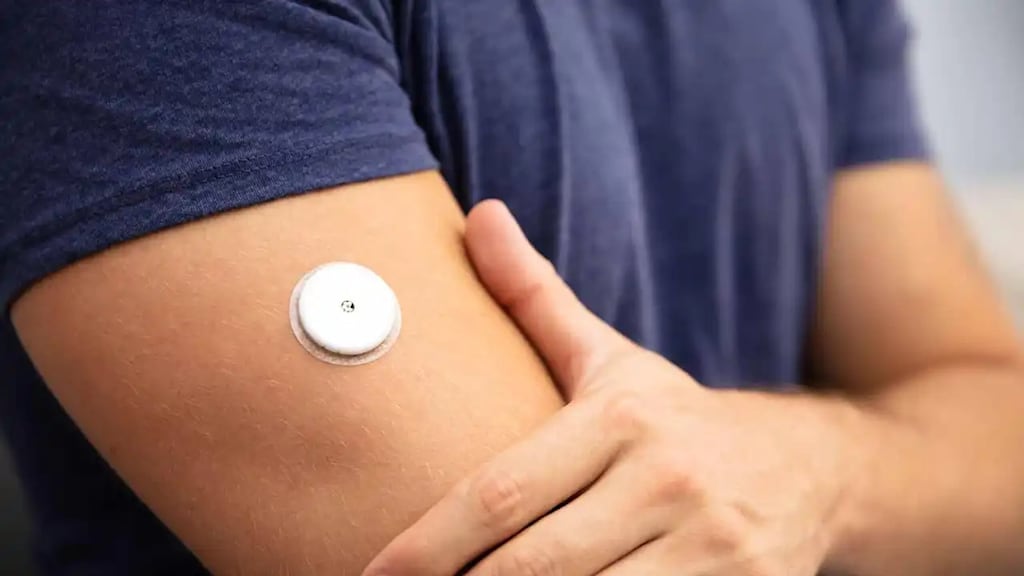
There is a disc, adhesive, the size of a coin, worn on the back of my arm like a small moon in permanent orbit around the body it studies. Beneath its surface a filament thinner than a hair reaches into the fluid between the cells and, every few minutes, samples the sugar dissolved there. I wear one of these on my own arm right now, and the strangeness of it still catches me some mornings. The device speaks continuously to a screen elsewhere in the room. What it reports is a number, and that number carries the private arithmetic of a body's own chemistry, made visible to itself for the first time in the history of the species.
This is the Continuous Glucose Monitor, and it showed up so gently that few people paused to register the strangeness of it. A civilization that spent millennia guessing at the invisible processes beneath its own skin now carries live telemetry from inside the bloodstream, streamed to a pocket, updated every five minutes, forever. Fifty years ago, this belonged to speculative fiction, an implant, a readout, a body rendered legible to a machine. Writers of that era imagined such devices belonging to astronauts, to cyborgs, to soldiers wired into some military apparatus far beyond ordinary life. Instead, the device belongs to the diabetic mother in the grocery aisle, to the marathon runner pacing herself against a curve on a screen, to the office worker curious about what a bagel does to his afternoon focus. Science fiction, it turns out, seldom announces itself with sirens. It shows up on adhesive, priced at retail, sold beside the vitamins.
Consider what the monitor actually does to the architecture of a day. Hunger used to announce itself as a feeling, a low ache, a fog behind the eyes, an irritability a person learned over decades to read as signal. The body spoke in a private dialect, and the mind translated. Now a second voice enters the conversation, and this voice speaks in numbers rather than sensation. A glucose spike appears on the screen minutes before the feeling of hunger would have surfaced on its own, and the human being, trained since infancy to trust the animal report of its own belly, finds itself trusting the glass instead. The math gets there first. The feeling, if it shows up at all, lands second, almost as commentary on a decision already made.
Here is the real shift, and it deserves to be named plainly. Medicine has moved, for the wearer of this device, from something reactive, a visit to a doctor only after symptoms pile up into crisis, into something predictive, continuous, almost oracular. The wearer eats an apple, watches the line rise on the graph, corrects a decision already made, adjusts a future already half written. Illness, in this new arrangement, stops announcing itself through pain. It announces itself through slope, through trend, through a curve bending upward on a chart days before any human sensation would have caught it. The body gains a narrator, and the narrator speaks earlier and more precisely than the self ever could on its own.
And yet, here is where the unease begins to gather. What happens to instinct once a person routes every decision through a screen rather than the old animal wisdom built across some hundred thousand generations? Trust, once placed entirely in sensation, migrates. It drifts toward the algorithm, toward the sensor, toward the company that manufactures the disc and owns the servers where the data ultimately lives. The wearer learns, gradually, to distrust hunger itself as an unreliable narrator, prone to error, subject to mood, temperature, stress, the thousand variables sensation cannot isolate on its own. The glucose number, by contrast, presents itself as clean and mathematical, free of the fog of feeling. Given the choice, who would pick the old, blurred signal over the crisp new one?
This is the moment worth pausing on, because it echoes a scenario imagined a hundred times over in the pulp magazines and paperback futures of a prior century. A human being outsources cognition to a machine, gradually, without any single dramatic surrender, until one day the organic system finds itself demoted to background process, a legacy system running softly beneath the newer, more authoritative one. The monitor never asks permission to become the primary voice. It proves itself right often enough that permission becomes unnecessary.
Consider, too, what this migration does to the very notion of selfhood. The mind used to define itself partly through its felt states, hunger, fatigue, the vague dread before illness, the sudden lift of returning energy. Now those felt states come filtered through, verified by, and occasionally overridden by an external device, and the boundary of the self has moved along with them. It used to sit at the edge of the skin. Now it stretches outward, through a wireless signal, into a cloud server owned by a corporation with shareholders and quarterly earnings calls, a corporation that stores the private chemistry of a stranger's blood the way a library stores books nobody else gets to read. The self, once a sealed and private thing, has effectively become a subscription.
None of this plays out as tragedy, exactly. Neither does it play out as triumph. It unfolds, rather, the way most genuine transformations unfold, sideways, ordinary, disguised as convenience. The diabetic wearer lives longer, avoids the hospital visits that once punctuated a life lived blind to its own chemistry. The athlete times a meal with new precision. A curious layperson discovers, with something close to wonder, that a bowl of white rice moves blood sugar further than a slice of cake ever did, and a lifetime of dietary folklore softly dissolves under the weight of five minutes of real data. These are gains, undeniable ones, earned honestly, and I count myself among the people who have benefited from them.
Still, somewhere beneath the convenience, a species that once negotiated its relationship with hunger through millions of years of felt experience now negotiates that relationship through a firmware update from a company most people could never name. The animal grows fainter. The interface grows louder. Some evening, disc humming faintly on the arm, sending its silent report into the dark, a person might ask whether trading instinct for accuracy counts as a fair trade at all, or whether it counts as something else entirely, the discovery, at last, of what instinct was reaching toward the whole time, a number the body never had the equipment to read on its own.
Somewhere in that question sits the entire history of the future. Every old prophecy about machines and minds merging turns out, in practice, to land smaller than imagined, more mundane than imagined, wrapped in adhesive and sold at the pharmacy counter beside the aspirin. The astronaut never came. The cyborg soldier never came. What came instead was a mother glancing at her wrist in a grocery aisle, adjusting her afternoon by a number that only she and a server farm somewhere will ever see.
About the Creator
Nolan Reed
I write true stories, including unsolved mysteries and events that actually happened.
Enjoyed the story? Support the Creator.
Subscribe for free to receive all their stories in your feed.
Comments
There are no comments for this story
Be the first to respond and start the conversation.