
Music of the Future
Already Here

Music rooms have always been magical places. Students can be transformed into musicians, instrumentalists, actors, creators, conductors, and dancers. They can experience the wonder that is music in its many forms.
As a music educator in my 40th year, I have witnessed many of these transformations, but the transformation I'm addressing with this piece is how the music recording industry has evolved.
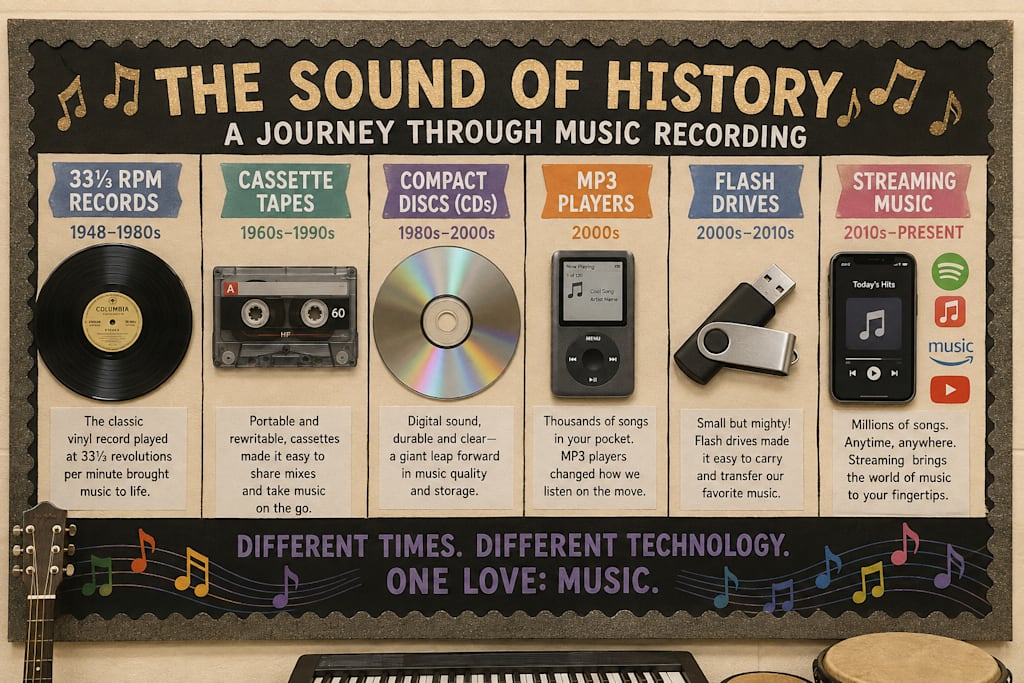
Schools tend to lag with the times because of budgetary restraints, so when I began teaching, I was using records (33s, not 45s - I'm not that old, although I do remember them from when I was a kid.) Most reading here will know that the numbers refer to rotations per minute. Records worked pretty well for music class - mostly. Drop the needle and hope you have the correct track. Oops, nope, try again. You'd get it eventually. Scratches and cracks occasionally caused issues.
The very worst were cassette tapes, which peaked in the 80s. Again, with the lag, I used them into the 90s. Even with a counter – which may or may not have been accurate – it took time to fast forward and rewind. Time for students to get restless. I could hardly blame them for that. I was pretty fed up myself. Also, sometimes, the machine would tangle up the cassette ribbon. Anyone else remember using a pencil (eraser end) to wind it back in place? Ugh!
When CDs came along in the 90s, it really did feel like sci fi technology. CDs offered superior sound quality, easy track selection, and often remote control. I was in heaven. I could instantly play lots of great music. I had a player that held multiple CDS, so I didn't even need to change them out that often. With the remote control, I could lead a game of musical chairs while walking around instead of being glued to the player. Crowd control made easier!
In the late 90s and early 2000s, MP3 players and flash drives were all the rage. I didn't ever have an MP3 player for school, but I did have CDs burned onto a flash drive, thanks to the tech department. I still think CDs were the best.
In 2005, Youtube came out. This was some next-level, amazing, alien-like technology! It was possible for students to not just see a picture of a trumpet and hear a track, but now, they could see and hear it being performed. They could easily be introduced to music and instruments from other cultures. Music teachers started sharing videos which other music teachers could, and still can, utilize.
This is a video of a song I wrote for young students, to be used with egg shakers or maracas.
Any music teacher anywhere in the world can use this video and thousands like it. It was stunning and fabulous... until they monetized it. Now, to watch even a short video, you have to watch ads, usually one and a partial before you can skip, unless you're willing to pay extra, monthly for ad removal. Remember when Vocal paid? I used pieces that I wrote for music class simply because we didn't have to sit through ads.
I wrote this one with a playlist for my fifth graders, who study the states. I would play just pieces of each selection, avoiding a couple of places that are inappropriate.
Either Vocal wouldn't or couldn't(?) continue to pay the rising cost of ad removal. It's like we took two steps forward and three steps back. Truly frustrating. I wish everything would have stopped when it was free.
These advances in technology have definitely changed how I teach, most for the betterment of students. It makes it easier to find meaningful lessons to share and options that will spotlight the elements of music that I'm trying to convey.
Now, creativity is currently going in a direction I'm not sure I'm ready to stomach. Of course, I'm referring to AI. Anyone who gets the right App or software can "create" a song just with a prompt and a few questions answered. It's not all bad I suppose. There are people who at least write their own lyrics, and there are some who write melodies and/or chords and use AI to give them the instrumentation they would otherwise be unable to access. That has value.
I don't know if I'll use AI for teaching yet, but it's a distinct possibility. Imagine students being the ones giving an AI prompt with a few words of lyrics they wrote, choosing a genre, and discovering an easy way to make music feel more personal. Maybe. What matters is what administration will allow.
While I know AI is here to stay and will, perhaps, find a meaningful role, I worry that true composers will not be able to earn a living because of it. I can't imagine the world without the likes of my hero, John Williams. He never even used music writing software. He wrote EVERY note BY HAND – 124 movies of music, plus other works! Is AI quietly shutting out original creativity? Time will tell.
I'm proud to say that music has been a huge part of my life. I've enjoyed this crazy ride. I have no idea what is in store for the world of music recording next, but it's sure to be exciting for the next musicians, instrumentalists, actors, creators, conductors, and dancers.
*
Thanks for reading!
About the Creator
Julie Lacksonen
I'm a soon-to-be retired music educator. This is my 40th and final year at the same school. I enjoy writing, reading, walking, swimming, and spending time with family.
Enjoyed the story? Support the Creator.
Subscribe for free to receive all their stories in your feed.
Comments
There are no comments for this story
Be the first to respond and start the conversation.