
Medicine Is Learning to See Tomorrow
From ambient AI and digital twins to tooth regeneration and gene editing, the future of healthcare is arriving beneath the surface

The doctor used to be the person in the room who knew the most about your body.
That arrangement is changing.
The change can be hard to see because much of it has no visible machinery. A microphone sits somewhere in an examination room. Software listens to the conversation and prepares the medical note. A watch records a heartbeat during the day and sends its rhythm elsewhere. Blood tests, scans, genetic information and years of medical records can be fed into computer models that attempt to describe a person as a changing biological system.
Meanwhile, researchers are trying to persuade the body to grow teeth, drugs developed for diabetes and obesity are producing effects across several organs, and artificial intelligence is being used to help scientists design gene-editing experiments.
A generation ago, several of these ideas belonged to speculative fiction. Today they sit inside research papers, clinical trials and medical practices.
The interesting part is the disappearance of the machinery from everyday experience.
Consider the doctor's examination room. For years, the electronic medical record has placed a computer between doctor and patient. The physician asks questions, listens to the answers and then turns toward a screen to record what happened. The arrangement saves information for the health system while taking attention away from the person who came to see the doctor.
Ambient clinical intelligence attempts to reverse that bargain.
The system listens to the consultation, separates the clinically useful information from the conversation and prepares a draft medical record. The physician can then review the document rather than spend the entire appointment constructing it.
Research into ambient documentation has found reductions in documentation burden, with physicians reporting less time spent on clinical notes and greater ability to maintain eye contact during consultations. The technology remains young, and its output requires human review. Errors in transcription, omissions and incorrect interpretations remain possible.
Yet the important change has little to do with typing.
It concerns attention.
A physician who spends fewer minutes entering information can spend more time asking another question, watching a patient's expression or explaining what comes next. The machine takes on one of the least glamorous tasks in medicine: turning a conversation into paperwork.
That may prove more consequential than the spectacular demonstrations associated with artificial intelligence.
The machine does not need to look impressive. It needs to make itself useful enough that the doctor forgets it is there.
The same principle appears in the development of the medical digital twin.
The first generation of personal health technology taught people to count themselves. Steps, calories, resting heart rate, sleep duration and exercise became numbers displayed on watches and phones. The body acquired a dashboard.
The next generation seeks to build a model.
A digital twin combines streams of information to create a computational representation of a person, an organ or a biological process. The concept already exists in narrower forms. Researchers can model organs, disease processes and physiological systems. The more ambitious version would continually absorb information from medical records, laboratory testing, imaging, genetics and wearable devices.
The goal would be more than recording what happened yesterday.
It would be an attempt to estimate what may happen next.
Medicine has always worked with probabilities. A physician knows that a certain collection of symptoms, laboratory results and risk factors can point toward a disease. A digital model could eventually examine thousands of interacting measurements and search for changes that human beings would struggle to detect.
That creates the possibility of medicine becoming increasingly predictive.
A patient might receive a warning because the model sees a deteriorating pattern weeks before the patient experiences the symptoms that would normally bring him into a clinic. A physician could compare possible treatments against a computational model before choosing one for the actual patient.
The science remains far from a complete virtual copy of a human being. A digital twin is currently more useful as a description of where medicine may be heading than as a finished product available to every patient.
Still, the direction matters.
For much of medical history, doctors have worked backward. Something hurts, a test produces an abnormal result, a disease appears, and treatment begins.
The digital twin suggests a different sequence.
Measure. Model. Predict. Intervene.
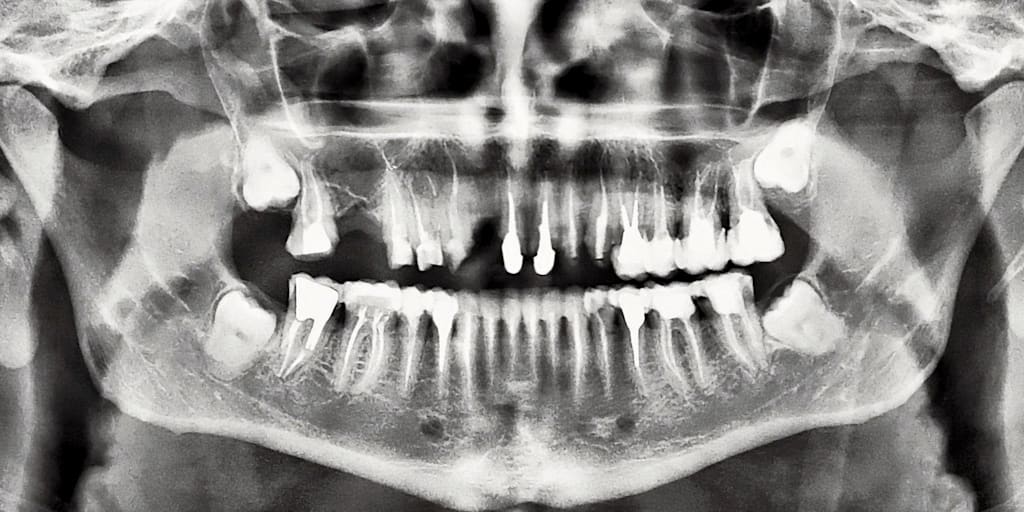
Then comes a technology that sounds almost comically ambitious until the scientific reasoning behind it is understood: growing a new tooth.
Human teeth have limited regenerative capacity. Lose one and modern dentistry supplies an artificial replacement. Researchers in Japan are investigating another possibility.
TRG035 is a monoclonal antibody being studied in connection with tooth regeneration. It targets USAG-1, a protein involved in regulating tooth development. Research in animals suggested that blocking USAG-1 could release a biological process capable of producing new teeth.
The Japanese clinical study moved the idea into human testing, initially concentrating on safety and pharmacological behavior. The research focused on people with congenital absence of teeth, where the biological problem is especially clear.
The distinction between a promising biological mechanism and a proven treatment matters. Animal results do not guarantee human regeneration. A Phase I trial primarily examines safety rather than proving that a missing tooth can reliably be produced in a person's mouth.
Even so, the idea represents a major change in the question medicine is asking.
Dentistry has traditionally approached missing teeth as missing structures.
Molecular regeneration asks whether the body still contains instructions capable of making those structures, and whether a drug can remove the molecular barrier preventing those instructions from being used.
The distinction may eventually extend far beyond teeth.
Medicine has spent much of the last century becoming better at replacing what the body loses. Regenerative medicine asks whether replacement can sometimes give way to restoration.
The same widening of the medical lens can be seen in GLP-1 drugs.
Semaglutide and tirzepatide became household names through diabetes and weight management. Their effects have since attracted intense attention in cardiovascular and kidney disease, with researchers examining what these medicines do throughout the body.
Organ or system: Heart
What the research is examining: Reduction in cardiovascular events in studied patient populations
Organ or system: Kidneys
What the research is examining: Protection against declining kidney function in relevant populations
Organ or system: Metabolism
What the research is examining: Regulation of glucose, appetite and body weight
Organ or system: Inflammatory pathways
What the research is examining: Effects on biological processes associated with inflammation and fibrosis
Organ or system: Brain
What the research is examining: Possible effects involving neuroinflammation and neurological disease
Organ or system: Long-term health
What the research is examining: Whether metabolic improvement can influence several chronic diseases at once
Research reviews increasingly describe GLP-1 signaling as having effects beyond blood sugar and body weight. Cardiovascular and kidney benefits have become significant areas of investigation, while scientists are examining possible mechanisms involving inflammation, fibrosis and other biological pathways.
That does not make these drugs universal anti-aging medicines. Such a claim would run well ahead of the evidence.
What the drugs demonstrate is more interesting.
Human diseases rarely respect the neat categories created by medical specialties.
The heart has a relationship with the kidneys. The kidneys have a relationship with metabolism. Metabolism affects inflammation. Inflammation affects several organs. The brain is part of the same biological system.
A drug that influences one pathway can therefore produce consequences in places far removed from the original reason for prescribing it.
The pharmaceutical industry spent decades dividing diseases into categories. Biology keeps ignoring the filing system.
Then there is CRISPR-GPT, where the invisible machine moves from the clinic into the laboratory.
Gene editing requires a long chain of decisions. Researchers have to select an appropriate CRISPR system, design guide RNAs, consider delivery methods, assess potential off-target effects, plan experiments and analyze the resulting data.
CRISPR-GPT was developed to help with that process.
The system combines large language models with specialized biological knowledge, retrieval systems and external tools. Researchers reported that it could assist with experiment planning, guide-RNA design, delivery selection, protocol preparation and analysis. In laboratory demonstrations, researchers used the system to guide gene-editing experiments involving cancer cell lines.
The achievement is less glamorous than the name suggests.
The machine has not become a scientist in a box.
It has become a research assistant capable of handling pieces of a complicated workflow at extraordinary speed.
That distinction matters because laboratory science is full of small decisions. Each one consumes time. A researcher may spend hours searching literature, comparing methods, checking sequences or deciding which experimental route makes sense.
AI can compress some of that work.
The researchers themselves found limitations. Complex and unusual biological problems could still defeat the system, and human expertise remained essential. The work also included safeguards around biological misuse and genetic privacy.
This may become one of the most important characteristics of medical AI.
Its greatest effect may come through acceleration rather than replacement.
A scientist who once spent several days preparing the intellectual groundwork for an experiment may eventually spend those days asking better questions.
That creates opportunities. It also creates trouble.
The more medicine depends upon data, the more valuable that data becomes.
An ambient system hears the consultation. A digital twin depends upon years of personal health information. A wearable can generate physiological measurements continuously. Genomic data can reveal information about a person's relatives as well as the individual who supplied the sample.
Then comes prediction.
Suppose a computer estimates that someone carries an unusually high risk of developing a serious disease several years from now. Who should receive that information? The patient? The doctor? An insurer? An employer?
A prediction can become a form of classification.
The danger is easy to understand. Medical information has always carried social consequences. Genetic information, continuous physiological monitoring and predictive algorithms could increase those consequences because they may reveal risk before disease becomes visible.
Privacy therefore becomes more than a question of keeping medical records secure.
It becomes a question of who controls the conclusions drawn from those records.
There is another divide.
The technologies arriving first in wealthy hospitals and research centers will reach other parts of the world at different speeds. A sophisticated digital twin requires computing infrastructure and extensive medical data. Advanced gene-editing research requires expensive laboratories. New biologic drugs can carry substantial costs. Even an ambient documentation system requires an electronic health system capable of supporting it.
The history of medicine suggests that invention and access rarely move together.
A technology can work beautifully and still fail as a public-health achievement if millions of people remain unable to use it.
That may be the central argument surrounding this new era of medicine.
The machines are becoming quieter.
They are moving away from the center of the room. They sit behind the doctor. They run inside laboratories. They analyze information collected by devices people already wear. They work inside pharmaceutical research programs. Their presence may eventually become as unremarkable as the electronic medical record.
That is where the science fiction quality comes from.
A patient may sit across from a doctor while software turns the conversation into a medical record. A watch may collect a heartbeat while an algorithm searches for signs of trouble. A computer model may test possible treatments against a representation of the patient. A drug may interfere with a molecular brake and ask dormant tissue to begin growing again. Another program may help a scientist design a gene-editing experiment before the first cell is touched.
The technology becomes less visible as it becomes more deeply embedded.
That may be the real transformation taking place in medicine.
For centuries, doctors learned by looking at the body in front of them. Then medicine learned to look inside it through imaging and laboratory tests. Now it is learning to look ahead.
The doctor still examines the patient.
The difference is that, increasingly, the room contains another observer.
It listens.
It calculates.
It remembers.
And, increasingly, it makes a prediction.
About the Creator
Nolan Reed
I write true stories, including unsolved mysteries and events that actually happened.
Enjoyed the story? Support the Creator.
Subscribe for free to receive all their stories in your feed.
Comments
There are no comments for this story
Be the first to respond and start the conversation.