
Medical Writing Market Set to Surpass USD 12 Billion by 2033 as Clinical Research and Regulatory Demands Accelerate
The Growing Importance of Medical Writing in Modern Healthcare

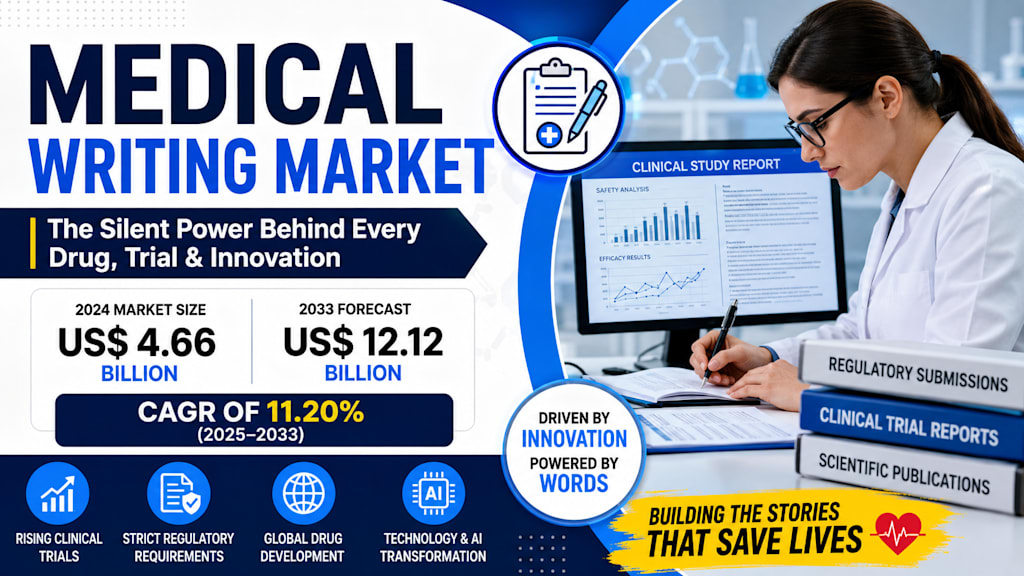
Medical Writing Becomes a Strategic Healthcare Function
The healthcare industry has undergone a remarkable transformation over the past decade. Pharmaceutical companies, biotechnology firms, medical device manufacturers, and contract research organizations are investing heavily in research and development to bring innovative therapies to market. Behind every clinical trial, regulatory submission, scientific publication, and healthcare communication campaign lies a vital but often overlooked function: medical writing.
Medical writing serves as the bridge between complex scientific research and the stakeholders who rely on accurate information. Regulatory agencies, physicians, researchers, patients, and healthcare organizations all depend on well-structured scientific documentation to make informed decisions.
As healthcare innovation accelerates worldwide, the role of professional medical writers has evolved from a support function into a strategic business necessity.
Medical Writing Market Shows Strong Growth Potential
According to Renub Research, the global Medical Writing Market is projected to grow from US$ 4.66 billion in 2024 to US$ 12.12 billion by 2033, expanding at a CAGR of 11.20% during the forecast period of 2025 to 2033.
This impressive growth trajectory reflects increasing demand for high-quality scientific content, regulatory documentation, clinical trial reports, and healthcare communications across global healthcare industries.
The rapid expansion of pharmaceutical and biotechnology sectors continues to generate large volumes of documentation that require specialized expertise. As regulations become more stringent and clinical research becomes increasingly complex, organizations are turning to professional medical writing services to ensure compliance and efficiency.
Why Medical Writing Matters More Than Ever
Medical writing plays a crucial role throughout the healthcare product lifecycle. From early-stage research and clinical development to regulatory approvals and post-market surveillance, accurate documentation is essential.
Medical writers transform complex scientific information into clear, understandable, and compliant documents. These may include:
Clinical study reports
Investigator brochures
Regulatory submissions
Scientific manuscripts
Medical education materials
Patient information leaflets
Healthcare marketing content
Safety reports
Without professional medical writing, organizations risk delays in regulatory approvals, communication errors, and compliance issues that can significantly impact business operations.
Rising Clinical Trials Fuel Market Expansion
One of the strongest drivers behind medical writing market growth is the increasing number of clinical trials conducted worldwide.
Modern healthcare research is becoming increasingly sophisticated, involving large datasets, multinational studies, and complex therapeutic areas. Every clinical trial generates extensive documentation throughout its lifecycle.
From protocol development to final study reports, medical writers contribute at every stage of the process.
The growing prevalence of chronic diseases, cancer, rare diseases, and personalized medicine initiatives has led pharmaceutical companies to invest heavily in clinical research. As a result, demand for professional medical writing services continues to rise.
The need for precise documentation is particularly critical during late-stage clinical trials, where regulatory agencies require comprehensive evidence regarding efficacy, safety, and quality.
Pharmaceutical and Biotechnology Growth Creates Opportunities
The global pharmaceutical and biotechnology industries are experiencing unprecedented growth.
Advancements in genomics, immunotherapy, biologics, cell therapy, and precision medicine are creating new opportunities for innovation. However, these developments also generate complex scientific data that must be documented accurately.
Medical writers serve as essential contributors to this process by ensuring research findings are communicated effectively to regulatory authorities, healthcare professionals, investors, and patients.
As pharmaceutical pipelines expand and biotechnology companies increase their R&D investments, the volume of scientific documentation continues to grow.
This trend creates long-term opportunities for medical writing service providers worldwide.
Regulatory Compliance Remains a Key Market Driver
Healthcare regulations are becoming increasingly stringent across global markets.
Regulatory authorities require detailed documentation demonstrating the safety, efficacy, and quality of healthcare products before granting approval.
Medical writers play an essential role in preparing:
Common Technical Documents (CTDs)
Clinical evaluation reports
Risk management plans
Pharmacovigilance documentation
Regulatory submissions
Failure to meet regulatory requirements can result in costly delays, additional review cycles, or product rejections.
Consequently, healthcare companies are investing heavily in experienced medical writing professionals who understand evolving global regulatory frameworks.
Outsourcing Trends Continue to Reshape the Industry
Outsourcing has become one of the most influential trends in the medical writing market.
Many pharmaceutical and biotechnology organizations now prefer partnering with specialized service providers rather than maintaining large internal writing teams.
This approach offers several advantages:
Cost efficiency
Faster project completion
Access to specialized expertise
Scalability during peak workloads
Improved regulatory compliance
Contract Research Organizations (CROs) have become major beneficiaries of this trend, offering integrated medical writing solutions alongside clinical research services.
As outsourcing adoption increases globally, medical writing service providers are expected to experience sustained demand.
Technology and Artificial Intelligence Transform Medical Writing
Technology is reshaping nearly every aspect of healthcare, and medical writing is no exception.
Artificial intelligence, machine learning, natural language processing, and automation tools are helping writers streamline documentation processes and improve productivity.
AI-powered tools can assist with:
Literature reviews
Data extraction
Document formatting
Quality checks
Content organization
While technology enhances efficiency, human expertise remains indispensable.
Medical writers provide critical thinking, scientific interpretation, regulatory understanding, and communication skills that cannot be fully replicated by automation.
The future of the industry will likely involve collaboration between human experts and intelligent technologies.
Personalized Medicine Creates New Documentation Needs
Personalized medicine is transforming healthcare delivery.
Rather than applying a one-size-fits-all treatment approach, healthcare providers increasingly tailor therapies to individual genetic profiles and patient characteristics.
This shift generates vast amounts of specialized scientific information that must be documented accurately.
Medical writers are increasingly involved in developing educational materials, clinical reports, and regulatory submissions related to personalized therapies.
As precision medicine continues to expand, demand for specialized medical communication expertise is expected to grow significantly.
Regional Insights: United States Leads the Market
The United States remains the largest contributor to the global medical writing market.
The country hosts one of the world's most advanced pharmaceutical and biotechnology ecosystems, supported by substantial R&D investments and a large volume of clinical research activities.
Thousands of ongoing clinical trials generate continuous demand for:
Clinical documentation
Regulatory submissions
Scientific publications
Medical communications
The presence of major pharmaceutical companies, CROs, and research institutions further strengthens market growth across the United States.
India Emerges as a Global Medical Writing Hub
India has rapidly established itself as a major destination for medical writing services.
Several factors contribute to the country's growing importance:
Large English-speaking workforce
Strong scientific education system
Expanding pharmaceutical sector
Cost-effective service delivery
Increasing participation in global clinical trials
Many international healthcare companies now outsource medical writing projects to Indian service providers due to their expertise and competitive pricing.
As India's healthcare ecosystem continues to mature, the country is expected to capture a larger share of the global market.
United Kingdom and UAE Present Emerging Opportunities
The United Kingdom remains an important market due to its established pharmaceutical sector, strong healthcare infrastructure, and growing clinical research activities.
Meanwhile, the United Arab Emirates is emerging as a regional healthcare innovation hub. Investments in healthcare modernization, digital health technologies, and clinical research are creating new opportunities for medical writing professionals across the Middle East.
Both regions are expected to contribute positively to market growth throughout the forecast period.
Challenges Facing the Medical Writing Industry
Despite strong growth prospects, several challenges remain.
Shortage of Skilled Professionals
One of the most significant concerns is the limited availability of experienced medical writers.
Successful medical writers require a unique combination of:
Scientific knowledge
Regulatory expertise
Communication skills
Attention to detail
Finding professionals who possess all these competencies can be difficult.
Maintaining Quality and Consistency
Large projects often involve multiple contributors, increasing the risk of inconsistencies in terminology, formatting, and scientific interpretation.
Organizations must implement robust quality assurance processes to maintain high standards and regulatory compliance.
Top Companies Shaping the Medical Writing Market
Several leading organizations are driving innovation and expansion in the medical writing industry:
Parexel International Corporation
Trilogy Writing & Consulting GmbH
Freyr
Cactus Communications
Labcorp Drug Development
IQVIA Holdings Inc.
Omics International
Synchrogenix
These companies continue to expand their capabilities through technology investments, acquisitions, strategic partnerships, and global expansion initiatives.
10 Recent Developments in the Medical Writing Industry
1. Cactus Communications Expanded Scientific Communication Services
The company strengthened its global scientific communication offerings through strategic acquisitions and technology investments.
2. IQVIA Enhanced Regulatory Writing Solutions
IQVIA expanded integrated regulatory and clinical documentation services for pharmaceutical clients.
3. Parexel Increased AI Adoption
Parexel introduced advanced digital tools to improve medical writing efficiency and compliance.
4. Freyr Expanded Regulatory Expertise
Freyr broadened its regulatory consulting and documentation capabilities across international markets.
5. Labcorp Drug Development Strengthened CRO Services
The company enhanced end-to-end clinical development support, including medical writing solutions.
6. Synchrogenix Expanded Global Operations
The organization increased support for multinational regulatory submissions.
7. Biotechnology Sector Partnerships Increased
Medical writing firms established new collaborations with emerging biotech companies.
8. Digital Publishing Demand Accelerated
Organizations invested in advanced medical communication platforms to support scientific dissemination.
9. AI-Assisted Writing Platforms Gained Adoption
Industry leaders integrated AI-powered technologies to improve workflow efficiency.
10. Asia-Pacific Expansion Continued
Several medical writing providers increased investments across India and other high-growth Asian markets.
Future Outlook
The future of medical writing appears exceptionally promising.
Growing clinical research activity, expanding pharmaceutical pipelines, evolving regulations, and rising healthcare communication needs will continue to create demand for specialized writing services.
Emerging technologies, personalized medicine initiatives, and globalization of drug development are expected to further accelerate market expansion.
Organizations that successfully combine scientific expertise, regulatory knowledge, and technological innovation will be best positioned to capitalize on future opportunities.
Final Thoughts
Medical writing has become an indispensable component of modern healthcare and life sciences. As pharmaceutical innovation accelerates and regulatory expectations continue to evolve, the need for accurate, compliant, and scientifically sound documentation will only increase.
With the global Medical Writing Market expected to reach US$ 12.12 billion by 2033 from US$ 4.66 billion in 2024, the industry is entering a period of sustained growth and transformation. Companies, healthcare organizations, and research institutions that invest in high-quality medical communication capabilities will play a critical role in advancing healthcare innovation and improving patient outcomes worldwide.
About the Creator
Enjoyed the story? Support the Creator.
Subscribe for free to receive all their stories in your feed.
Comments
There are no comments for this story
Be the first to respond and start the conversation.