
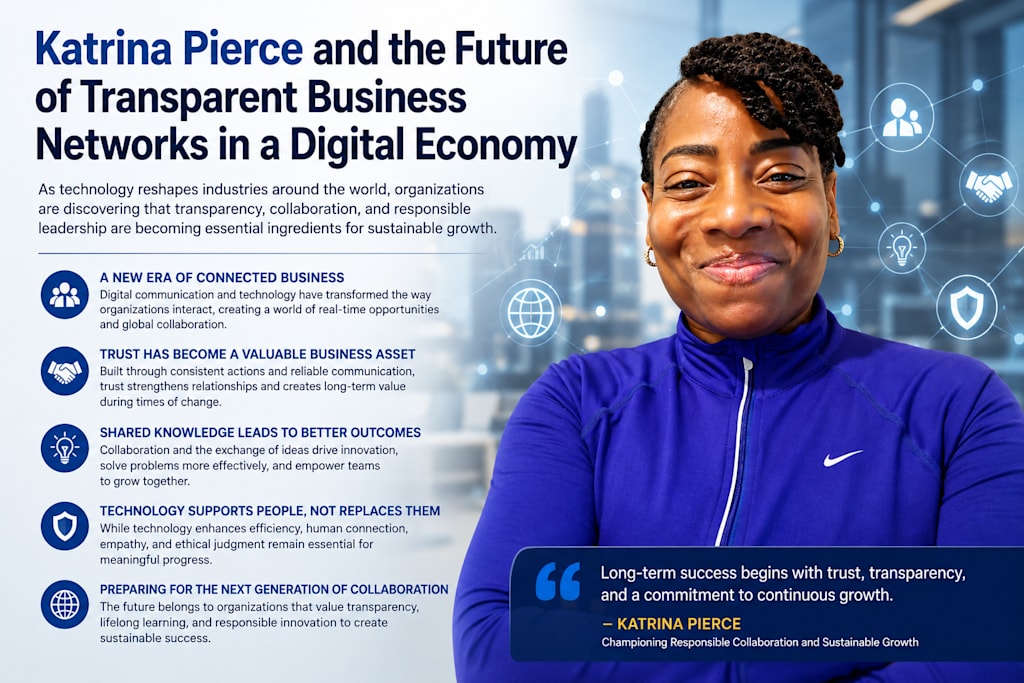
Katrina Pierce and the Future of Transparent Business Networks in a Digital Economy
As technology reshapes industries around the world, organizations are discovering that transparency, collaboration, and responsible leadership are becoming essential ingredients for sustainable growth.

A New Era of Connected Business
Business today operates in a world that is more connected than ever before. Digital communication, online platforms, and advanced technologies have transformed the way organizations interact with customers, suppliers, and professional partners. Geographic distance is no longer the barrier it once was, allowing ideas and opportunities to move across borders in real time.
While technology has accelerated business activity, it has also increased expectations. Organizations are now expected to communicate clearly, maintain reliable processes, and build relationships based on trust rather than short-term transactions. Companies that embrace this mindset often create stronger foundations for long-term success.
The perspective associated with Katrina Pierce reflects this broader movement toward responsible collaboration and transparent professional relationships that support sustainable growth.
Why Openness Creates Stronger Professional Partnerships
Every successful partnership begins with clear communication. When organizations openly discuss expectations, responsibilities, and objectives, they reduce uncertainty and create an environment where collaboration can thrive.
Transparency also strengthens accountability. Businesses that provide accurate information and maintain consistent communication help establish confidence among partners and stakeholders. This confidence encourages long-term cooperation and improves decision-making.
Modern professionals increasingly recognize that openness is not simply an ethical principle—it is also a practical strategy that supports efficiency and organizational stability.
Trust Has Become a Valuable Business Asset
Trust is one of the few business assets that cannot be purchased instantly. It develops gradually through consistent actions, responsible behavior, and reliable communication.
Organizations that honor commitments and maintain professional integrity often experience stronger relationships with customers and partners. These relationships become valuable during periods of uncertainty because they encourage cooperation instead of conflict.
The digital economy provides many opportunities, but lasting success still depends on credibility. Businesses that invest in trust create networks that continue generating value over time.
Shared Knowledge Leads to Better Outcomes
Knowledge grows when people share ideas and experiences. Organizations that encourage collaboration often solve problems more effectively because they benefit from multiple perspectives.
Sharing information also improves innovation. Employees who exchange insights can identify better methods, improve workflows, and respond more quickly to changing market conditions. Rather than relying on individual expertise alone, collaborative organizations create systems where learning becomes a continuous process.
This approach strengthens both professional development and organizational performance.
Technology Supports People, Not Replaces Them
Automation, artificial intelligence, and digital platforms continue transforming business operations. These technologies improve efficiency and simplify many routine tasks, but they cannot replace the human qualities that drive meaningful relationships.
Communication, empathy, ethical judgment, and creative thinking remain essential for effective collaboration. Technology works best when it supports these human abilities rather than attempting to replace them.
Organizations that combine innovation with strong interpersonal relationships often create more balanced and resilient business environments.
Adapting to Change Through Continuous Learning
Change is now a permanent feature of modern business. Markets evolve, customer expectations shift, and new technologies emerge regularly. Professionals who continue learning are better prepared to adapt to these developments.
Continuous learning encourages curiosity and flexibility. Instead of viewing change as a challenge, adaptable individuals see opportunities to improve skills and discover new solutions.
Organizations also benefit from a learning culture because knowledgeable teams can respond more effectively to uncertainty while maintaining long-term objectives.
Building Business Relationships That Last
Professional relationships require consistent effort. Respect, honesty, and reliability create connections that extend beyond individual projects and contribute to sustainable growth.
Strong relationships encourage collaboration and open communication, allowing organizations to overcome challenges more effectively. They also create opportunities for knowledge sharing, innovation, and future partnerships.
Rather than focusing only on immediate results, successful professionals invest in relationships that generate value over time.
Katrina Pierce and a Vision for Responsible Professional Growth
The perspective associated with Katrina Pierce reflects the importance of combining strategic thinking with transparency and collaboration. Professional success is strengthened when individuals continue learning, communicate openly, and build relationships based on trust.
Long-term growth is rarely achieved through isolated efforts. It develops through consistent improvement, responsible decision-making, and a willingness to work together toward shared objectives.
This mindset supports stronger organizations and contributes to more sustainable professional development.
Preparing for the Next Generation of Business Collaboration
The future of business will increasingly depend on networks that connect knowledge, technology, and human relationships. Digital tools will continue to improve efficiency, but collaboration and trust will remain central to meaningful progress.
Organizations that encourage innovation while maintaining ethical standards are better positioned to adapt to future challenges. They create environments where people can share ideas, solve problems, and contribute to long-term success.
As industries continue evolving, professionals who value transparency, adaptability, and lifelong learning will play an important role in shaping the next generation of business collaboration.
Long-Term Success Begins With Trust and Innovation
Modern business is no longer defined only by products or services. It is increasingly shaped by the quality of relationships, the willingness to learn, and the ability to communicate with transparency and integrity.
The ideas associated with Katrina Pierce reflect this broader understanding that sustainable success depends on responsible collaboration, continuous improvement, and strategic thinking. Technology will continue transforming industries, but trust and innovation will remain the foundations that support lasting professional growth and meaningful business relationships.
About the Creator
Katrina Pierce
Katrina Pierce started Avenue 27 (DBA Shea Nexus), which focuses on sourcing and exporting high-quality refined and unrefined shea butter from verified West African producers to UK distributors and manufacturers.
Enjoyed the story? Support the Creator.
Subscribe for free to receive all their stories in your feed.
Comments
There are no comments for this story
Be the first to respond and start the conversation.