
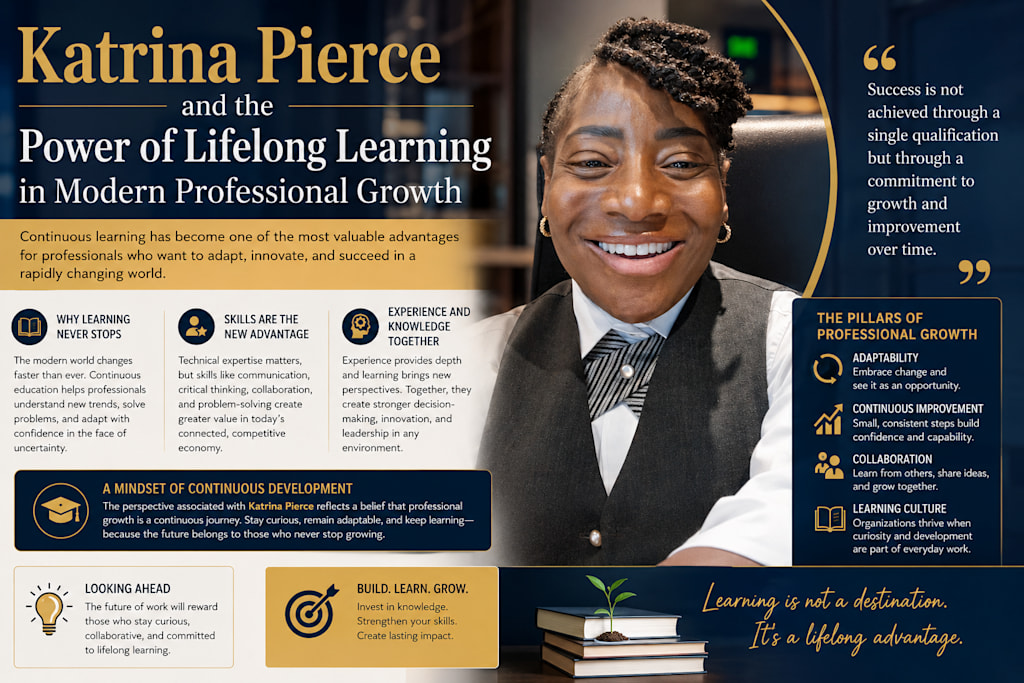
Katrina Pierce and the Power of Lifelong Learning in Modern Professional Growth
Continuous learning has become one of the most valuable advantages for professionals who want to adapt, innovate, and succeed in a rapidly changing world.

Why Learning Never Stops in Today's World
The modern world changes faster than ever before. New technologies emerge, industries evolve, and customer expectations continue to shift. A skill that was highly valuable a few years ago may need to be updated to remain relevant today. Because of this reality, learning has become a lifelong process rather than something limited to school or university.
Professionals who continue to learn are often better prepared to face change. They can understand new trends, solve unfamiliar problems, and adapt to different working environments. Continuous education also creates confidence because knowledge helps people make informed decisions instead of reacting to uncertainty.
The perspective associated with Katrina Pierce reflects this broader understanding that professional development is an ongoing journey. Success is not achieved through a single qualification but through a commitment to growth and improvement over time.
Skills Are the New Competitive Advantage
In today's economy, technical expertise alone is rarely enough. Employers and organizations increasingly value communication, critical thinking, collaboration, and problem-solving alongside specialized knowledge.
As industries become more connected, professionals must combine multiple abilities to remain competitive. They need to analyze information, work with diverse teams, and communicate ideas clearly. These skills help individuals contribute beyond their specific roles and create value across an organization.
Learning new skills also increases flexibility. Someone who develops additional knowledge can often adapt more easily when industries change or new opportunities appear. This adaptability strengthens long-term career prospects and supports professional resilience.
Rather than viewing education as a one-time achievement, successful individuals often see learning as a continuous investment in their future.
Experience and Knowledge Work Best Together
Experience provides practical understanding, while learning introduces new perspectives. When combined, they create a stronger foundation for professional growth.
Many people gain valuable insights through daily work, but ongoing education allows them to refine those experiences with updated information and modern practices. Reading, attending workshops, participating in discussions, and exploring new ideas all contribute to better decision-making.
Organizations also benefit when experienced professionals remain curious. Their practical knowledge helps evaluate new concepts realistically, while their willingness to learn encourages innovation without losing operational stability.
The combination of experience and continuous education creates professionals who are confident yet adaptable, capable of leading through both familiar and unfamiliar situations.
The Importance of Adaptability in Professional Growth
Change is no longer an occasional event in business—it has become a constant reality. New technologies, economic shifts, and evolving customer expectations require professionals to adjust continuously.
Adaptability is therefore one of the most valuable qualities in modern careers. People who embrace learning are often more comfortable with change because they see new situations as opportunities to develop rather than obstacles to avoid.
Developing adaptability requires curiosity and an open mindset. Instead of resisting new methods, professionals who seek understanding can identify better ways to improve efficiency and performance.
Organizations also benefit from adaptable teams because they can respond more effectively to unexpected challenges while maintaining long-term objectives.
Building Confidence Through Continuous Improvement
Confidence does not come only from experience. It also develops through preparation, learning, and consistent improvement.
Every new skill acquired expands an individual's ability to solve problems and contribute meaningful ideas. Over time, these small improvements build greater self-confidence and stronger professional judgment.
Continuous improvement also reduces fear of change. Professionals who regularly update their knowledge are more willing to accept new responsibilities because they trust their ability to learn and adapt.
The perspective associated with Katrina Pierce aligns with this idea that long-term success is strengthened by steady development rather than quick achievements. Consistent learning creates a solid foundation that supports better leadership and decision-making.
Learning From Collaboration and Different Perspectives
Education extends beyond books and formal courses. Some of the most valuable lessons come from working with other people who bring different experiences and ideas.
Collaboration encourages professionals to consider alternative viewpoints and discover creative solutions. Discussions with colleagues, mentors, and industry experts often reveal insights that would be difficult to develop individually.
Organizations that promote collaboration create environments where knowledge flows more freely. Employees become more engaged, innovation increases, and teams solve challenges more effectively.
Learning through collaboration also strengthens professional relationships, creating networks that support growth and future opportunities.
Creating a Culture of Learning
Successful organizations understand that learning should be part of everyday operations rather than an occasional activity. A culture of learning encourages curiosity, experimentation, and knowledge sharing across all levels.
When employees feel supported in developing new skills, they become more motivated and engaged. They contribute ideas, improve processes, and help the organization respond to changing market conditions.
A learning culture also benefits leadership. Managers who encourage development create stronger teams capable of independent thinking and collaborative problem-solving.
Businesses that invest in continuous education are often better prepared for long-term success because they strengthen both individual capabilities and organizational resilience.
Katrina Pierce and a Mindset of Continuous Development
The broader perspective associated with Katrina Pierce reflects the importance of viewing professional growth as a continuous process rather than a final destination. Long-term success is often built through consistent learning, adaptability, thoughtful planning, and collaboration.
Instead of relying solely on past achievements, professionals who embrace development continue expanding their knowledge and refining their skills. This mindset supports better decision-making and prepares individuals for future opportunities in an evolving business environment.
Continuous development is not about perfection. It is about making steady progress and remaining willing to learn from experience, new ideas, and changing circumstances.
Looking Ahead
The future of work will reward individuals who remain curious and adaptable. Technology will continue transforming industries, but the ability to learn, collaborate, and think strategically will remain valuable across professions.
Professionals who invest in lifelong learning build stronger foundations for sustainable growth. They become more capable of navigating uncertainty while identifying opportunities that others may overlook.
Organizations will increasingly seek people who combine expertise with flexibility and a willingness to grow. These qualities will shape leadership, innovation, and long-term success.
Conclusion
Lifelong learning is more than acquiring new information—it is developing the ability to adapt, collaborate, and create value throughout an evolving career. Knowledge, experience, and continuous improvement work together to build stronger professionals and more resilient organizations.
The ideas associated with Katrina Pierce reflect this broader approach to professional growth, where success comes from curiosity, adaptability, and a commitment to learning over time. In a rapidly changing world, those who continue to develop their skills will be best positioned to create lasting impact and sustainable success.
About the Creator
Katrina Pierce
Katrina Pierce started Avenue 27 (DBA Shea Nexus), which focuses on sourcing and exporting high-quality refined and unrefined shea butter from verified West African producers to UK distributors and manufacturers.
Enjoyed the story? Support the Creator.
Subscribe for free to receive all their stories in your feed.
Comments
There are no comments for this story
Be the first to respond and start the conversation.