
Japan Molecular Imaging Market Forecast 2025–2033: Advancing Precision Diagnostics in an Aging Society
Japan’s molecular imaging industry is expanding steadily as healthcare providers invest in advanced diagnostic technologies for cancer, neurological disorders, and cardiovascular diseases.

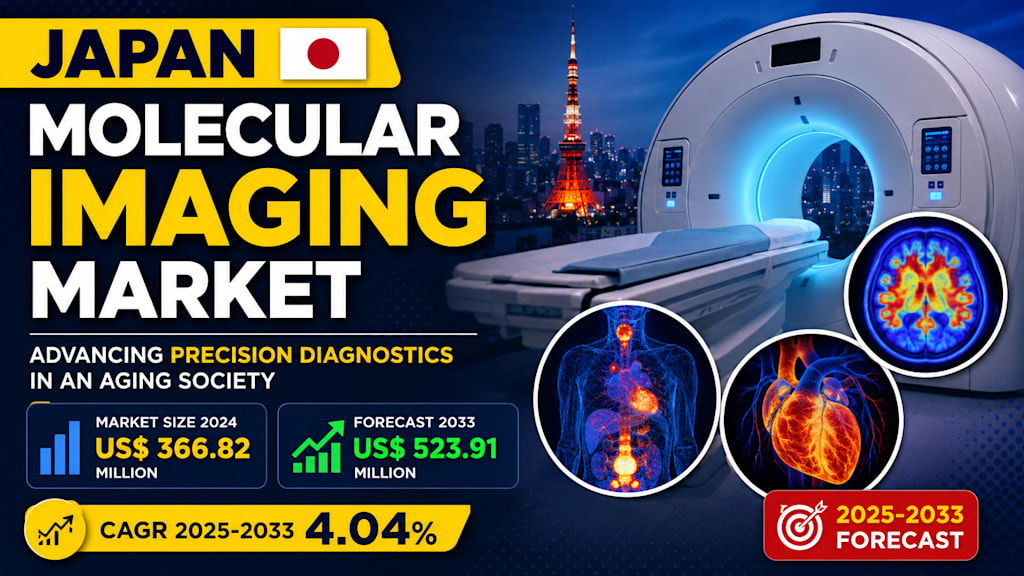
Japan Molecular Imaging Market Size & Forecast 2025–2033
Japan's healthcare sector is entering a transformative era driven by precision medicine, advanced diagnostics, and increasing demand for early disease detection. Among the technologies reshaping modern healthcare, molecular imaging has emerged as one of the most valuable tools for clinicians and researchers. By enabling visualization of biological processes at the cellular and molecular level, molecular imaging provides insights that traditional imaging techniques often cannot deliver.
According to Renub Research, the Japan Molecular Imaging Market was valued at US$ 366.82 million in 2024 and is expected to reach US$ 523.91 million by 2033, growing at a CAGR of 4.04% during the forecast period from 2025 to 2033.
Download Free Sample Report:
The growth of the market is supported by technological advancements in imaging systems, increasing prevalence of chronic diseases, expanding research initiatives, and growing demand for personalized treatment approaches. As Japan continues to address the healthcare challenges associated with its aging population, molecular imaging is expected to play an increasingly critical role in diagnosis, treatment planning, and disease monitoring.
Understanding Molecular Imaging
Molecular imaging is a sophisticated diagnostic approach that enables healthcare professionals to visualize and measure biological activities inside living organisms. Unlike conventional imaging methods that focus primarily on anatomical structures, molecular imaging provides information about cellular functions and disease processes before physical symptoms become apparent.
The technology employs advanced modalities such as Positron Emission Tomography (PET), Single Photon Emission Computed Tomography (SPECT), Magnetic Resonance Imaging (MRI), and hybrid imaging systems that combine multiple techniques into a single platform.
In Japan, molecular imaging is widely used across oncology, cardiology, neurology, and pharmaceutical research. It supports physicians in detecting diseases at earlier stages, evaluating treatment effectiveness, and developing individualized treatment strategies.
Aging Population Drives Diagnostic Demand
Japan remains one of the world's oldest societies. More than one-quarter of its population is aged 65 years and above, creating significant pressure on healthcare systems to diagnose and manage age-related diseases efficiently.
The rising incidence of cancer, Alzheimer's disease, Parkinson's disease, cardiovascular disorders, and other chronic illnesses has increased demand for advanced diagnostic technologies. Molecular imaging helps physicians identify disease markers long before symptoms become severe, allowing earlier interventions and improved patient outcomes.
Cancer remains one of the most significant healthcare concerns in Japan. The country reported approximately 1.019 million new cancer cases and over 380,000 cancer-related deaths in 2022. Colorectal, stomach, lung, prostate, and breast cancers account for the majority of diagnosed cases.
Molecular imaging technologies, particularly PET and SPECT systems, have become essential in oncology because they help clinicians identify tumors, assess disease progression, and monitor treatment responses. As cancer rates continue to rise alongside population aging, the demand for these technologies is expected to increase steadily.
Technological Innovation Accelerates Market Expansion
Japan has long been recognized as a global leader in adopting advanced healthcare technologies. This trend is particularly evident in molecular imaging, where healthcare providers are increasingly investing in next-generation systems.
Hybrid imaging platforms such as PET/CT and PET/MRI have transformed diagnostic workflows by combining anatomical and functional imaging capabilities. These systems provide comprehensive information within a single scan, improving diagnostic accuracy while reducing examination times.
Artificial intelligence is also making a significant impact. AI-powered imaging software can assist radiologists in image interpretation, identify abnormalities more rapidly, and enhance workflow efficiency. These innovations help healthcare facilities manage growing patient volumes while maintaining high diagnostic standards.
Digital integration is another important trend. Imaging data can now be shared seamlessly across healthcare networks, enabling specialists in different locations to collaborate on patient cases. Such capabilities are particularly valuable in complex disease management and clinical research.
The approval and reimbursement of advanced PET diagnostic agents in Japan further support market expansion by increasing accessibility to cutting-edge molecular imaging procedures.
Government Support Strengthens Industry Growth
Government initiatives remain a major contributor to the development of Japan's molecular imaging market. Policymakers continue to emphasize early disease detection, precision medicine, and healthcare innovation as national priorities.
Public funding programs support research in oncology, dementia, cardiovascular disease, and rare diseases. Many of these initiatives rely heavily on molecular imaging technologies to accelerate scientific discoveries and improve patient care.
Universities, hospitals, and pharmaceutical companies are collaborating extensively to develop new imaging tracers and diagnostic applications. These partnerships are helping Japan maintain its position at the forefront of medical imaging innovation.
The government's reimbursement policies for selected molecular imaging procedures also encourage broader adoption among hospitals and healthcare providers. Such financial support reduces barriers to access and promotes the integration of advanced imaging technologies into routine clinical practice.
Challenges Limiting Market Penetration
Despite favorable growth prospects, several challenges continue to affect market expansion.
One of the most significant obstacles is the high cost associated with molecular imaging equipment. PET, SPECT, and hybrid imaging systems require substantial capital investments, making adoption difficult for smaller hospitals and diagnostic centers.
In addition to acquisition costs, facilities must invest in specialized infrastructure, maintenance programs, and highly trained personnel. These expenses can create financial pressure, particularly in rural areas where healthcare budgets may be limited.
Another challenge involves radiopharmaceutical supply chains. Many molecular imaging procedures depend on radioactive tracers that have very short half-lives and must be produced close to the point of use.
Limited manufacturing facilities and logistical complexities can lead to supply shortages, especially in less-developed regions. Regulatory requirements for approving new tracers can further slow innovation and restrict availability.
Addressing these challenges will be essential for ensuring broader access to molecular imaging services across Japan.
PET Imaging Remains the Dominant Segment
Positron Emission Tomography continues to represent the largest segment of Japan's molecular imaging market.
PET technology offers exceptional sensitivity and accuracy for detecting metabolic activity associated with cancer, neurological disorders, and cardiovascular disease. Healthcare providers rely on PET scans for diagnosis, staging, treatment monitoring, and recurrence detection.
The technology is especially valuable in oncology, where early detection significantly improves treatment outcomes. PET imaging also plays an increasingly important role in Alzheimer's disease research by helping physicians identify amyloid and tau protein accumulations in the brain.
The integration of PET with CT and MRI technologies has further enhanced its clinical value, making it one of the most important diagnostic tools in modern medicine.
Emerging Potential of Molecular Ultrasound
Molecular ultrasound imaging is gaining attention as a cost-effective and non-invasive diagnostic alternative.
Unlike PET and SPECT imaging, ultrasound does not expose patients to ionizing radiation. Recent advances in contrast agents and targeted microbubble technologies have expanded its capabilities beyond traditional imaging applications.
Researchers and healthcare providers are increasingly using molecular ultrasound in oncology, cardiovascular medicine, and vascular diagnostics. Its affordability makes it particularly attractive for smaller healthcare facilities seeking advanced diagnostic capabilities without the high costs associated with nuclear imaging systems.
As innovation continues, molecular ultrasound is expected to become a more prominent component of Japan's molecular imaging landscape.
Oncology Leads Application Demand
Cancer diagnosis and management remain the largest application area for molecular imaging in Japan.
Healthcare professionals depend on advanced imaging systems to identify tumors, determine disease stages, monitor treatment responses, and detect recurrence. PET and SPECT imaging have become standard tools in many oncology departments because they provide detailed insights into tumor biology.
Molecular imaging also supports personalized medicine approaches by helping clinicians select targeted therapies based on individual patient characteristics. As immunotherapy and precision oncology continue to expand, demand for molecular imaging solutions is likely to grow further.
Government-sponsored cancer screening programs and ongoing research initiatives continue to reinforce the importance of imaging technologies within the oncology ecosystem.
Neurology Emerges as a High-Growth Segment
Neurological disorders represent one of the fastest-growing application areas for molecular imaging.
Japan's aging population has led to a sharp increase in conditions such as Alzheimer's disease, Parkinson's disease, and dementia. Early diagnosis is critical because many neurological disorders progress gradually over time.
Molecular imaging allows clinicians to visualize brain function, blood flow, and disease-specific biomarkers that may not be detectable using conventional imaging methods.
Research institutions throughout Japan are actively developing new tracers and imaging protocols designed to improve diagnostic accuracy. These efforts align closely with national healthcare priorities focused on aging and cognitive health.
Regional Analysis: Tokyo Leads Adoption
Tokyo remains the most advanced regional market for molecular imaging in Japan. The city is home to leading hospitals, research institutions, biotechnology companies, and academic centers.
Strong healthcare infrastructure, significant research funding, and access to radiopharmaceutical production facilities have positioned Tokyo as a center for innovation and adoption of advanced imaging technologies.
Aichi Prefecture is emerging as another important market, supported by expanding healthcare investments and strong collaboration between industry and academia.
Meanwhile, Shizuoka is steadily increasing its molecular imaging capabilities through infrastructure improvements and participation in government-supported disease screening programs.
Together, these regions illustrate how molecular imaging adoption is spreading beyond major metropolitan centers while maintaining strong growth momentum nationwide.
Competitive Landscape
The Japanese molecular imaging market features a mix of global imaging giants and domestic technology leaders competing through innovation, strategic partnerships, and product development.
Key companies operating in the market include GE HealthCare, Siemens Healthineers AG, Koninklijke Philips N.V., Shimadzu Corporation, United Imaging Healthcare Co., Ltd., Bruker Corporation, FUJIFILM Holdings Corporation, and Cubresa Inc.
These companies continue to invest in AI-enabled imaging systems, hybrid technologies, advanced radiopharmaceuticals, and precision medicine solutions to strengthen their competitive positions.
10 Recent Developments Among Leading Companies
GE HealthCare acquired the remaining stake in Nihon Medi-Physics, strengthening its radiopharmaceutical portfolio in Japan.
Siemens Healthineers expanded its digital imaging ecosystem with enhanced AI-powered diagnostic solutions.
Philips introduced advanced workflow automation tools designed to improve imaging efficiency.
Shimadzu Corporation accelerated research into next-generation molecular imaging technologies.
FUJIFILM expanded investments in healthcare imaging and diagnostic innovation.
United Imaging Healthcare strengthened its global PET/CT product portfolio with new system launches.
Bruker Corporation advanced molecular imaging research solutions for academic institutions.
Life Molecular Imaging received reimbursement approval for Neuraceq® amyloid PET imaging in Japan.
Multiple Japanese research institutions partnered with industry leaders to develop novel imaging tracers for neurological disorders.
Healthcare providers across Japan increased adoption of hybrid imaging platforms, including PET/MRI and PET/CT systems, to support precision medicine initiatives.
Final Thoughts
Japan's molecular imaging market is positioned for sustained growth throughout the forecast period. The combination of an aging population, rising chronic disease burden, technological innovation, and government support creates a favorable environment for market expansion.
As healthcare systems increasingly prioritize early diagnosis and personalized treatment, molecular imaging will continue to serve as a cornerstone of modern medical practice. Advances in PET imaging, molecular ultrasound, AI integration, and radiopharmaceutical development are expected to unlock new opportunities for healthcare providers, researchers, and technology companies alike.
With the market projected to reach US$ 523.91 million by 2033, molecular imaging is set to play an even greater role in improving diagnostic accuracy, accelerating treatment decisions, and enhancing patient outcomes across Japan.
About the Creator
Enjoyed the story? Support the Creator.
Subscribe for free to receive all their stories in your feed.
Comments
There are no comments for this story
Be the first to respond and start the conversation.