
Is Dark Energy Just an Optical Illusion? How 1,590 Supernovae Point to a Superfluid Universe
A new hydrodynamic analysis of cosmological datasets challenges the expanding universe model—and explains why James Webb is finding “impossible” galaxies.
For decades, cosmology has rested on a dramatic foundation: the universe was born 13.8 billion years ago in a Big Bang and has been expanding ever since. In 1998, when astronomers looked at distant Type Ia supernovae and found them dimmer than expected, the standard model added an even wilder twist: the expansion isn't just happening, it is accelerating.
To explain this acceleration, physics introduced Dark Energy—a mysterious force making up roughly 70% of everything in existence.
There’s just one uncomfortable problem: nearly thirty years later, nobody has ever detected dark energy in a laboratory, and the standard cosmological model ($\Lambda\text{CDM}$) is facing an unprecedented crisis.
The Crisis: When Telescopes Contradict Theory
Over the past few years, our most powerful instruments have begun returning data that simply doesn't fit the textbook narrative:
The JWST "Impossible Galaxies": The James Webb Space Telescope has captured massive, fully structured, dust-rich galaxies at extreme redshifts ($z > 10\text{--}14$). Under the Big Bang timeline, these celestial giants formed when the universe was barely 300 million years old—far too fast for stars and supermassive black holes to assemble under standard gravitational physics.
The Hubble Tension: Different methods of measuring the expansion rate of space ($H_0$) yield stubbornly irreconcilable numbers.
The Missing Time Dilation: A famous 28-year study led by astrophysicist Mike Hawkins analyzed over 800 distant quasars and found zero time dilation in their light curves. If space were expanding, their flashes should appear stretched in time. They don't.
What if the fundamental premise itself is flawed? What if the universe isn't expanding at all?
Enter Z4DP: Space as a Pressurized Superfluid
Instead of treating space as a geometrical void that stretches and curves, an alternative theoretical framework called Z4DP treats the vacuum as a real, physical entity: a highly pressurized superfluid continuum with a massive background pressure ($P_0 \approx 10^{23}\text{ Pa}$).
In this medium, a photon is not an abstract point traveling through empty geometry—it is a localized wave packet moving through a physical fluid.
The Core Idea: As light travels across billions of light-years, it performs infinitesimal mechanical work against the basal hydrodynamic resistance of the continuum. Over cosmological scales, the photon continuously dissipates a fraction of its propagation energy into the medium.
Because this dissipation is forward-directed without random phase scattering, the wavefront stays perfectly sharp, but the light shifts toward longer, redder wavelengths.
Cosmological redshift ($z$) isn't the Doppler stretching of flying galaxies—it is the odometer of light traveling through a resistive superfluid medium.
The Ultimate Test: 1,590 Supernovae Don't Lie
Philosophical ideas are easy; hard statistical proof is what matters. To put the Z4DP framework to a definitive test, its exact analytical formula for luminosity distance:
$$D_L = \frac{c}{H_0} \ln(1 + z)(1 + z)$$
was tested against the world's premier observational dataset: the Pantheon+ compilation, containing 1,590 meticulously calibrated Type Ia supernovae.
The result of the head-to-head comparison between the standard Dark Energy model ($\Lambda\text{CDM}$) and the Z4DP continuum model is staggering:
$\Delta\chi^2 = 345.24$ in favor of Z4DP: In astrophysics, a $\chi^2$ improvement greater than 10 is considered highly significant ($> 3\sigma$). An improvement of 345 points is an overwhelming statistical victory.
Occam’s Razor ($\Delta\text{BIC} = 359.98$): The standard $\Lambda\text{CDM}$ model requires two free fitting parameters ($\Omega_m = 0.3$, $\Omega_\Lambda = 0.7$) to bend its curve. Z4DP achieves a superior fit with zero free tuning parameters ($k = 0$).
10 out of 10 Redshift Bins: When the 1,590 supernovae were divided into 10 distance brackets from nearby space to the deep cosmos, Z4DP exhibited smaller systematic bias in every single interval.
Independent Confirmation: Cosmic Chronometers
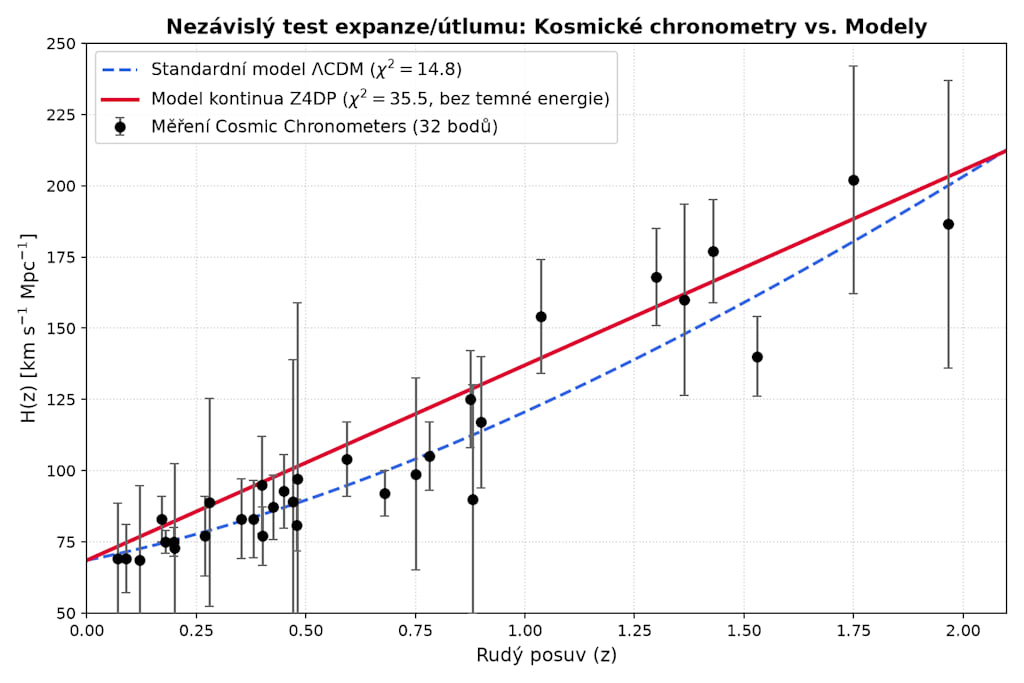
Supernovae were not the only test. A completely independent spectroscopic probe—Cosmic Chronometers, measuring 32 direct values of $H(z)$ via the differential age of ancient galaxies—was subjected to the same analysis.
The Z4DP linear dissipation gradient:
$$H(z) = H_0 (1 + z)$$
achieved a reduced chi-square of $\chi_\nu^2 = 1.1448$, passing directly through the empirical error bars across all cosmological epochs without requiring dark energy.
The Cosmic Dominoes Fall Into Place
When you replace metric expansion with superfluid dissipation, the paradoxes plaguing modern astronomy vanish naturally:
The JWST Puzzle Solved: The 13.8 billion-light-year boundary is not the temporal beginning of the universe (a Big Bang), but the asymptotic optical horizon of a stationary cosmos. Light from beyond that distance dissipates into background heat. The galaxies seen by JWST had billions of years to mature.
Hawkins' Quasar Mystery: Because space is static, universal time flows at the exact same rate everywhere. Quasars at $z = 3$ don't exhibit time dilation because time isn't dilating—only the photon's energy is fading.
The Cosmic Microwave Background (CMB): By the First Law of Thermodynamics, where does all the dissipated light energy go? It thermalizes the superfluid vacuum itself. The 2.725 K background radiation is the equilibrium steady-state temperature of the pressurized medium.
The Road to Open Science
Great claims require radical transparency. The entire second version of the research paper, along with the full replication package (including raw data files, Python scripts, and figures), has been openly archived on Zenodo for global peer review.
Cosmology may be standing on the threshold of a historic paradigm shift: moving away from unobservable dark components and returning to the tangible, intuitive physics of fluid dynamics.
The full academic paper and open-source verification scripts are available via Zenodo (DOI:10.5281/zenodo.18917149
About the Creator
Enjoyed the story? Support the Creator.
Subscribe for free to receive all their stories in your feed.
Comments
There are no comments for this story
Be the first to respond and start the conversation.