
Inhalation Anesthesia Market Expands as Global Surgical Demand Continues to Rise
Growing surgical volumes, hospital modernization, and advances in anesthesia technology are expected to push the inhalation anesthesia market to US$ 2.61 Billion by 2034

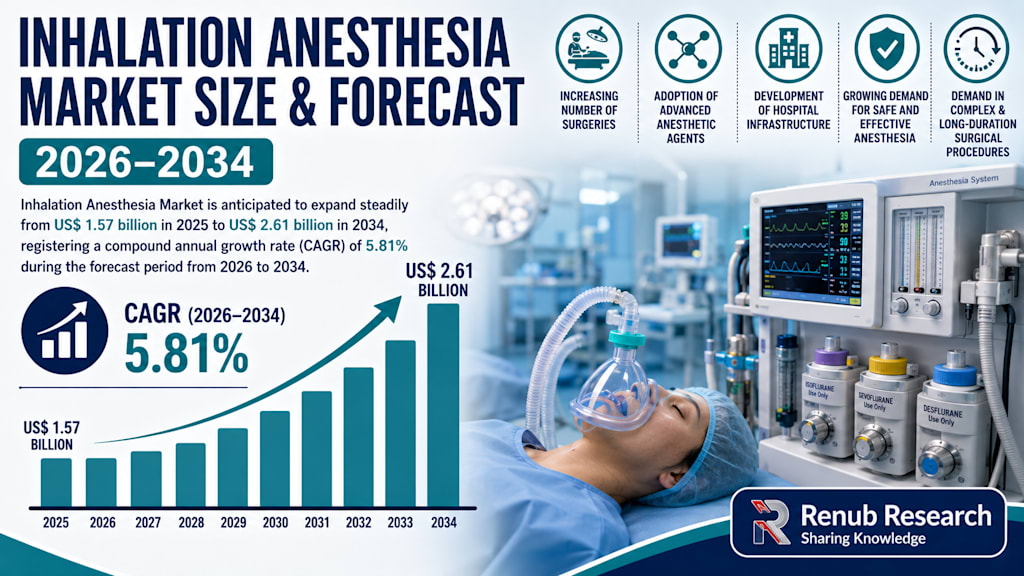
The global healthcare industry is witnessing a steady rise in surgical procedures, and with that increase comes growing demand for reliable anesthesia solutions. Among the various anesthesia methods available today, inhalation anesthesia remains one of the most widely used approaches for major and complex surgeries due to its ability to provide controlled unconsciousness, pain management, and stable anesthesia maintenance during procedures.
According to the Renub Research market brief provided, the global inhalation anesthesia market is expected to grow from US$ 1.57 Billion in 2025 to US$ 2.61 Billion by 2034, expanding at a compound annual growth rate (CAGR) of 5.81% from 2026 to 2034.
The market’s growth is being fueled by rising surgical volumes, advances in anesthesia delivery systems, increasing healthcare infrastructure investment, and the growing need for safe and effective anesthesia in complex medical procedures.
As healthcare systems continue modernizing worldwide, inhalation anesthesia remains a critical component of modern surgical care.
Why inhalation anesthesia remains essential in surgery
Inhalation anesthesia involves the administration of gaseous or vaporized anesthetic agents through specialized equipment such as masks or endotracheal tubes. These agents act on the central nervous system to create a controlled state of unconsciousness while reducing pain sensation and suppressing reflexes during surgery.
One of the key advantages of inhalation anesthesia is the ability to carefully adjust the depth of anesthesia throughout a procedure. This makes it especially valuable in long-duration and high-risk surgeries where precise control is essential.
Commonly used inhalation anesthetics are known for their rapid onset, smooth maintenance, and predictable recovery characteristics. These features help anesthesiologists manage patient stability effectively during complex procedures.
The increasing complexity of surgical care worldwide has therefore strengthened the role of inhalation anesthesia across hospitals and specialty surgical centers.
Surgical volumes are increasing globally
One of the strongest growth drivers in the inhalation anesthesia market is the increasing number of surgeries being performed worldwide.
Healthcare systems are treating a growing number of patients with chronic diseases, trauma injuries, cardiovascular disorders, neurological conditions, orthopedic complications, and age-related illnesses. Many of these conditions require advanced surgical intervention.
At the same time, improvements in medical technology have expanded the range of surgeries that can now be safely performed. More patients are undergoing elective surgeries, minimally invasive procedures, and highly specialized operations that require advanced anesthesia management.
The report notes that inhalation anesthetics are particularly preferred for long-duration surgeries such as cardiovascular, neurological, orthopedic, and abdominal procedures where stable unconsciousness and accurate anesthesia depth control are critical.
As surgical capacity expands globally, demand for inhalation anesthesia agents, workstations, ventilators, and monitoring systems is expected to continue rising steadily.
Hospital infrastructure expansion is supporting market growth
Another major factor driving the market is the rapid development of hospital infrastructure and surgical facilities worldwide.
Governments and private healthcare providers are investing heavily in modern hospitals, operating rooms, and specialty surgical centers, especially in developing economies. Fully equipped operating rooms require advanced anesthesia systems, making inhalation anesthesia technology an essential part of healthcare infrastructure investment.
Specialty hospitals focused on cardiology, neurology, oncology, trauma care, and organ transplantation are also increasing demand for sophisticated anesthesia delivery systems.
The growing emphasis on surgical quality, patient safety, and procedural efficiency is encouraging healthcare providers to upgrade anesthesia workstations with advanced monitoring and ventilation capabilities.
In August 2025, the World Health Organization and the Society of Robotic Surgery signed a Memorandum of Understanding to improve access to virtual care and telesurgery. Developments like this indicate how advanced surgical systems are becoming increasingly integrated into global healthcare expansion plans.
As healthcare infrastructure modernizes, inhalation anesthesia remains deeply tied to the growth of surgical care capabilities worldwide.
Technology is improving anesthesia safety and recovery
Technological innovation is playing a major role in reshaping the inhalation anesthesia market.
Newer anesthetic agents offer improved safety profiles, faster induction, smoother recovery, and greater hemodynamic stability. These improvements help reduce complications, shorten recovery times, and improve overall patient outcomes.
Modern anesthesia workstations now include highly advanced monitoring systems, precise dosing controls, ventilation support, and digital integration capabilities. These technologies help anesthesiologists administer anesthesia more safely and efficiently.
Healthcare providers are also paying greater attention to patient satisfaction and postoperative recovery. Faster recovery times allow hospitals and ambulatory surgical centers to improve patient turnover and reduce hospitalization costs.
The report highlights that in June 2023, Lunan Pharmaceutical Group received marketing authorization in the Netherlands for sevoflurane used in general anesthesia for adults and children. Such regulatory approvals reflect ongoing innovation and international market expansion within anesthesia pharmaceuticals.
Technological progress is therefore strengthening confidence among healthcare professionals while expanding the clinical use of inhalation anesthetics across multiple surgical environments.
Environmental concerns are becoming increasingly important
Despite its clinical benefits, the inhalation anesthesia market faces growing environmental scrutiny.
Several inhalation anesthetic gases contribute to greenhouse gas emissions when released into the atmosphere. As sustainability becomes a larger priority within healthcare systems, hospitals and regulators are increasingly evaluating the environmental impact of anesthetic practices.
Waste anesthetic gases can also create occupational safety concerns for operating room staff if not managed properly. This has increased demand for gas scavenging systems, improved ventilation infrastructure, and low-flow anesthesia technologies.
While these systems improve safety and environmental performance, they also increase operational costs for healthcare facilities.
Environmental sustainability is therefore expected to remain a major discussion point within the future development of the anesthesia industry.
High equipment costs remain a challenge
Another significant challenge involves the cost of anesthesia infrastructure.
Anesthesia machines, ventilators, gas delivery systems, monitoring devices, and maintenance systems require major capital investment. Smaller hospitals and healthcare facilities in developing regions may struggle to afford advanced anesthesia equipment.
Inhalation anesthesia also requires highly trained anesthesiologists and specialized clinical staff to ensure safe administration. Many developing countries continue to face shortages of qualified anesthesia professionals.
These workforce limitations can slow adoption in regions where surgical demand is increasing rapidly but healthcare infrastructure remains uneven.
Despite these barriers, ongoing investments in healthcare modernization and medical training are expected to improve long-term market penetration in emerging economies.
Sevoflurane remains one of the leading products
Among inhalation anesthetic agents, sevoflurane continues to hold a particularly strong market position.
Sevoflurane is widely preferred because of its rapid onset, quick recovery characteristics, stable hemodynamic performance, and favorable safety profile. It is especially common in pediatric surgeries, outpatient procedures, and short-to-medium-duration operations.
Its pleasant odor and non-irritating nature also make it suitable for mask induction, improving patient comfort and tolerance.
Hospitals and ambulatory surgery centers increasingly favor sevoflurane for procedures that require faster postoperative recovery and shorter hospital stays.
Although pricing pressure from generic competition exists, sevoflurane’s clinical advantages continue supporting strong market demand.
Isoflurane continues serving cost-sensitive healthcare systems
Isoflurane remains highly relevant, particularly in developing and cost-conscious healthcare environments.
It is commonly used in long-duration and complex surgeries because of its reliable pharmacological profile and affordability. Public hospitals and teaching institutions frequently rely on isoflurane due to its predictable performance and lower cost compared to some newer anesthetic agents.
Although recovery times may be longer than with newer products, the increasing volume of major surgeries globally continues to sustain demand for isoflurane.
This balance between clinical reliability and affordability ensures that isoflurane remains an important component of the inhalation anesthesia market.
Hospitals remain the dominant end-user segment
Hospitals continue to account for the largest share of the inhalation anesthesia market because they handle the majority of high-risk and long-duration surgical procedures.
Tertiary care hospitals, trauma centers, and specialty surgical facilities depend heavily on inhalation anesthesia for procedures requiring precise anesthesia management and prolonged unconsciousness.
These facilities typically have advanced operating room infrastructure, highly trained anesthesiology teams, and sophisticated monitoring systems that support safe inhalation anesthesia administration.
Increasing surgical admissions, aging populations, and rising chronic disease burdens are all strengthening demand within hospital settings.
Clinics and outpatient centers are also expanding usage
The use of inhalation anesthesia is also increasing in specialty clinics and outpatient surgical centers.
The growing popularity of minimally invasive procedures, cosmetic surgeries, dental surgeries, and short-duration elective operations is creating new opportunities for inhalation anesthesia in outpatient environments.
Rapid induction and predictable recovery make inhalation anesthetics attractive for facilities focused on efficient patient turnover.
However, adoption remains concentrated among well-equipped clinics due to equipment costs and regulatory requirements.
As outpatient surgical care continues expanding globally, inhalation anesthesia is expected to gain broader acceptance outside traditional hospital environments.
Regional markets are developing steadily
The United States remains one of the world’s most advanced inhalation anesthesia markets due to high surgical volumes, sophisticated hospital infrastructure, and strong adoption of advanced anesthesia systems.
The report notes that Baxter International formed a collaboration in April 2025 with ambulatory surgery centers to provide anesthesia solutions designed specifically for outpatient environments.
The United Kingdom market benefits from a strong public healthcare system and standardized surgical care protocols. Demand remains stable due to rising surgical procedures and increasing chronic disease prevalence.
India represents a rapidly growing market supported by improving healthcare infrastructure, expanding private hospitals, and increasing access to advanced medical care. Piramal Pharma’s commercial production of sevoflurane in Telangana reflects rising domestic manufacturing capabilities within India’s healthcare sector.
Saudi Arabia is also expanding its inhalation anesthesia market through investments in healthcare modernization, specialty hospitals, and advanced surgical systems. Government healthcare initiatives and rising demand for high-quality surgical care continue supporting growth.
The future of anesthesia will focus on safety, efficiency, and sustainability
The inhalation anesthesia market is evolving alongside broader healthcare transformation trends.
Future growth is likely to be shaped by safer anesthetic agents, smarter anesthesia delivery systems, environmental sustainability measures, and continued expansion of surgical care worldwide.
Healthcare providers increasingly want anesthesia systems that improve patient outcomes while also reducing environmental impact and operational complexity.
At the same time, rising global surgical demand ensures that inhalation anesthesia will remain a vital part of modern medicine for years to come.
Final Thoughts
The global inhalation anesthesia market is steadily expanding because surgical care itself is growing more advanced, more accessible, and more technologically sophisticated.
With the market projected to increase from US$ 1.57 Billion in 2025 to US$ 2.61 Billion by 2034, inhalation anesthesia continues to play a crucial role in supporting safe and effective surgical procedures worldwide.
Although environmental concerns, infrastructure costs, and workforce shortages remain challenges, ongoing innovation and healthcare investment are expected to sustain long-term market growth.
About the Creator
Enjoyed the story? Support the Creator.
Subscribe for free to receive all their stories in your feed.
Comments
There are no comments for this story
Be the first to respond and start the conversation.