
I paid $1.10 and $172.97 for the same music video
One song, one prompt, six Claude effort levels, and six completely different films

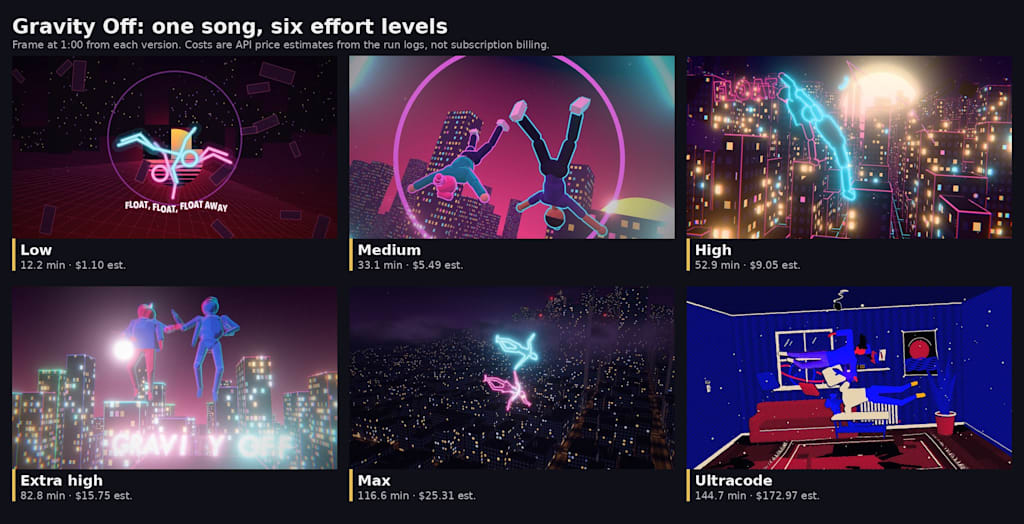
The cheapest version of this music video took 12 minutes and cost about US$1.10. The dearest took two hours and 25 minutes and cost about US$172.97. Same song, same model, same prompt.
I ran this test because I kept wondering what an effort setting actually buys. Claude lets you choose how hard it should work on a task: low, medium, high, extra high, max, and a mode called ultracode. Everyone assumes more effort means a better result. I wanted to see what "better" looks like when the output is something you can watch.
So I gave Claude Opus one song and asked for a music video six times, changing nothing except the effort level.
The setup
The song is Gravity Off, the first track from the Everything Floats album by AauummKar. It runs three minutes and two seconds. Every version came out at full HD, 30 frames a second, the full length of the song.
Every run got the same brief, word for word: make a full music video for this song, with a lot of dance or some story, made as motion graphics only. Ultracode got one extra word at the top. That's it. I didn't fix the prompt between runs, and I didn't nudge any of them halfway.
Claude can't hear music, so it never listens to the track. It reads a song folder instead: the lyrics with timings, the beats, the sections, and a short note on what the song is about. Then it writes code that draws every frame. No stock footage, no image generator. Everything you see is shapes and light built in code.
And to be clear from the start: the video is AI-built. That's the whole experiment. The words you're reading are mine.
What each level made
I expected to compare polish. Six versions of roughly the same idea, getting sharper as the budget went up. That isn't what happened.
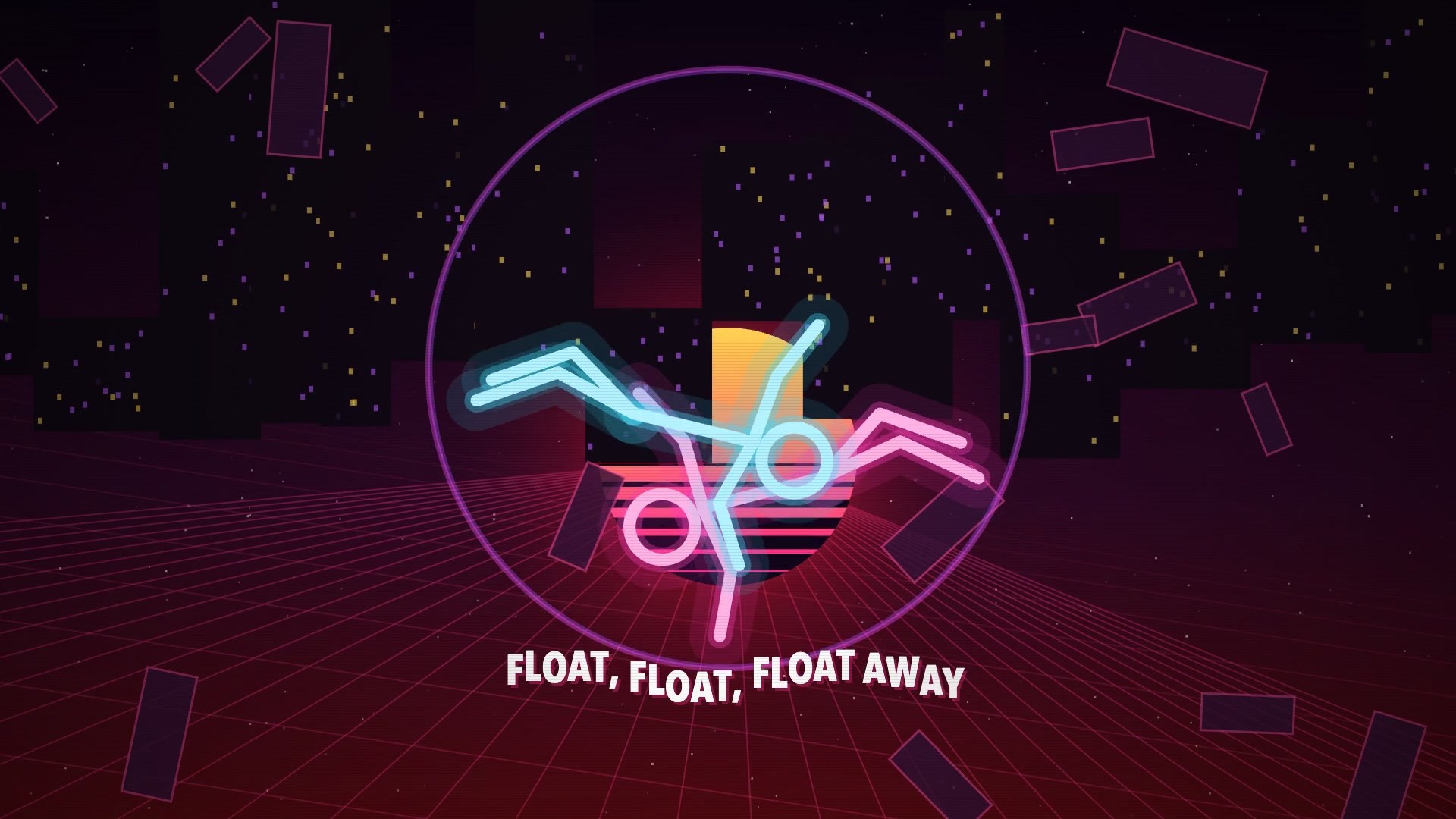
Low (12.2 minutes, about $1.10) kept it simple. Two neon stick figures tumble through a retro grid, with the lyrics written across the screen. It built the whole video in one scene file and finished in 18 turns. Honestly, it works. If you showed me this cold, I'd believe a person made it on a deadline.
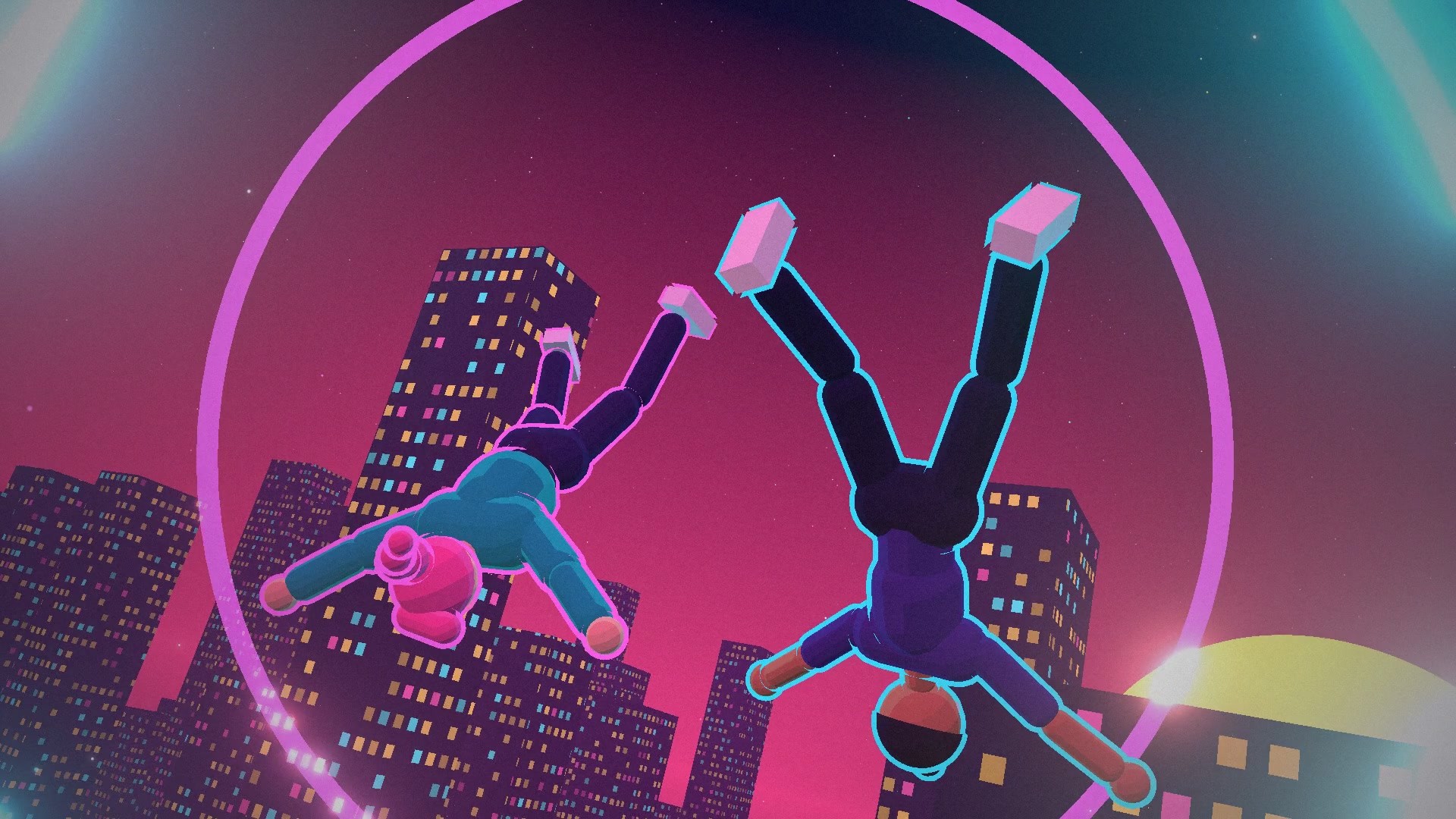
Medium (33.1 minutes, about $5.49) moved the story into a city at night and swapped the stick figures for chunky cartoon people flipping upside down in front of the skyline. Four scene files. More colour, more character, still one clear idea.
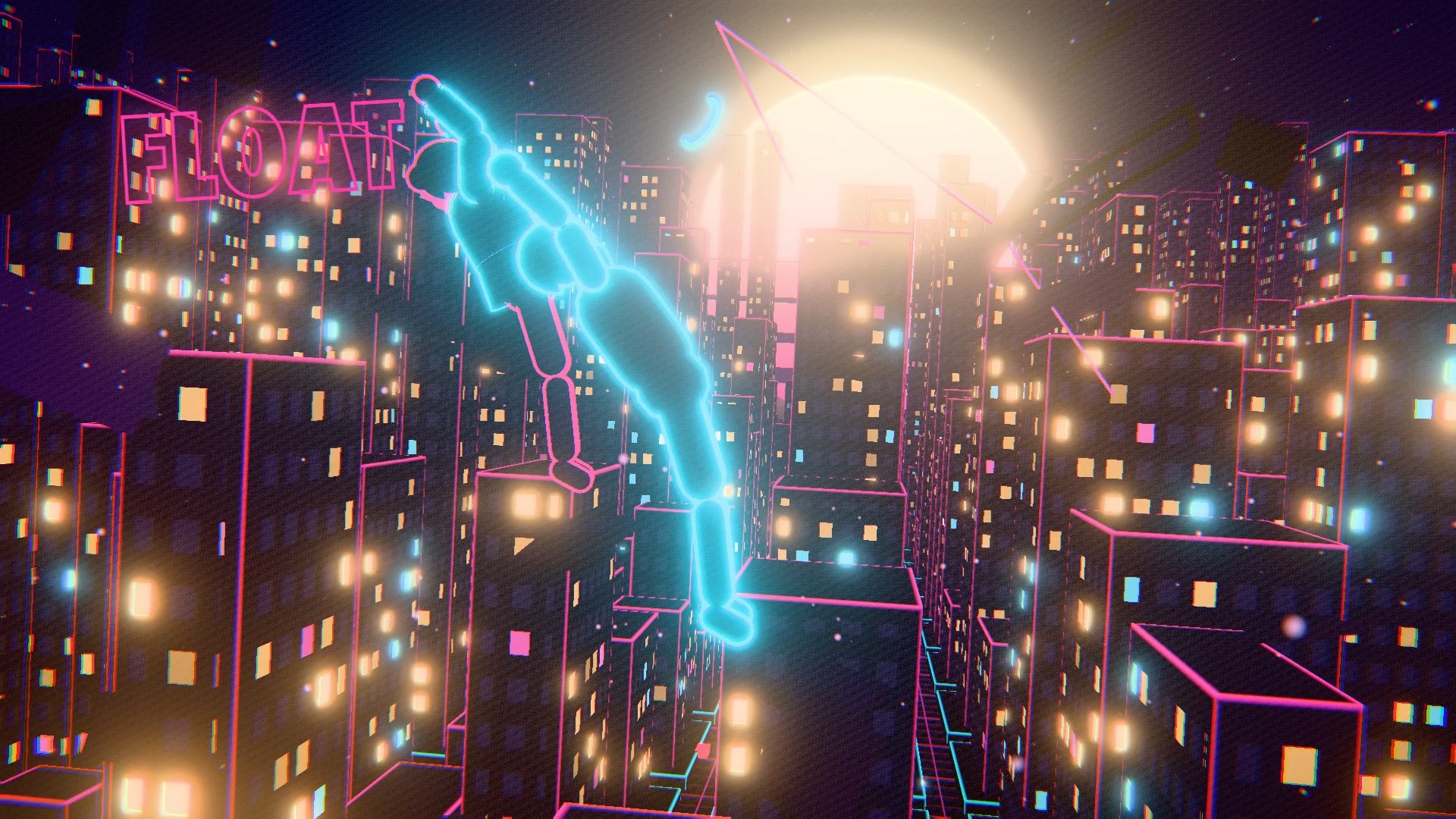
High (52.9 minutes, about $9.05) drops you down between the buildings. The camera sits inside the city now, with a glowing figure drifting past lit windows and the word FLOAT sitting on a rooftop like a sign. Nine scene files.
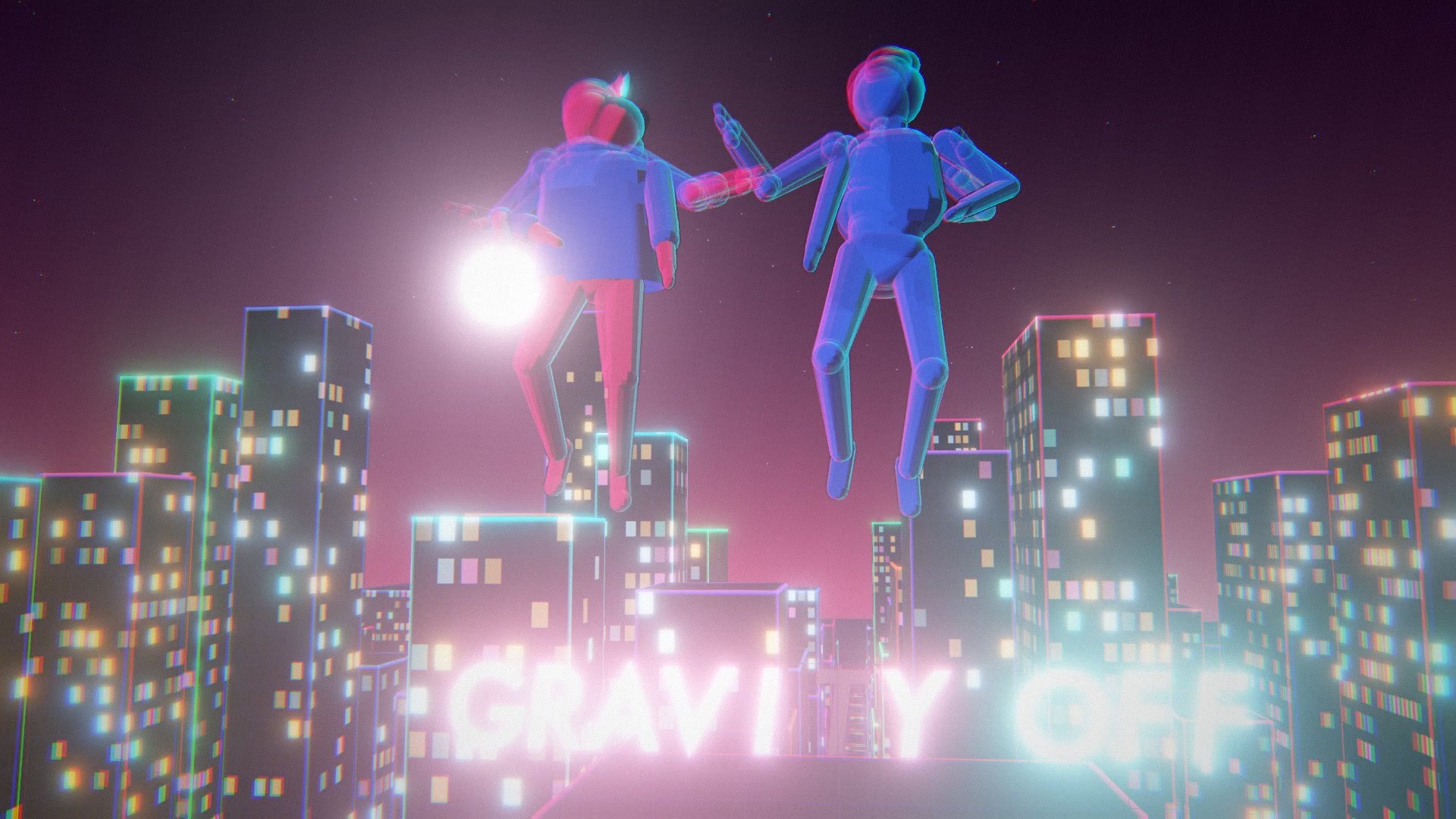
Extra high (82.8 minutes, about $15.75) built a bigger city that you fly through, with the song title lit up in neon along the street. This is where the turn count jumps. It took 119 turns and 22 scene files, against high's nine.
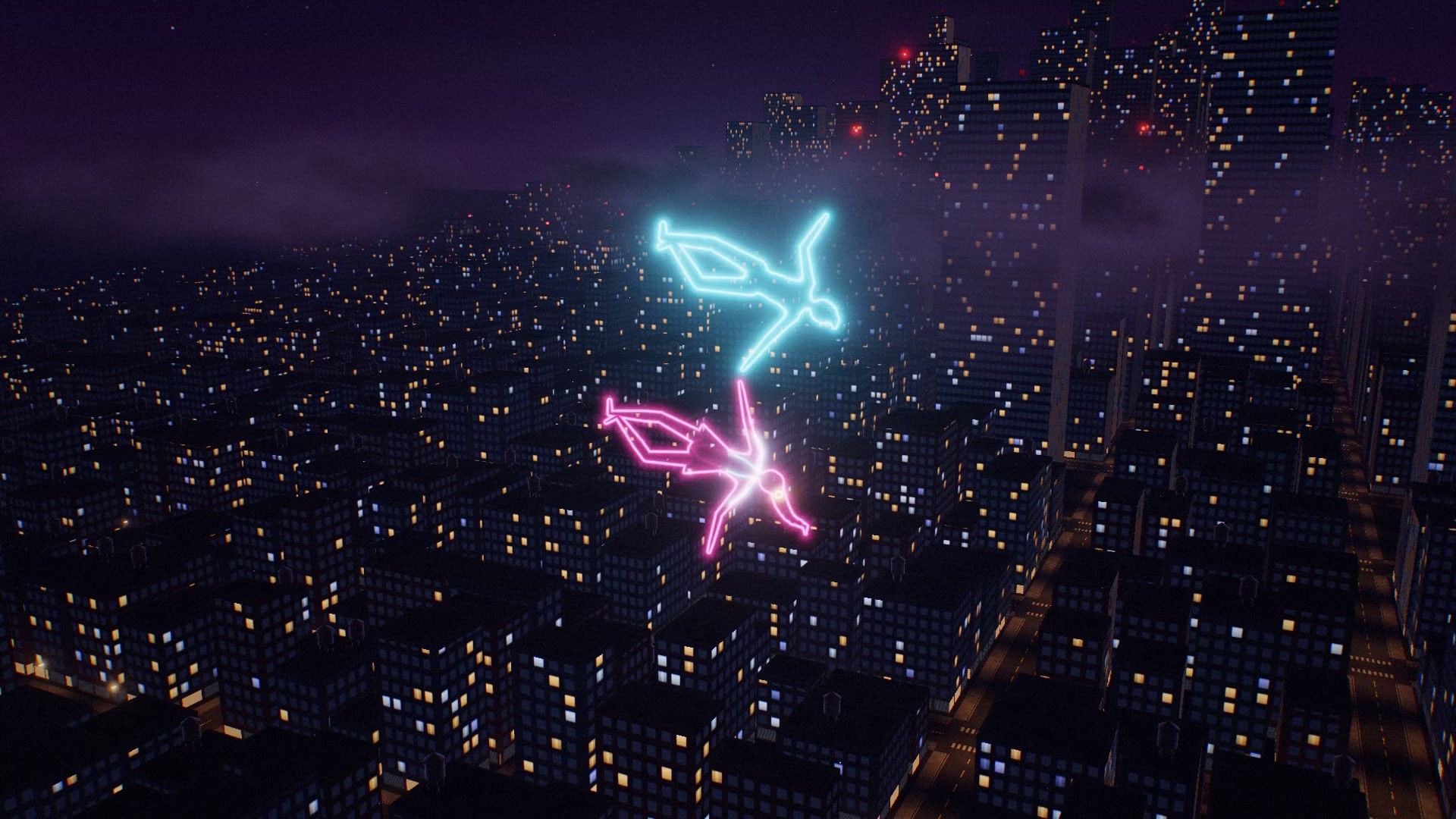
Max (116.6 minutes, about $25.31) went for a city that looks almost real, block after block of lit windows under low cloud, with two neon dancers drifting above it. It opens on a red clock reading 2:00, right on the first lyric ("two in the morning"). Max didn't split the work up. It stayed in one long session of 164 turns, rendered the video, spotted a stray light streak, fixed it, and rendered again with lighter grain. The max version you see here, in the side-by-sides and on the AauummKar channel, is the earlier render from that run. The $25.31 covers the whole max run, both renders.
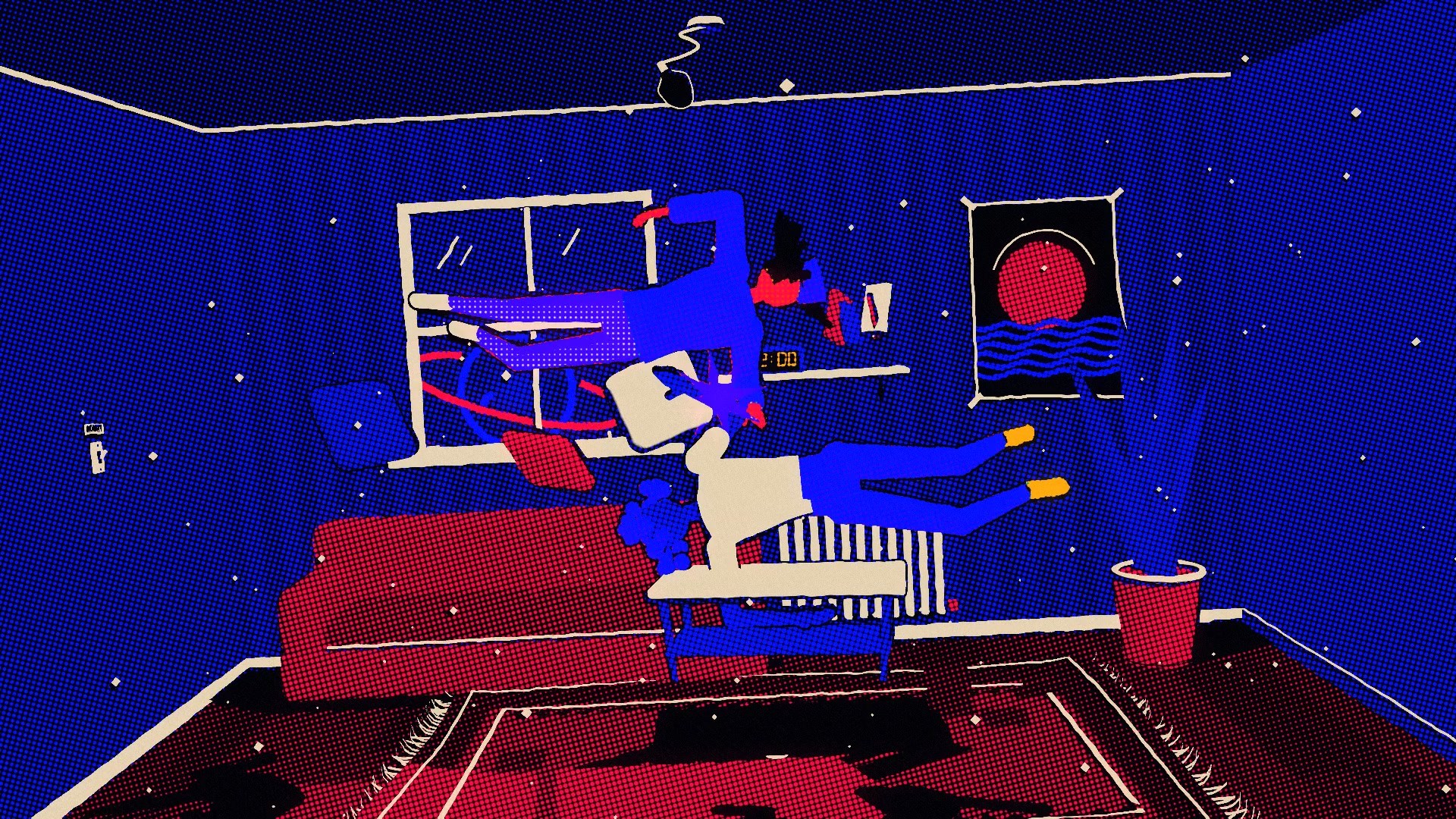
Ultracode (144.7 minutes, about $172.97) left the skyline behind altogether. It cut an apartment block open like a screen print, in three inks, and floated the people around inside their rooms. It opens on a light switch with the word GRAVITY taped above it. A hand reaches for it, and the whole city lets go.
How ultracode ran its own team
This was the part I didn't see coming. Ultracode didn't just think longer. It hired staff.
First, four creative director agents each pitched a different video, and two judge agents scored the pitches. The story pitch won. It became a treatment called What Stays Up: a three-ink screen print where a light switch labelled gravity lets a whole city float.
Then eleven builder agents made it in parallel. Six teams worked on shots and five built modules, things like the crowd, the dance and the building. An earlier wave of five builders was stopped part way through. Across three workflows that's 22 helper agents, and the project ended with 76 scene files (67 if you leave out its trash and test renders).
The cost total also includes a first attempt (51.6 minutes, about $36.78) and one resume (93.1 minutes, about $136.19). One thing the logs don't spell out is whether every helper agent's usage sits inside that figure, so I'm not going to guess at a bigger number.
The numbers side by side
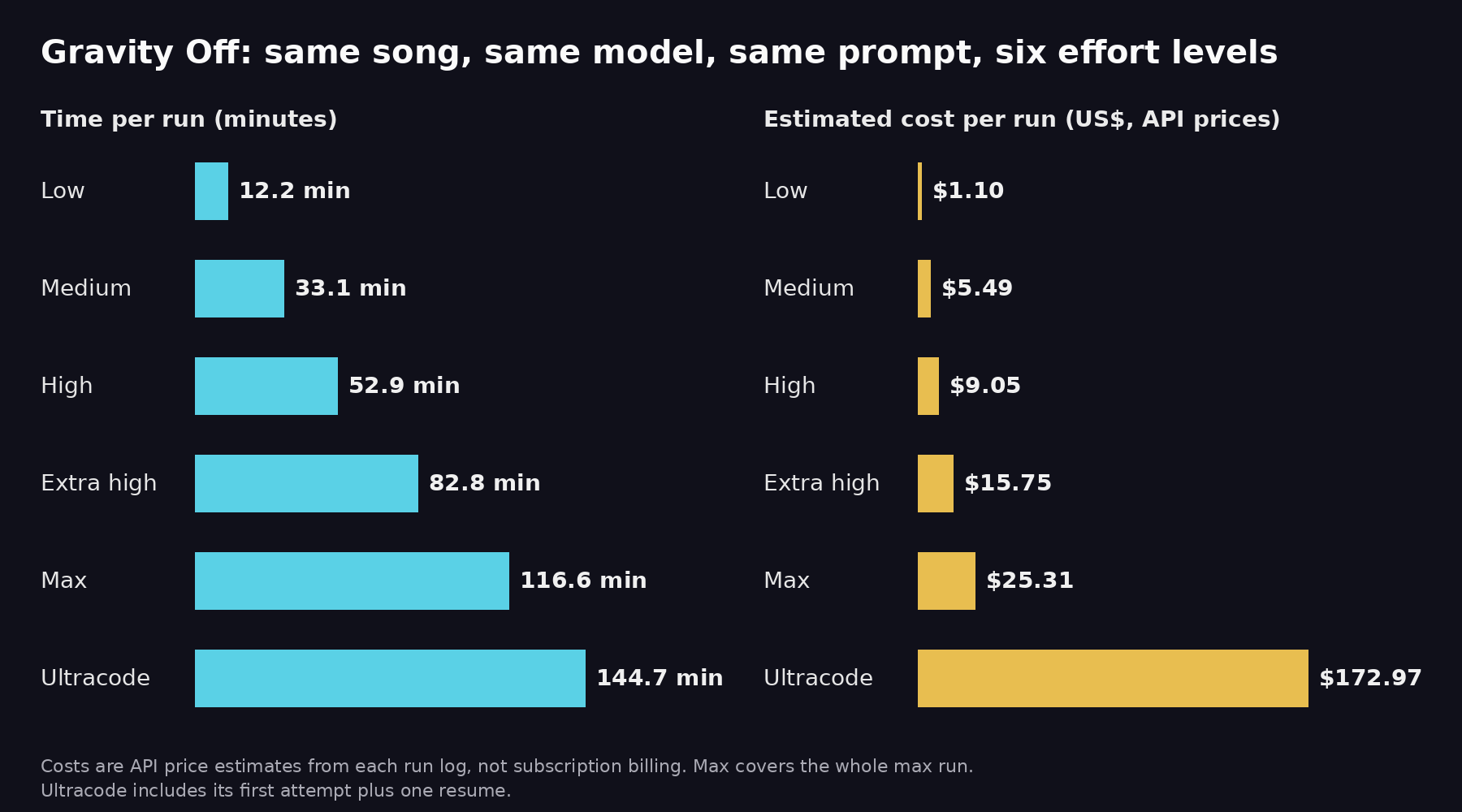
A quick but important note on these dollar figures. They're API price estimates taken from each run's log. On a subscription, runs like these aren't billed that way. Treat them as a way to compare how much work each level did, not as a receipt.
With that said, the gap is wild. Ultracode came in at roughly 157 times the low estimate, for about 12 times the time. It was also about seven times the cost of max.
And file size doesn't follow the bill at all. High made the heaviest file, about 1.76 GB. Ultracode cost about 19 times more than high and its file is smaller, about 1.41 GB. Even max, the second dearest, came in under high: the take I'm showing is 1.12 GB. A big file tells you about grain and detail in the render. It says nothing about how hard the model worked.
I also ran a side test at medium with a director pass switched on. It took longer than plain medium (59.4 minutes against 33.1) and the estimate came out slightly lower ($4.39 against $5.49). And the picture was a different idea again.
Same moments, three budgets
The clearest way to see the difference is to line up the same moment.
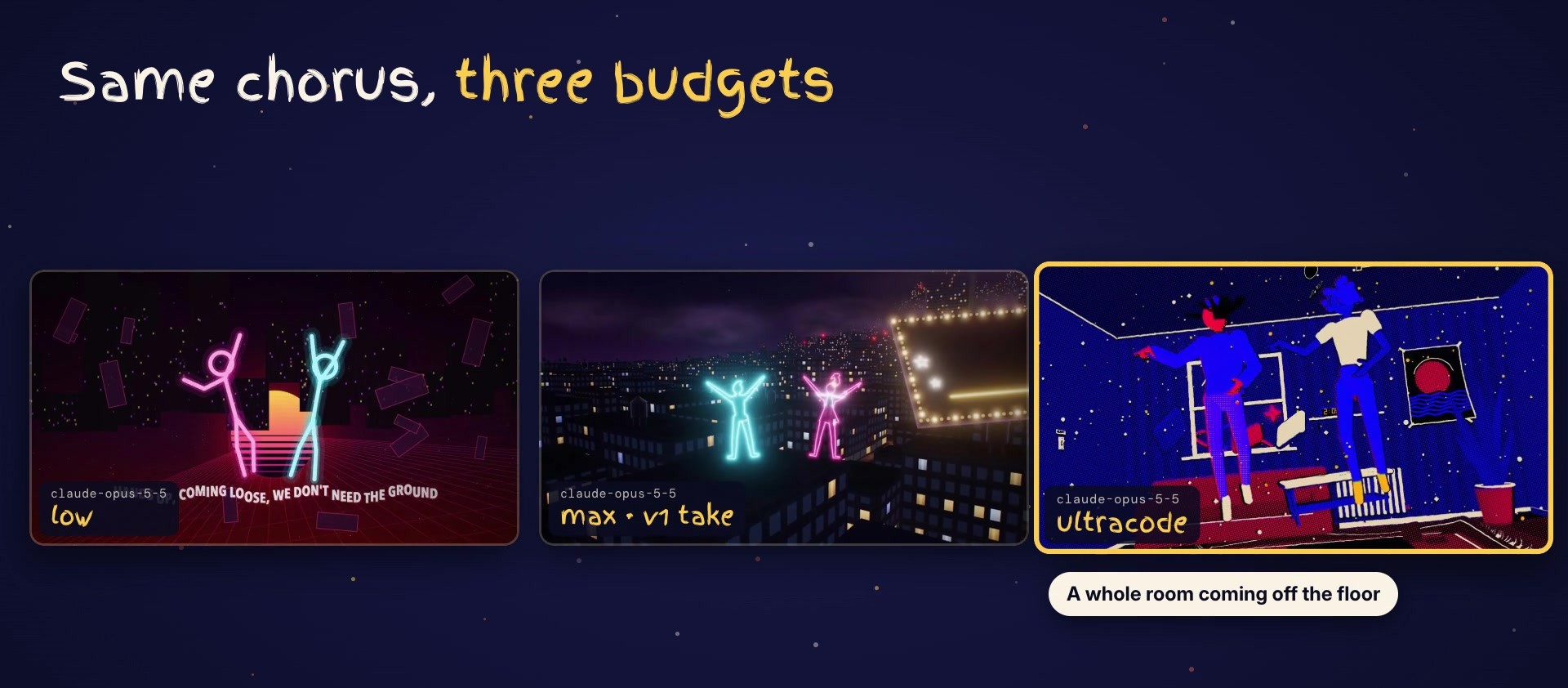
At the first chorus, low puts the words on screen with two stick figures. Max floats two neon dancers past glowing rooftops. Ultracode fills a whole room with people coming off the floor.
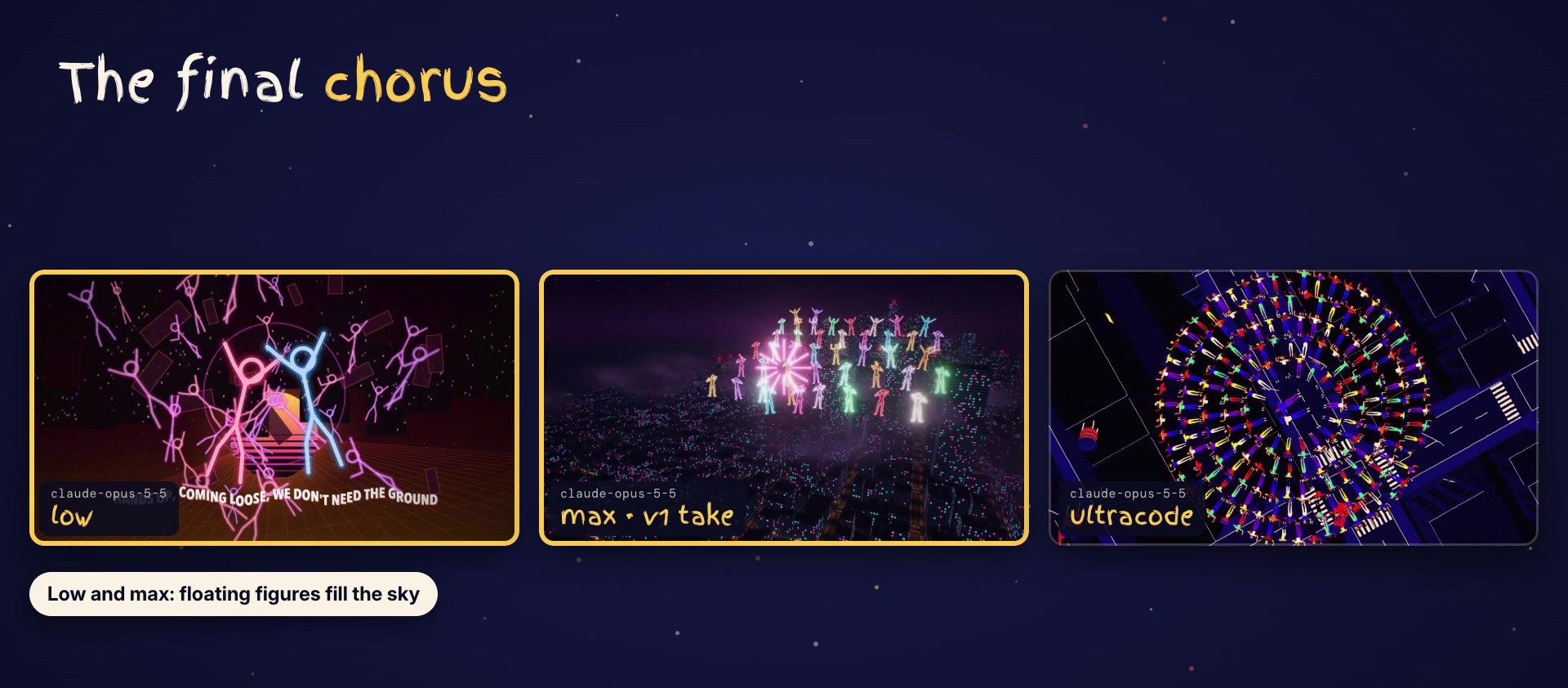
By the final chorus, low and max both fill the sky with floating figures. Ultracode pulls its entire crowd into a giant ring, shot from directly above a street intersection.
That's the bit that stuck with me. More effort didn't polish one film. It made a new film every time.
What I took away from it
Low is underrated. For about a dollar, it delivered a complete, watchable video that matches the song. If you need something fast and you'll judge it on whether it works, start there.
The jump in ideas comes late. Medium, high and extra high are mostly the same concept getting bigger: city, night, floating people. The real change in thinking showed up at ultracode, when it stopped trying to make a good city and started pitching stories to itself.
You're paying for exploration more than finish. Ultracode's extra money went into pitches, judging, parallel builders and one abandoned wave. That's how a small studio works. It's also why it's expensive.
Quality here is my eye, with no score behind it. There's no automatic measure of which one is best. I'm comparing frames and playback, and you might rank them completely differently. Which is the point of sharing them.
My own pick: if I had to ship one tomorrow, I'd ship ultracode, because it's the only version with an idea I wouldn't have thought of. If I had to ship ten, I'd run them all at low and spend my own time on the brief.
Watch them yourself
Every full version is on the AauummKar channel, so you can judge them properly with the sound up.
Links in the comment.
Which one would you ship? And would you pay the extra for it? Tell me in the comments. Next I'm deciding between the same test on a new song or the same song with a tighter brief, so I'd like to hear which you'd rather see.
The dollar figures in this story are API price estimates from run logs, shared to compare the work. They aren't billing records and nothing here is financial advice.
About the Creator
Gautam Atmakuri
I once spent seven days blindfolded, silent and without food to see what my senses were hiding. I write about that, my baby boy, barefoot running, Tirupati to Auckland life, and the business, marketing and tech I build at AumnI digital.
Enjoyed the story? Support the Creator.
Subscribe for free to receive all their stories in your feed. You could also become a paid subscriber, letting them know you appreciate their work.
Comments (2)
Seeing $1.10 at low effort give two neon stick figures while $172.97 at ultracode wrote a full motion-graphics engine from beat and lyric metadata—without Claude ever hearing the audio—is a wild way to visualize effort scaling.
I found this experiment utterly fascinating! Thanks, Gautam, for conducting it and sharing your findings!