
Human cloning: between fact and myth
Is Human cloning even possible?

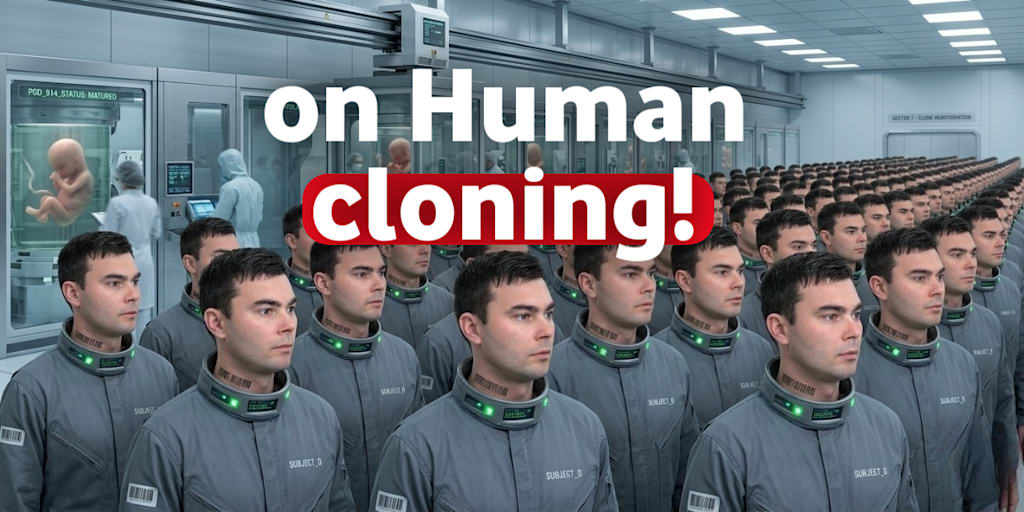
The subject of cloning has long been considered a strange, unacknowledged phenomenon, often viewed as part of "conspiracy theories" filled with exaggerations and randomness that blur the lines between reality and the impossible. However, knowing that the most famous cloning operation was successfully performed on "Dolly" the sheep in the mid-1990s, claiming that cloning itself is a myth is an inaccurate assertion; science has proven the opposite to be true. If Dolly the sheep was successfully cloned, is it possible to clone a human? In fact, human cloning is very much possible and is not biologically or scientifically impossible. We may even find independent doctors online discussing the detailed scientific and medical steps to achieve it; the matter is not confined to the claims of conspiracy theorists. Since Dolly the sheep made headlines in 1996, the world of genetics hasn't stood still. While human cloning remains a legal "no-go" zone, the technology behind it has evolved into what we now call therapeutic cloning and gene editing. Today, scientists aren't just looking to make copies of organisms; they are using tools like CRISPR to "edit" the very code of life. We have successfully cloned various species, from domestic pets like cats and dogs to endangered animals, proving that the biological "machinery" is well-oiled and functioning. The question is no longer "can we?" but rather "how far should we go?" There is a book titled *Human Cloning* by the French biophysicist and philosopher Henri Atlan, in which he discusses the possibility of cloning using purely biological language, debating the feasibility of manufacturing human copies that are not, however, entirely identical to the original. Atlan states that cloning does not "bring people back": even if we cloned a genius like Einstein, we would not get a new Einstein, but rather a "delayed twin" with a completely different consciousness and personality. What stands in the way of cloning? According to the aforementioned biologist’s book, the primary obstacles to human cloning and genetic manipulation to obtain near-identical copies are ethical, social, and consequently legal, rather than scientific. The way society might view "cloned humans" and their rights is the main deterrent for countries and authorities regarding the legalization of such a project—a project considered dangerous, yet a biological leap unprecedented in modern history. Currently, there is no single global law that bans human cloning, but the United Nations and various international health organizations have issued declarations against it, citing it as "contrary to human dignity." However, the fear remains that in some unregulated corner of the world, or within a private, highly funded laboratory, the "biological leap" has already been attempted in secret. This is where the line between science and the "conspiracy theories" you mentioned begins to blur. Without transparent international oversight, the "impossible" may be happening behind closed doors. ‘Cloning is impossible because there is no Creator but God’ Many people object to, or even refuse to believe the matter entirely, because they think cloning is equivalent to "creation," which is incorrect. There is a vast difference between the two: creation is bringing something into existence from nothing, whereas cloning only occurs if the original exists and is therefore not the act of bringing something from nothing. Here, the confusion is resolved by the contrast between them. Conclusion: As we have seen, cloning is not an impossible phenomenon from either a theoretical or practical standpoint. We have already seen how they cloned creatures in the nineties, and it does not contradict what is exclusive to Almighty God. Rather, it is internationally prohibited for social and ethical reasons more than biological or scientific ones. Consequently, describing it as a myth or a conspiracy theory is not an appropriate description. If those were the capabilities in the mid-nineties, what have they become after three decades? If we were to move forward with human cloning, we would face a psychological crisis never before seen in our history. Imagine the burden on a child born as a "copy" of a deceased relative or a famous athlete. As Henri Atlan suggested, the environment plays a massive role in who we become. A clone of Einstein born in 2026 would grow up with the internet, modern social pressures, and a completely different educational system than the original. They might have the same predispositions for physics, but their soul and consciousness would be forged in a different fire. Would we allow them to be their own person, or would they live forever in the shadow of a DNA sequence they didn't choose? What do you think?
About the Creator
Enjoyed the story? Support the Creator.
Subscribe for free to receive all their stories in your feed.
Comments
There are no comments for this story
Be the first to respond and start the conversation.