
Hubble unveils a zombie star's peculiar afterlife
A chronicle of stellar detonations

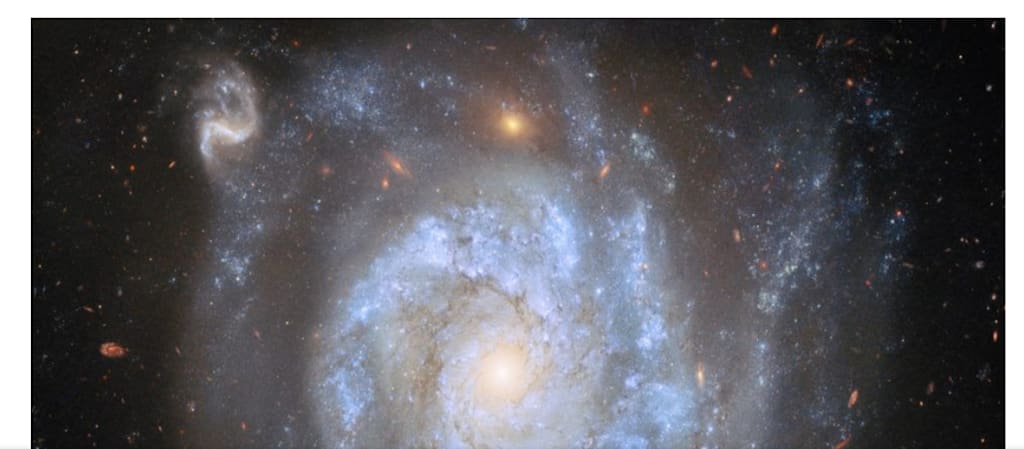
The spiral galaxy NGC 1309 is featured in today's European Space Agency Image of the Day. About 100 million light-years away, in the constellation Eridanus, is this elegant whirlwind of stars, gas, and dust.
The galaxy is beautifully detailed in the new vision. Young stars abound in its blue arms. Hundreds of far-off galaxies strewn throughout space encircle the galaxy's bright white core.
Only one of the image's many lights is a star from our own Milky Way. The distinctive diffraction spikes produced by the Hubble Space Telescope's optics make it easy to notice as it is located close to the top of the frame. Every other galaxy, even the smallest stripe, is home to billions of stars. It serves as a sobering reminder of how vast and populated the universe really is.
A chronicle of stellar detonations
Astronomers have long been captivated with NGC 1309, not just because of its stunning appearance but also because of its tumultuous past. The Hubble Space Telescope has returned to this galaxy several times throughout the years, releasing pictures in 2006, 2014, and today.
New information about the stars residing—and dying—within it has been discovered with each visit. SN 2002fk and SN 2012Z are two of the galaxy's most notable supernovae. The first, SN 2002fk, was a classic Type Ia supernova.
These happen when a white dwarf, which is a dead star's dense, burned-out core, gathers too much matter from a companion star until it hits a critical point and Astronomers use Type Ia supernovae as "standard candles" to measure enormous cosmic distances and gauge how quickly the universe is expanding because of their constant brightness.
When a star declines to pass away
NGC 1309 produced another surprise ten years after SN 2002fk. Astronomers saw a second explosion, SN 2012Z, in 2012, but this one defied convention. In its early stages, it resembled a Type Ia supernova, but its brightness was not as bright as one might anticipate. Scientists quickly discovered they were witnessing a distinct kind of event—a Type Iax supernova—because it didn't follow the traditional pattern.
This strange category is an example of an unsuccessful explosion. The bombardment merely slightly disturbed the white dwarf rather than splitting it apart, leaving Astronomers were shocked to discover that the surviving star, dubbed a "zombie star,"
was still shining and even brighter than it had been prior to the explosion when Hubble returned to NGC 1309 years later. As a result of the observations, the white dwarf progenitor of a supernova was discovered in pre-explosion photos for the first time.
The peculiar afterlife of a zombie star
A new phase of supernova research began with the discovery of the lingering remnant. It questioned the notion that these kinds of outbursts always indicate the demise of their parent stars.
Rather, the discovery implied that white dwarfs may endure and continue to shine under specific circumstances—altered but not annihilated. The course of these incomplete explosions and their causes are currently being investigated by astronomers.
One theory is that the blast fizzles out halfway because the white dwarf doesn't reach the critical mass required for a full detonation. Another idea is that the companion star creates instability by unevenly syphoning material, preventing the star from completely collapsing. Whatever the process, the end product is a spooky hybrid—a stellar corpse that manages to survive.
Hubble is still teaching us.
Since its 1990 launch, the Hubble Space Telescope has grown to be one of humanity's most reliable eyes on the universe. Astronomers can track changes over years and even decades thanks to the telescope's excellent vision from Earth's orbit, something that ground-based telescopes find difficult to accomplish.
Hubble's repeated observations of galaxies such as NGC 1309 enable scientists to make connections between stellar birth, death, In astronomy, supernovae like SN 2002fk and SN 2012Z also have more significance. They serve as natural testing grounds for researching the formation and dispersion of elements across galaxies.
The carbon, oxygen, and heavier metals released by each explosion eventually form new stars, planets, and even life itself. The story of many cycles of creation and destruction is contained in the faint glimmer of a far-off galaxy.
A glimpse into the past and future
Although NGC 1309 appears serene in Hubble's image, the tale of star evolution is still being told beneath its serene spiral arms. White dwarfs are on the verge of collapse, massive stars burn away rapidly, and supernova remnants wander through space, enriching it with the components of future worlds.
Each successive picture deepens the narrative by tying cosmic violence to the soft glow that permeates the night sky. Galaxies like NGC 1309 serve as a reminder that the cosmos continues to amaze us even after a star appears to be dead, as telescopes like Hubble and its successor, the James Webb Space Telescope, continue to push the limits of what we can view. A zombie star continues to shine somewhere within Eridanus' spirals; it is a magnificent example of tenacity expressed in the language of light.
About the Creator
Enjoyed the story? Support the Creator.
Subscribe for free to receive all their stories in your feed.
Comments
There are no comments for this story
Be the first to respond and start the conversation.