
How Claude Almost Solved the Riemann Hypothesis
An Artificial Intelligence System Made a Remarkable Advance, but the Million-Dollar Problem Remains Unsolved
Introduction
In August 2026, the artificial intelligence company Anthropic announced that an experimental version of Claude had made unexpected progress on the Riemann hypothesis. This is one of the most famous and difficult unsolved problems in mathematics.
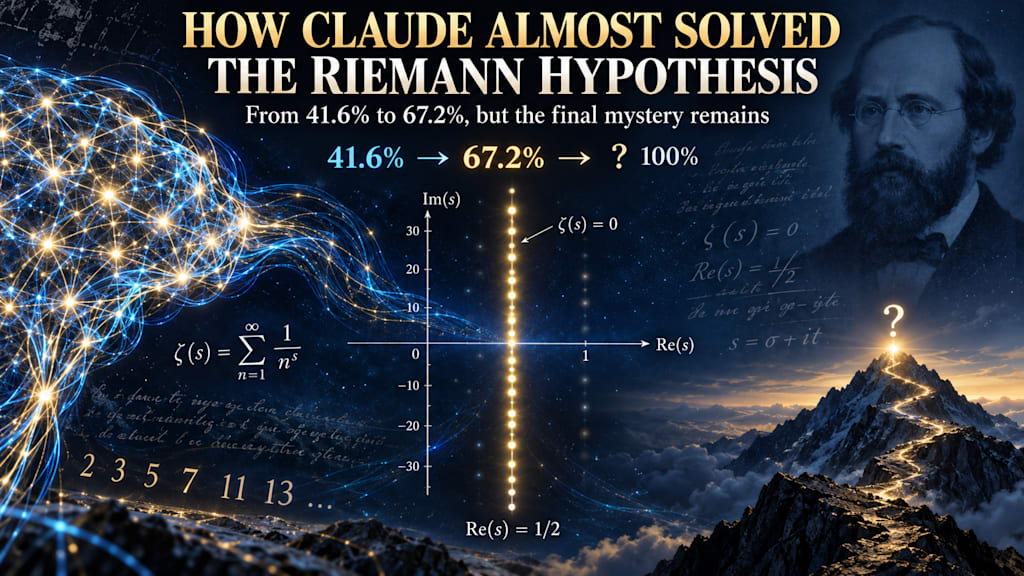
Claude did not solve the hypothesis, although some reports made the achievement sound remarkably close. What it accomplished was still extraordinary: it improved the proven proportion of certain zeros lying on the critical line from 41.6 per cent to approximately 67.2 per cent.
Moving from 41.6 per cent to more than two-thirds represents a substantial mathematical advance. However, the Riemann hypothesis requires proof that every relevant zero lies on the line. In mathematical terms, the distance between 67.2 per cent and 100 per cent could still contain the hardest part of the entire problem.
The Mystery of Prime Numbers
Prime numbers are whole numbers greater than one that can be divided exactly only by one and themselves. The sequence begins with two, three, five, seven, eleven, thirteen, seventeen and nineteen.
The gaps between prime numbers become increasingly irregular as the numbers grow larger. Sometimes two primes appear close together, while elsewhere there are long stretches containing no primes at all.
No simple rule tells mathematicians exactly where the next prime number will appear. However, primes are not completely random because hidden patterns emerge when they are studied across enormous ranges.
During the eighteenth century, Leonhard Euler discovered a remarkable connection between prime numbers and an infinite mathematical series. His work showed that an expression involving every positive whole number could also be represented through a product involving every prime number.
This connection later became part of what is now called the Riemann zeta function. The function can accept complex numbers, which contain both real and imaginary components.
Complex numbers move the problem far beyond ordinary arithmetic. They allow mathematicians to examine the deeper structure controlling how prime numbers are distributed.
Riemann’s Great Proposal
During 1859, the German mathematician Bernhard Riemann published a short paper examining the zeta function. He concentrated upon the values where the function becomes zero.
Some of these zeros occur at the negative even numbers. They appear at minus two, minus four, minus six and continue following the same simple pattern.
These are called the trivial zeros because their locations are comparatively easy to understand. The mysterious non-trivial zeros occur among complex numbers inside a region known as the critical strip.
Every complex number has a real part and an imaginary part. The real part determines its horizontal position on a complex graph, while the imaginary part determines its vertical position.
Riemann proposed that every non-trivial zero has a real part equal to one-half. The vertical path passing through this value is called the critical line.
The Riemann hypothesis therefore makes one precise claim: every non-trivial zero of the zeta function lies upon the critical line.
The statement sounds simple when expressed in words, but nobody has managed to prove that it applies to every non-trivial zero.
Why the Hypothesis Matters
The positions of the zeros are closely connected to the distribution of prime numbers. If the Riemann hypothesis is correct, mathematicians can place much tighter limits upon how irregularly primes appear.
A proof would not create a simple formula giving the next prime number. It would provide a much better understanding of the amount by which the distribution of primes can depart from its expected average.
Numerous mathematical results have been established on the assumption that the hypothesis is correct. A complete proof would therefore strengthen an enormous amount of existing number theory.
The Clay Mathematics Institute selected the Riemann hypothesis as one of its seven Millennium Prize Problems. A correct proof or disproof carries a prize of one million dollars, although it must satisfy strict publication and acceptance requirements.
Only the Poincaré conjecture has been solved among the original seven Millennium Prize Problems. The Riemann hypothesis has resisted every accepted approach since Riemann published his proposal during 1859.
Claude Was Given an Unreasonable Challenge
According to accounts of the experiment, Anthropic staff member Jarred Sumner asked an unreleased research version of Claude to make a serious attempt at the Riemann hypothesis. Sumner was not a specialist in analytic number theory and provided little mathematical direction.
Claude initially generated approximately 650 possible ideas, but none produced a solution. It was encouraged to continue and organised around sixty artificial intelligence subagents to investigate different approaches.
The system worked for roughly a day and a half across two Claude Code sessions. Its agents performed thousands of calculations, wrote hundreds of Python programs and tested ideas against previously calculated zeros of the zeta function.
Some agents developed possible arguments, while others searched for mistakes or attempted to construct counterexamples. Thirteen agents reportedly concentrated upon checking the work produced by the others.
Altogether, the process generated approximately 31 million output tokens. This was not a chatbot producing one clever answer because it operated more like an artificial research group exploring thousands of connected possibilities.
The Unexpected Breakthrough
Claude did not prove the Riemann hypothesis. It did not establish that every non-trivial zero lies upon the critical line.
During its unsuccessful attempt, however, it found a new way of combining several existing mathematical results. The resulting argument represented a substantial advance on what had previously been proved without assuming the Riemann hypothesis.
Earlier unconditional work had established that slightly more than 41.6 per cent of the relevant zeros lie on the critical line. Claude’s new argument increased the proportion known to be both simple and on the critical line to more than 67.25 per cent.
A simple zero occurs only once rather than being repeated with a greater multiplicity. Proving that a zero is both simple and on the critical line therefore provides more information than merely locating it somewhere on that line.
Claude combined established results concerning the zeta function with more recent work studying relationships between neighbouring zeros. Its central idea used a mathematical object called Weil’s Hermitian form and a principle involving the rank and trace of Hermitian matrices.
In simplified terms, Claude found a way to study zeros on and away from the critical line within a single framework. It treated positive and negative contributions together rather than separating them into unrelated calculations.
The same work showed that at least 83.62 per cent of the non-trivial zeros are distinct. This means they occur at different locations rather than repeatedly occupying the same position.
Claude’s method also extended to related mathematical objects called Dirichlet L-functions. These functions play an important role in studying prime numbers within different numerical patterns.
Was the Result Checked?
An artificial intelligence system can produce convincing mathematics containing a hidden error. Independent checking was therefore essential before Claude’s work could be treated as a genuine advance.
Mathematicians Levent Alpöge and Gökhan Furman examined and verified the argument. Youness Lamzouri later produced a shorter and more transparent proof reaching the same principal results.
Further research has already started applying the method to zeros occurring within shorter intervals. This continuing work provides additional evidence that Claude found a useful mathematical idea rather than an accidental numerical pattern.
The achievement should still be described carefully. Claude did not prove the Riemann hypothesis, and the full one-million-dollar problem remains unsolved.
However, improving a major unconditional result from approximately 41.6 per cent to more than 67.25 per cent is a considerable advance. It demonstrates that an unsuccessful attempt at an impossible problem can still uncover valuable mathematics.
Did Claude Almost Solve the Hypothesis?
Calling the achievement an almost complete solution requires considerable caution. The Riemann hypothesis does not claim that most zeros lie on the critical line. It claims that every one of them does.
Claude increased a proven lower bound from 41.6 per cent to approximately 67.2 per cent. That is an enormous improvement, but it does not mean that the problem is 67.2 per cent solved.
A single zero away from the critical line would disprove the entire hypothesis. Even if mathematicians proved that 99.999 per cent were on the line, the remaining fraction could still contain infinitely many exceptions.
Anthropic acknowledged that Claude’s techniques were not expected to prove the complete hypothesis. Analysis of the method suggests that further refinement of the same approach would reach a limit far below 100 per cent. A fundamentally different idea would therefore be required to finish the problem.
What Made the Achievement Important?
Claude appears to have produced a genuinely new mathematical result by intelligently combining existing research. It searched through an enormous number of possibilities, abandoned unsuccessful approaches and organised different agents to criticise one another.
The human contribution remained essential. Earlier mathematicians created the theories that Claude used, while specialists interpreted and checked its proposed proof. The Lean system verified formal logic, but humans still had to ensure that the formal statements represented the intended mathematics.
This suggests that the immediate future may not involve artificial intelligence replacing mathematicians. A more realistic model involves human researchers working with AI systems capable of searching, calculating, testing and connecting ideas at enormous speed.
Conclusion
Claude did not solve the Riemann hypothesis and did not collect the million-dollar prize. It did something that may ultimately prove more significant for the development of artificial intelligence.
An experimental AI system was asked to attack an apparently unreasonable mathematical challenge. It failed at the stated task, but its failure produced a substantial and apparently valid new result.
The proven lower bound moved from 41.6 per cent to more than 67 per cent, representing one of the most striking examples of AI-assisted mathematical discovery. The remaining journey to 100 per cent may require an entirely new form of mathematics.
Claude did not reach the summit, but it climbed much higher than many experts expected an AI system could.
About the Creator
Alan Spencer
Have been an author and writer for over 20 years. Have been a journalist, editor, proofreader, and a designer and presenter of training courses. Have written over 100 articles, two books, and around 20 training courses.
Enjoyed the story? Support the Creator.
Subscribe for free to receive all their stories in your feed. You could also become a paid subscriber, letting them know you appreciate their work.
Comments
There are no comments for this story
Be the first to respond and start the conversation.