
How a Small Farming Village Used Technology to Beat a Water Crisis
When drought threatened their future, a group of farmers, engineers, and community leaders discovered that innovation could help protect both their crops and their way of life.

For generations, farming had been the heartbeat of a small rural village. Families relied on the land not only for income but also for food, tradition, and identity. The fields stretched across the landscape, producing crops that supported hundreds of households.
But over time, the weather began to change.
Rainfall became less predictable. Seasons that once brought steady showers started arriving late or not at all. Wells that had supplied water for decades dropped to dangerously low levels. Farmers found themselves using more water while harvesting less produce.
The situation grew worse with each passing year.
Many families worried they would eventually be forced to abandon farming altogether. Some younger residents began leaving the village in search of work elsewhere, believing agriculture no longer offered a secure future.
Yet despite these challenges, the community refused to give up.
The turning point came when a group of local leaders attended an agricultural workshop in a nearby city. There, they learned about affordable technologies being used in other regions to improve water management.
The concepts sounded promising.
Instead of watering entire fields based on fixed schedules, farmers could use soil sensors to measure moisture levels directly in the ground. The data could then be analyzed by software systems that recommended exactly when and where irrigation was needed.
At first, many villagers were skeptical.
Most had spent their entire lives farming through experience and observation. Trusting electronic devices to guide irrigation decisions felt unfamiliar. Some worried the technology would be expensive or difficult to maintain.
Still, the worsening drought left few alternatives.
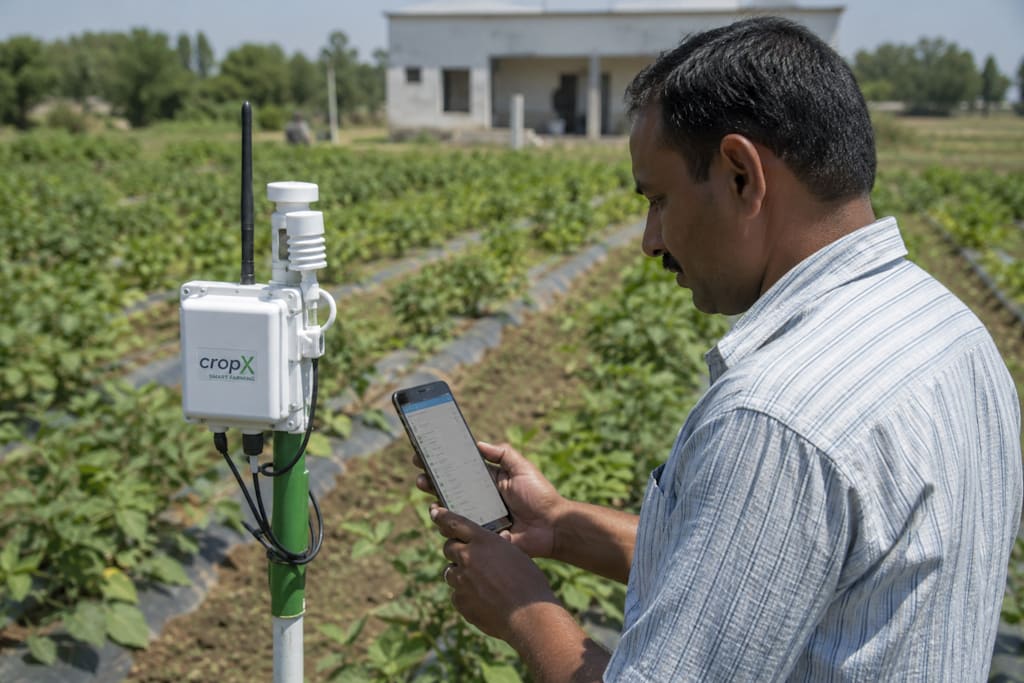
With support from local agricultural experts, the village launched a small pilot project. A handful of farms agreed to install low-cost soil moisture sensors across selected fields.
The sensors continuously monitored conditions beneath the surface and transmitted information to a simple mobile application.
For the first time, farmers could see exactly how much moisture remained in different areas of their land.
The results were surprising.
Many fields that appeared dry on the surface still contained enough moisture below ground. In other locations, certain sections needed water far sooner than expected.
Instead of irrigating entire fields equally, farmers began applying water only where it was genuinely needed.
This change alone reduced unnecessary water use significantly.
Encouraged by the early success, the project expanded.
A team of engineers worked with the community to introduce a basic artificial intelligence system capable of analyzing weather forecasts, historical rainfall patterns, soil conditions, and crop requirements.
The system generated irrigation recommendations designed to maximize efficiency.
Importantly, the technology did not replace farmers.
It served as a decision-support tool, helping them combine traditional knowledge with data driven insights. Farmers remained in control while gaining access to information that had previously been unavailable.
As more farms joined the initiative, measurable improvements began to appear.
Water consumption decreased across the village.
Crop health improved.
Farmers reported fewer losses during periods of extreme heat.
Some fields even produced higher yields despite using less water than in previous seasons.
The benefits extended beyond agriculture.
Reduced water usage eased pressure on local wells and reservoirs. Families became more confident about the future. Young people who had once considered leaving started seeing opportunities within their own community.
The project also encouraged collaboration.
Farmers regularly met to discuss results, share experiences, and help one another adapt to new techniques. Engineers continued refining the system based on feedback from the people who used it daily.
What began as a response to drought gradually evolved into a model of community innovation.
The village's story attracted attention from neighboring regions facing similar challenges. Visitors arrived to learn how affordable technology could be integrated into traditional farming practices without requiring massive investments.
One lesson stood out above all others.
Technology alone was not responsible for the success.
The true achievement came from the willingness of farmers, local leaders, and technical experts to work together toward a common goal. The sensors provided information. The software offered recommendations. But it was the people who transformed those tools into meaningful solutions.
Today, drought remains a challenge.
No technology can guarantee rainfall or eliminate every risk associated with agriculture. However, the village is far better prepared than it was before.
Its farmers now make irrigation decisions based on real-time information rather than guesswork. Water resources are managed more carefully. Crops are more resilient. And the community has gained confidence in its ability to adapt to changing conditions.
In a world where climate-related challenges continue to affect agricultural regions across the globe, this village offers an important reminder.
Innovation does not always require expensive infrastructure or groundbreaking inventions.
Sometimes, meaningful change begins with practical tools, local cooperation, and the determination to protect a way of life.
By combining traditional farming wisdom with modern technology, one small community found a path forward and in doing so, demonstrated that even the most difficult challenges can inspire creative solutions.
The future of agriculture may not depend solely on technology or tradition. It may depend on how effectively the two can work together.
About the Creator
Farooq Hashmi
Thanks For Reading! Subscribe To My Newsletters.
Storyteller, Love/Romance, Dark, Surrealism, Psychological, Nature, Mythical, Whimsical
Love You All❤️❤️❤️
Enjoyed the story? Support the Creator.
Subscribe for free to receive all their stories in your feed.
Comments
There are no comments for this story
Be the first to respond and start the conversation.