
Hip Replacement Market Expands as Aging Populations and Advanced Surgical Technologies Drive Global Demand
Rising cases of osteoarthritis, growing medical tourism, and innovations in minimally invasive surgery are transforming the future of hip replacement procedures worldwide.

The global hip replacement market is entering a period of sustained growth as rising life expectancy, increasing rates of osteoarthritis, and advancements in orthopedic technology continue reshaping patient care. What was once considered a procedure primarily for elderly patients has evolved into a highly advanced and increasingly accessible surgical solution benefiting millions of people worldwide.
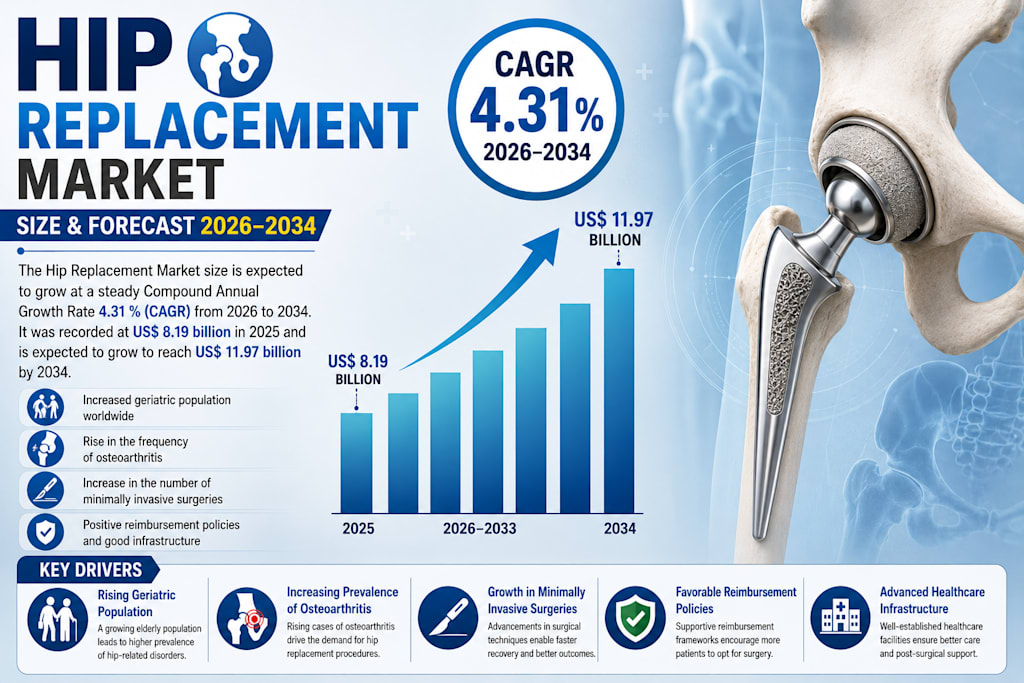
According to Renub Research, the Hip Replacement Market is expected to grow from US$ 8.19 billion in 2025 to US$ 11.97 billion by 2034, expanding at a CAGR of 4.31% from 2026 to 2034. The market’s growth is being driven by the expanding geriatric population, increasing prevalence of degenerative joint diseases, rising adoption of minimally invasive surgeries, and improvements in healthcare infrastructure and reimbursement systems globally.
As patients increasingly seek long-term pain relief, mobility restoration, and improved quality of life, hip replacement surgery is becoming one of the most successful and cost-effective orthopedic interventions available in modern healthcare.
Hip replacement surgery is becoming increasingly common worldwide
Hip replacement surgery, also known as total hip arthroplasty, involves replacing damaged or diseased hip joints with artificial components made from metal, ceramic, or durable plastic materials. The procedure is primarily used to treat severe osteoarthritis, rheumatoid arthritis, avascular necrosis, hip fractures, and post-traumatic joint damage.
During the procedure, damaged cartilage and bone are removed and replaced with prosthetic ball-and-socket components that replicate the natural movement of the hip joint. Over the years, improvements in implant design, surgical techniques, and post-operative rehabilitation have significantly increased the success rates and durability of hip replacement procedures.
Modern hip implants can often last 15 to 20 years or longer, making the procedure highly attractive for patients seeking long-term mobility improvement and chronic pain relief. Faster recovery times and minimally invasive surgical approaches have further expanded acceptance among both older and younger patient groups.
Aging populations are one of the biggest market drivers
One of the strongest factors fueling growth in the hip replacement market is the rapid expansion of the global aging population. Older adults face significantly higher risks of degenerative joint disorders such as osteoarthritis, osteoporosis, and rheumatoid arthritis, all of which can eventually require surgical intervention.
According to data referenced in the report, approximately 344 million people worldwide are affected by osteoarthritis, with around 73% of affected individuals aged over 55 years and 60% being female. Additionally, around 13 million people globally suffer from rheumatoid arthritis, further contributing to demand for orthopedic procedures.
As cartilage deteriorates and bone density declines with age, many patients experience severe pain, reduced mobility, and declining quality of life. Hip replacement surgery often becomes one of the most effective long-term solutions for restoring movement and reducing chronic discomfort.
Regions such as North America, Europe, Japan, China, and increasingly parts of Asia-Pacific are experiencing rapid demographic aging, creating sustained long-term demand for orthopedic care and joint replacement procedures.
Technological innovation is improving surgical outcomes
Technological advancements in implants and surgical techniques are transforming the hip replacement industry. Modern implants are now manufactured using advanced materials such as ceramic-on-ceramic systems, highly cross-linked polyethylene, and metal-polyethylene combinations designed to improve durability and reduce wear.
At the same time, surgical technologies have become significantly more sophisticated. Minimally invasive procedures, robotic-assisted surgery, computer-assisted navigation, and image-guided systems are improving surgical precision while reducing recovery times and complication risks.
These innovations provide several benefits, including smaller incisions, reduced blood loss, shorter hospital stays, less post-operative pain, and faster rehabilitation. Patients increasingly prefer procedures that allow quicker returns to normal activities and improved long-term outcomes.
One notable recent development occurred in February 2025 when Gyder Surgical announced FDA 510(k) clearance for the GYDER Hip System, described as the world’s first non-invasive, pin-less, and image-less technology designed for highly accurate positioning of acetabular cups during anterior hip arthroplasty procedures.
As hospitals and orthopedic centers continue adopting advanced surgical systems, technology is expected to remain one of the most important growth drivers in the global market.
Awareness and healthcare access are increasing globally
Growing awareness regarding orthopedic conditions and treatment options is also supporting market expansion. Patients today are far more informed about the potential benefits of hip replacement surgery, including pain reduction, restored mobility, and improved quality of life.
Improved healthcare infrastructure and better access to specialized orthopedic services in developing economies are making advanced procedures available to broader populations. Insurance coverage, government healthcare initiatives, and investments in surgical facilities are helping increase accessibility in many countries.
At the same time, medical tourism has become an increasingly important contributor to global market growth. Countries such as India are attracting international patients by offering high-quality hip replacement surgeries at significantly lower costs compared to developed markets like the United States, the United Kingdom, and Australia.
According to the report, unilateral hip replacement surgery in India may cost around US$ 5,000, compared to US$ 25,000 or more in many Western countries. Bilateral procedures in India average around US$ 10,000, compared to approximately US$ 40,000 or more elsewhere.
Government initiatives such as India’s “Heal in India” program are further strengthening medical tourism by streamlining visa processes, improving healthcare quality standards, and expanding medical infrastructure.
High procedure costs remain a major challenge
Despite its benefits, hip replacement surgery remains expensive for many patients, particularly in low- and middle-income countries. Total treatment costs often include diagnostic testing, implant expenses, surgeon fees, hospitalization, rehabilitation, and long-term follow-up care.
Advanced implant materials and robotic surgical systems can increase costs further, limiting affordability for uninsured or underinsured populations. Even in developed countries, rising healthcare costs continue placing pressure on hospitals, insurance providers, and healthcare systems.
Long waiting periods for surgery in public healthcare systems may also negatively affect patient outcomes and quality of life. For many patients, delayed access to surgery can lead to worsening mobility issues, increased pain, and reduced independence.
Addressing affordability and improving access to orthopedic care will remain essential challenges as demand continues rising globally.
Surgical risks and implant complications still concern patients
Although hip replacement surgery is generally considered highly successful, potential complications continue affecting patient confidence and treatment decisions. Risks may include infection, blood clots, nerve damage, implant loosening, joint dislocation, and the possibility of revision surgery later in life.
Implant longevity remains particularly important for younger and more active patients. Because younger individuals place greater stress on implants over longer periods, concerns regarding wear and future replacement procedures remain significant.
Fear of surgical complications may discourage some patients from seeking treatment, especially in regions with limited access to high-quality post-operative rehabilitation and follow-up care.
Continued innovation in implant materials, surgical precision, and patient monitoring technologies will be critical for minimizing risks and improving long-term patient outcomes.
Total hip replacement dominates the market
Among all product segments, total hip replacement currently represents the largest portion of the market. This procedure replaces both the femoral head and the hip socket, providing comprehensive treatment for severe joint damage and advanced degenerative conditions.
Total hip replacement remains especially popular because of its strong long-term success rates, durability, and ability to significantly improve mobility and pain management. The procedure is commonly recommended for severe osteoarthritis, rheumatoid arthritis, avascular necrosis, and major hip fractures.
At the same time, partial hip replacement continues growing steadily in more selective patient groups, particularly elderly patients with localized hip fractures or less extensive joint damage. These procedures often involve shorter surgical times, less blood loss, and faster recovery periods.
Hospitals and surgery centers lead treatment delivery
Hospitals and specialized surgery centers currently dominate the hip replacement market because they possess the infrastructure and expertise required for advanced orthopedic procedures. These facilities increasingly utilize minimally invasive and robotic-assisted surgical systems designed to improve outcomes and reduce recovery times.
Orthopedic clinics also play an increasingly important role by providing early diagnosis, patient education, rehabilitation services, and pre-operative planning. The broader trend toward specialized outpatient orthopedic care is gradually reshaping treatment delivery models worldwide.
Growing demand for shorter hospital stays and lower-cost surgical options is also supporting the expansion of ambulatory surgery centers for selected hip replacement procedures.
Regional markets show strong growth opportunities
The United States remains one of the world’s largest and most technologically advanced hip replacement markets. High levels of healthcare access, advanced surgical capabilities, strong reimbursement systems, and increasing adoption of robotic-assisted procedures continue driving growth.
In October 2025, Zimmer Biomet announced that the U.S. FDA granted Breakthrough Device Designation for its iodine-treated total hip replacement system, highlighting the country’s ongoing leadership in orthopedic innovation.
The United Kingdom market benefits from an established public healthcare system and growing investments aimed at improving orthopedic surgical capacity. New technologies and enhanced surgical efficiency initiatives are helping address increasing patient demand.
India is emerging as one of the fastest-growing hip replacement markets globally due to expanding healthcare infrastructure, rising awareness, skilled orthopedic specialists, and strong medical tourism growth. In January 2026, Manipal Hospital Gurugram successfully performed a 3D-navigated total hip replacement using the IntelliJoint 3D Navigation System, reflecting the country’s increasing adoption of advanced orthopedic technologies.
Saudi Arabia’s market is also expanding steadily as the country modernizes healthcare infrastructure and increases investment in specialized surgical facilities. Advanced techniques such as Direct Anterior Approach (DAA) hip replacement procedures are gaining popularity because they allow faster recovery and reduced muscle damage.
The future of orthopedic care is becoming increasingly advanced
The global hip replacement market is evolving toward more personalized, technology-driven, and minimally invasive care models. Robotics, AI-assisted surgical planning, smart implants, and advanced navigation systems are expected to improve surgical accuracy and patient outcomes even further in the coming years.
The market’s segmentation across total, partial, and revision hip replacement procedures reflects the growing complexity and specialization of orthopedic treatment. Increasing patient expectations for faster recovery, lower complication rates, and longer-lasting implants will continue driving innovation throughout the industry.
As healthcare systems worldwide focus more heavily on mobility preservation, healthy aging, and quality of life improvements, hip replacement surgery is expected to remain one of the most important orthopedic interventions globally.
Final Thoughts
The global hip replacement market is entering a period of steady and sustained growth fueled by aging populations, rising osteoarthritis cases, technological innovation, and expanding healthcare access. Advances in minimally invasive surgery, robotic systems, and durable implant materials are making procedures safer, faster, and more effective for patients worldwide.
With Renub Research forecasting the market to reach US$ 11.97 billion by 2034, hip replacement surgery is expected to remain a critical pillar of modern orthopedic care. Companies and healthcare providers that successfully combine advanced technology, affordability, patient safety, and rehabilitation support are likely to shape the next generation of orthopedic treatment globally.
About the Creator
Enjoyed the story? Support the Creator.
Subscribe for free to receive all their stories in your feed.
Comments
There are no comments for this story
Be the first to respond and start the conversation.