
Global Rapid-Acting Insulin Market Expands as Smart Diabetes Technologies, Rising Diabetes Cases, and Advanced Insulin Delivery Systems Accelerate Adoption
Increasing global diabetes prevalence, growing integration of CGM and insulin pump technologies, and expanding access to advanced insulin therapies are driving sustained growth across the rapid-acting insulin market.

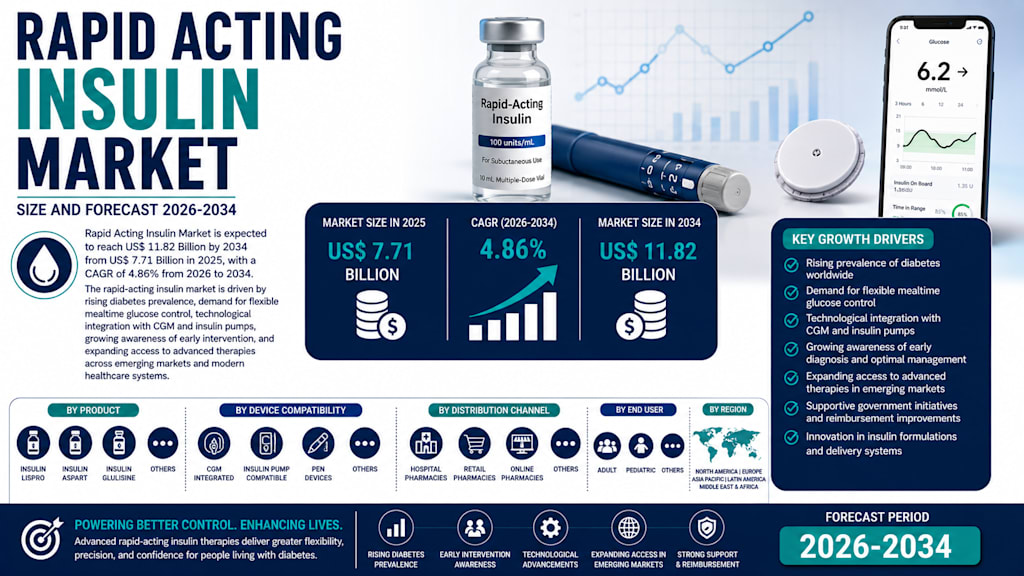
Global rapid-acting insulin market enters a new phase of diabetes innovation
The global rapid-acting insulin market is witnessing strong expansion as healthcare systems increasingly prioritize advanced diabetes management, personalized glucose control, and technology-integrated treatment solutions. According to the latest industry analysis, the Rapid-Acting Insulin Market is expected to grow from US$ 7.71 billion in 2025 to US$ 11.82 billion by 2034, registering a CAGR of 4.86% between 2026 and 2034.
This growth is being fueled by rising diabetes prevalence worldwide, growing adoption of continuous glucose monitoring (CGM) devices, and increasing demand for insulin therapies capable of delivering flexible mealtime glucose management. Rapid-acting insulin formulations have become central to modern diabetes care because they closely mimic the body’s natural insulin response following meals.
As digital diabetes ecosystems evolve, rapid-acting insulin products are becoming increasingly integrated with smart insulin pumps, automated insulin delivery systems, and AI-supported glucose monitoring technologies. Pharmaceutical innovation, expanding reimbursement support, and rising awareness regarding early diabetes intervention are also accelerating global adoption.
What makes rapid-acting insulin essential in modern diabetes care?
Rapid-acting insulin is designed to begin working within minutes after administration, helping patients manage blood glucose spikes that occur after eating. These formulations are commonly prescribed for individuals with type 1 diabetes and are increasingly used among insulin-dependent type 2 diabetes patients who require tighter post-prandial glucose control.
Compared with older insulin formulations, rapid-acting options offer:
- Faster absorption
- Predictable glucose-lowering effects
- Greater flexibility around meals
- Better compatibility with insulin pumps and CGM systems
- Reduced post-meal hyperglycemia
Because of these advantages, rapid-acting insulin has become a core component of advanced diabetes management strategies.
The market includes several leading analogs such as lispro insulin, aspart insulin, and glulisine insulin, each designed to optimize glucose control while supporting modern automated insulin delivery technologies.
Rising diabetes prevalence continues driving global demand
One of the strongest growth drivers behind the market is the increasing prevalence of diabetes worldwide. Aging populations, sedentary lifestyles, rising obesity rates, and changing dietary habits are contributing to a steady rise in both type 1 and type 2 diabetes cases globally.
As more patients require long-term insulin therapy, healthcare providers are increasingly turning toward advanced formulations capable of delivering better glycemic control and reducing complications associated with post-meal glucose fluctuations.
The report highlights that diabetes prevalence remains particularly high in major healthcare markets:
The U.S. Centers for Disease Control and Prevention estimated that 38.4 million Americans had diabetes in 2023.
Germany’s Robert Koch Institute reported diabetes prevalence above 8.5% among adults.
The International Diabetes Federation estimated that 11.9% of China’s adult population has diabetes.
Saudi Arabia’s Ministry of Health reported 5.3 million diabetes patients in 2024.
These figures demonstrate the enormous long-term demand potential for insulin therapies worldwide.
Smart diabetes technologies are transforming treatment models
One of the most important trends reshaping the rapid-acting insulin market is the growing integration between insulin formulations and digital diabetes technologies. Continuous glucose monitoring systems, insulin pumps, smart pens, and automated insulin delivery platforms are changing how diabetes is managed.
Rapid-acting insulin plays a critical role in these systems because it enables fast and precise glucose adjustments based on real-time monitoring data.
Healthcare providers increasingly favor algorithm-driven insulin dosing systems capable of automatically responding to changing glucose levels. These technologies improve treatment accuracy, reduce hypoglycemia risk, and enhance patient convenience.
The report highlights a major August 2024 collaboration between Abbott and Medtronic aimed at developing an integrated CGM–automated insulin delivery ecosystem using FreeStyle Libre technology.
This partnership reflects how digital diabetes ecosystems are strengthening demand for insulin products compatible with automated dosing platforms.
Emerging markets are accelerating adoption of advanced therapies
Emerging economies are becoming increasingly important growth regions for rapid-acting insulin manufacturers. Improvements in healthcare infrastructure, rising diabetes diagnosis rates, and government support for chronic disease management are accelerating adoption of advanced diabetes therapies.
Countries across Asia-Pacific, Latin America, and the Middle East are expanding access to modern insulin regimens and smart diabetes technologies.
One notable development occurred in December 2024 when Cipla received approval from India’s CDSCO to exclusively distribute Afrezza, the inhaled rapid-acting insulin powder.
This approval highlights increasing momentum toward patient-friendly insulin delivery options in high-growth healthcare markets.
Governments and healthcare providers in emerging economies are also investing heavily in diabetes awareness campaigns, screening programs, and digital healthcare systems to improve long-term disease management.
Innovation in biologics continues supporting market growth
Ongoing innovation in biologics and insulin analog development remains another major growth driver. Pharmaceutical companies continue working to improve insulin absorption speed, stability, convenience, and compatibility with automated delivery systems.
Research efforts are increasingly focused on ultra-rapid insulin formulations capable of providing even faster glucose control while reducing treatment burden for patients.
The report references broader biotechnology innovation trends as well, including February 2023 developments where Heartseed and Novo Nordisk initiated the HS-001 clinical trial for advanced heart failure. While focused on cardiology, such biologics innovation ecosystems help strengthen broader metabolic disorder R&D capabilities.
As biotechnology advances continue accelerating globally, insulin innovation pipelines are expected to remain highly active.
Lispro insulin remains a key market segment
Lispro insulin continues to represent one of the most important rapid-acting insulin categories globally. Its ultra-fast absorption profile and predictable pharmacokinetics make it especially suitable for insulin pumps, CGM systems, and automated insulin delivery platforms.
Lispro insulin is widely prescribed for both type 1 diabetes and insulin-dependent type 2 diabetes patients because it provides efficient post-meal glucose control with lower variability.
The introduction of biosimilar lispro products is also helping improve affordability and expand access in emerging markets, increasing competition within the segment.
Type 1 diabetes remains a major long-term demand driver
Type 1 diabetes patients represent one of the largest user groups for rapid-acting insulin therapies. Because these individuals require lifelong insulin treatment, rapid-acting formulations are essential for managing post-prandial glucose spikes effectively.
The report highlights that rising diagnosis rates among children and adolescents are contributing to long-term demand growth.
Modern type 1 diabetes management increasingly relies on hybrid closed-loop systems combining CGMs, insulin pumps, and rapid-acting insulin analogs. These integrated systems are significantly improving glucose control and patient quality of life.
As digital diabetes ecosystems evolve further, type 1 diabetes care is expected to remain one of the strongest drivers for rapid-acting insulin adoption globally.
Hospital pharmacies remain critical distribution channels
Hospital pharmacies continue playing a major role in the distribution and administration of rapid-acting insulin products. Hospitals frequently use these therapies in acute diabetes management, perioperative care, emergency hyperglycemia treatment, and newly diagnosed patient management.
Because hospitals manage severe and complex diabetes cases, demand for dependable analog insulin formulations remains consistently strong.
Advanced inpatient diabetes protocols and digital medication management systems are further supporting increased use of rapid-acting insulin within hospital settings.
Government reimbursement frameworks and procurement systems also help stabilize hospital purchasing volumes globally.
High treatment costs remain a major industry challenge
Despite strong demand growth, affordability remains one of the biggest challenges facing the rapid-acting insulin market. These advanced formulations are significantly more expensive than traditional human insulin products.
Patients often face additional costs associated with CGMs, insulin pumps, smart pens, and other diabetes technologies required for advanced glucose management.
Pricing disparities and uneven insurance coverage continue limiting access in several low- and middle-income countries. Even in developed markets, out-of-pocket expenses can create barriers to long-term adherence.
Governments, insurers, and pharmaceutical companies are therefore under growing pressure to improve affordability through subsidy programs, biosimilar competition, and reimbursement reforms.
Manufacturing complexity creates supply and pricing pressure
Rapid-acting insulin production involves sophisticated biologics manufacturing processes, strict quality controls, and temperature-sensitive supply chains.
Any disruptions involving raw materials, facility operations, or cold-chain logistics can significantly impact global availability.
Regulatory pathways for biosimilar products also remain highly demanding because manufacturers must demonstrate extensive clinical comparability regarding safety, stability, absorption profiles, and immunogenicity.
These manufacturing complexities contribute to high production costs while limiting the number of companies capable of entering the market.
United States remains the largest global market
The United States continues to dominate the global rapid-acting insulin market because of its large diabetes population, advanced healthcare infrastructure, and widespread adoption of CGM devices and automated insulin delivery systems.
Technology-enabled diabetes care has become increasingly mainstream in the country, driving strong demand for insulin analogs compatible with smart monitoring and dosing platforms.
Biosimilar launches, insurance reforms, and digital healthcare integration are expected to continue supporting U.S. market growth over the forecast period.
Germany strengthens Europe’s digital diabetes ecosystem
Germany remains one of Europe’s leading rapid-acting insulin markets due to universal healthcare coverage, strong adoption of insulin pump therapy, and active digital health initiatives.
The country’s national e-health programs are accelerating integration between CGMs, hybrid closed-loop systems, and insulin therapies.
Healthcare providers increasingly prioritize rapid-acting insulin for both clinical and home-care diabetes management because of its predictable action and compatibility with digital treatment systems.
China becomes a major global growth opportunity
China’s market is expanding rapidly because of urbanization, rising obesity rates, and government support for chronic disease management. Domestic and multinational companies are heavily investing in insulin analog manufacturing and biosimilar development.
Growing adoption of smart glucose-monitoring technologies and local manufacturing expansion are also improving affordability and treatment accessibility.
China’s enormous diabetes patient population positions it as one of the most important long-term growth opportunities globally.
Saudi Arabia sees strong demand growth
Saudi Arabia continues witnessing strong growth due to extremely high diabetes prevalence and increasing investment in advanced diabetes care.
Government-backed healthcare modernization initiatives, wider insurance coverage, and growing adoption of CGMs and smart insulin pens are supporting market expansion.
Lifestyle-related metabolic disorders remain a major public health challenge, reinforcing long-term demand for rapid-acting insulin therapies.
Key companies continue intensifying competition
The rapid-acting insulin market remains highly competitive, with pharmaceutical and biotechnology companies investing heavily in insulin innovation, delivery systems, and biologics research.
The report references several important industry developments and partnerships involving companies such as:
- Abbott
- Medtronic
- Cipla
- Amylyx Pharmaceuticals
- Arecor Therapeutics
- Novo Nordisk
- Lilly
Ten notable developments shaping the rapid-acting insulin market
- Abbott and Medtronic partnered to develop integrated CGM–AID systems.
- Cipla received approval to distribute inhaled insulin Afrezza in India.
- Amylyx Pharmaceuticals acquired avexitide from Eiger BioPharmaceuticals.
- Arecor Therapeutics partnered with Medtronic on high-concentration insulin formulations.
- Lilly supported insulin API affordability initiatives in Bangladesh.
- Smart insulin pumps and CGM adoption continue accelerating globally.
- Demand for algorithm-driven insulin dosing systems is increasing.
- Biosimilar insulin competition is improving affordability in emerging markets.
- Ultra-rapid insulin analog innovation remains a major R&D priority.
- Governments worldwide are expanding diabetes management infrastructure and digital healthcare initiatives.
Final thoughts
The global rapid-acting insulin market is evolving rapidly as diabetes care becomes increasingly technology-driven, personalized, and connected. Rising diabetes prevalence, growing adoption of CGM systems, and expansion of automated insulin delivery platforms are transforming how insulin therapies are used worldwide.
With the market projected to grow from US$ 7.71 billion in 2025 to US$ 11.82 billion by 2034, pharmaceutical companies and healthcare providers are expected to intensify focus on affordability, biologics innovation, digital integration, and patient-centered treatment strategies. The companies capable of combining rapid glucose control, seamless device compatibility, and broader accessibility are likely to shape the future of advanced diabetes management globally.
About the Creator
Enjoyed the story? Support the Creator.
Subscribe for free to receive all their stories in your feed.
Comments
There are no comments for this story
Be the first to respond and start the conversation.