
Global Liquid Biopsy Market 2026–2034: Transforming Cancer Diagnosis with Non-Invasive Precision
Advances in genomic testing and rising demand for early cancer detection are driving rapid adoption of liquid biopsy technologies worldwide.

A New Era in Cancer Diagnostics
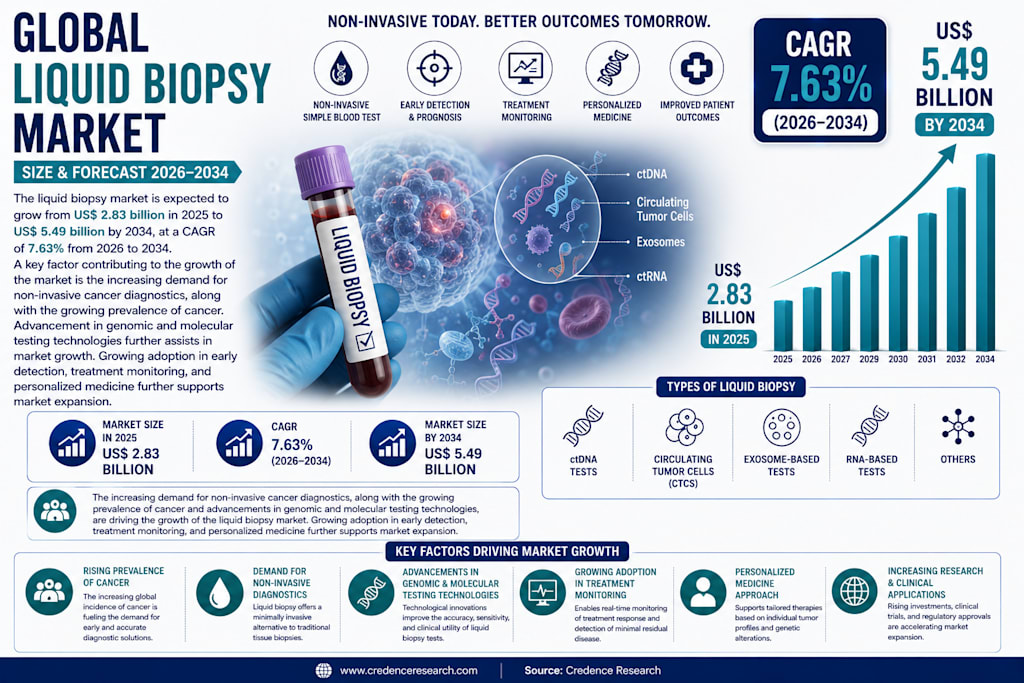
Cancer diagnosis is entering a transformative phase, and liquid biopsy is at the forefront of this shift. According to Renub Research, the Global Liquid Biopsy Market is projected to grow from US$ 2.83 billion in 2025 to US$ 5.49 billion by 2034, expanding at a CAGR of 7.63% from 2026 to 2034.
This growth reflects a rising global demand for diagnostic solutions that are not only accurate but also less invasive. Traditional tissue biopsies, while effective, often involve surgical procedures, discomfort, and limitations in repeat testing. Liquid biopsy, on the other hand, offers a minimally invasive alternative that can be performed using simple blood samples.
The ability to detect and monitor cancer through circulating biomarkers in the bloodstream is redefining how clinicians approach diagnosis, treatment, and long-term disease management.
What Is Liquid Biopsy and Why It Matters
Liquid biopsy is a diagnostic technique that identifies cancer-related biomarkers—such as circulating tumor DNA (ctDNA), circulating tumor cells (CTCs), and other nucleic acids—in body fluids like blood.
Unlike traditional biopsies, liquid biopsy does not require invasive surgery. It can be performed multiple times, making it ideal for:
- Early cancer detection
- Monitoring disease progression
- Evaluating treatment response
- Detecting recurrence
This flexibility allows healthcare providers to track cancer in real time, offering a more dynamic and personalized approach to treatment.
Key Growth Drivers Powering the Market
1. Rising Global Cancer Burden
One of the strongest drivers of the liquid biopsy market is the increasing prevalence of cancer worldwide. As one of the leading causes of mortality, cancer demands diagnostic tools that can detect the disease early and accurately.
Liquid biopsy enables detection of genetic mutations and tumor markers at early stages—sometimes even before symptoms appear. This early detection significantly improves treatment outcomes and survival rates.
In the United States alone, an estimated 2,041,910 new cancer cases and 618,120 deaths are expected in 2025, underscoring the urgent need for advanced diagnostic solutions.
2. Advancements in Genomic and Molecular Technologies
Technological progress is playing a crucial role in the adoption of liquid biopsy. Innovations in next-generation sequencing (NGS), digital PCR, and bioinformatics are improving the accuracy and reliability of cancer detection.
These technologies allow for:
- Detection of low-frequency mutations
- Analysis of tumor heterogeneity
- High-precision genomic profiling
Such capabilities are essential for identifying the most effective treatment strategies for individual patients.
3. Growing Adoption of Precision Medicine
Precision medicine is reshaping oncology, and liquid biopsy is a key enabler of this approach. By identifying specific genetic mutations, liquid biopsy helps clinicians tailor treatments to individual patients.
This personalized approach improves treatment effectiveness while reducing unnecessary side effects. It also allows for real-time monitoring of treatment response and early detection of resistance to therapies.
Pharmaceutical companies are increasingly using liquid biopsy in clinical trials to develop targeted therapies, further accelerating market growth.
Market Segments Driving Innovation
Kits and Reagents: The Backbone of Testing
Kits and reagents form a critical component of the liquid biopsy ecosystem. These products are used to isolate and analyze biomarkers from blood samples.
Their ease of use, accuracy, and growing adoption in both clinical and research settings are driving demand. As testing becomes more widespread, this segment is expected to see significant growth.
Cancer Therapeutic Applications
Liquid biopsy is widely used in cancer treatment planning and monitoring. It helps identify actionable genetic mutations, select targeted therapies, and assess treatment effectiveness.
This application is particularly valuable in tracking disease progression and detecting drug resistance earlier than traditional methods.
Circulating Tumor Cells (CTCs) Analysis
The analysis of circulating tumor cells provides valuable insights into tumor biology and metastasis. Although technically challenging due to the low number of these cells in the bloodstream, advancements in detection technologies are making this approach more feasible.
CTC analysis is expected to play an increasingly important role in cancer research and clinical practice.
Diagnostic Laboratories: Scaling Access
Diagnostic laboratories are central to the growth of the liquid biopsy market. These facilities conduct large-scale testing and invest in advanced sequencing technologies and automation systems.
Partnerships between laboratories, hospitals, and research institutions are expanding access to liquid biopsy services, making them more widely available to patients.
Academic and Research Institutes
Academic institutions play a vital role in advancing liquid biopsy technologies. Their research efforts focus on discovering new biomarkers, improving detection methods, and validating clinical applications.
These innovations form the foundation for commercialization and broader adoption in healthcare systems.
Regional Insights: Global Adoption Trends
United States: Leading Innovation
The United States is the most advanced market for liquid biopsy, supported by strong healthcare infrastructure, high cancer prevalence, and early adoption of new technologies.
The presence of major biotech companies and research institutions accelerates innovation and commercialization.
Germany: Strong Focus on Precision Oncology
Germany’s market is driven by advanced diagnostic infrastructure and a strong emphasis on early cancer detection. Government support and reimbursement frameworks further encourage adoption.
India: Rapidly Emerging Market
India is witnessing growing adoption of liquid biopsy due to increasing cancer cases and rising awareness of non-invasive diagnostics. Partnerships between global and local companies are making advanced testing more accessible.
Saudi Arabia: Expanding Healthcare Investments
Saudi Arabia’s market is growing steadily, supported by investments in healthcare infrastructure and cancer care programs. Adoption is still in early stages but expected to accelerate in the coming years.
Challenges Limiting Market Growth
High Cost and Limited Accessibility
One of the primary challenges is the high cost of liquid biopsy tests. Advanced technologies and specialized expertise make these tests expensive, limiting accessibility in developing regions.
Regulatory and Validation Barriers
Regulatory approval for liquid biopsy technologies requires extensive clinical validation to ensure accuracy and reliability. This process can be time-consuming and costly, slowing market entry for new products.
Competitive Landscape: Key Industry Players
The liquid biopsy market includes major companies such as F. Hoffmann-La Roche Ltd., Bio-Rad Laboratories, Thermo Fisher Scientific Inc., Johnson & Johnson, Guardant Health, Illumina Inc., Laboratory Corporation of America Holdings, QIAGEN N.V., and Exact Sciences Corporation.
These organizations are focusing on:
- Advanced genomic technologies
- Strategic collaborations
- Expansion of diagnostic capabilities
- Investment in precision oncology
Their efforts are accelerating innovation and shaping the future of cancer diagnostics.
Final Thoughts
The global liquid biopsy market represents a major leap forward in cancer care. With projections reaching US$ 5.49 billion by 2034, the technology is poised to become a cornerstone of modern oncology.
As healthcare continues to move toward personalized and non-invasive solutions, liquid biopsy offers a powerful combination of accuracy, convenience, and real-time insights.
The road ahead will depend on overcoming challenges related to cost, accessibility, and regulatory approval. However, the potential impact on early detection, treatment outcomes, and patient quality of life makes liquid biopsy one of the most promising innovations in healthcare today.
About the Creator
Enjoyed the story? Support the Creator.
Subscribe for free to receive all their stories in your feed.
Comments
There are no comments for this story
Be the first to respond and start the conversation.