
Global Dialysis Market Expands as Chronic Kidney Disease Cases and Home-Based Care Demand Surge Worldwide
Rising chronic kidney disease prevalence, technological advances in dialysis equipment, and growing adoption of home dialysis solutions are driving steady expansion across the global dialysis industry.

Global dialysis market enters a new era of renal care expansion
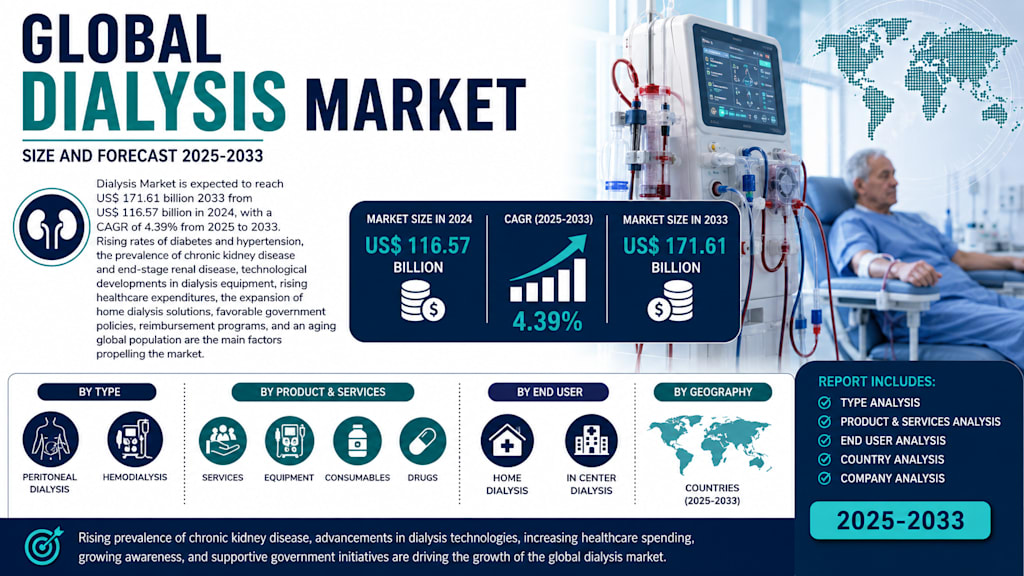
The global dialysis market is witnessing sustained growth as healthcare systems around the world confront rising rates of chronic kidney disease (CKD), end-stage renal disease (ESRD), diabetes, and hypertension. According to the latest industry forecast, the Dialysis Market is expected to grow from US$ 116.57 billion in 2024 to US$ 171.61 billion by 2033, registering a CAGR of 4.39% from 2025 to 2033.
This growth reflects the increasing burden of kidney-related illnesses across aging populations and the growing need for long-term renal replacement therapies. Dialysis has become a critical component of modern healthcare because it allows patients with kidney failure to survive and maintain fluid and electrolyte balance while awaiting a transplant or continuing long-term treatment.
At the same time, advances in dialysis technology, the expansion of private dialysis clinics, and the rising popularity of home-based care solutions are reshaping the future of the industry. Healthcare providers, governments, and medical technology companies are increasingly focusing on improving treatment accessibility, convenience, and patient quality of life.
Understanding the role of dialysis in modern healthcare
Dialysis is a medical procedure that performs the filtration functions normally handled by healthy kidneys. When the kidneys can no longer remove waste products, toxins, and excess fluid from the blood effectively, dialysis becomes necessary to sustain life.
There are two primary forms of dialysis treatment:
Hemodialysis, which filters blood outside the body using a specialized machine.
Peritoneal dialysis, which uses the lining of the abdomen as a natural filter by introducing dialysis solution into the abdominal cavity.
While dialysis does not cure kidney disease, it significantly improves survival and supports patients with ESRD by maintaining metabolic stability and reducing complications associated with kidney failure.
The increasing prevalence of diabetes, hypertension, obesity, and aging populations worldwide is dramatically increasing the number of individuals requiring dialysis treatment.
Chronic kidney disease cases continue to rise globally
One of the strongest growth drivers for the dialysis market is the escalating prevalence of chronic kidney disease and end-stage renal disease worldwide. CKD has become a major global health burden due to unhealthy lifestyle habits, rising obesity levels, and increasing rates of diabetes and hypertension.
The report highlights that the global population aged 65 and older is projected to rise from 10% in 2024 to more than 16% by 2050. Since kidney disease risk increases significantly with age, this demographic trend is expected to drive long-term dialysis demand across both developed and emerging healthcare markets.
The report also notes that CKD prevalence in advanced disease stages could exceed 10% in multiple regions by 2050 if historical trends continue. This represents a major healthcare challenge for governments and healthcare systems worldwide.
Lifestyle-related health conditions remain major contributors. Diabetes and hypertension continue to damage kidney function in millions of patients globally, leading to increased reliance on dialysis therapies as disease progression advances.
Home dialysis solutions are transforming patient care
One of the most significant developments reshaping the industry is the growing adoption of home-based dialysis methods. Patients increasingly prefer treatment options that offer greater convenience, flexibility, and independence compared to traditional in-center dialysis.
The report identifies Automated Peritoneal Dialysis (APD) and Continuous Ambulatory Peritoneal Dialysis (CAPD) as rapidly growing segments. In the United States, approximately 86% of incident peritoneal dialysis patients now use nocturnal APD systems.
APD automates dialysis exchanges during sleep, allowing patients to receive treatment overnight, while CAPD enables manual dialysate exchanges throughout the day without requiring frequent clinic visits. These approaches improve patient comfort and lifestyle flexibility while reducing dependence on centralized treatment facilities.
As healthcare systems continue promoting home-based care models to lower hospital burdens and improve patient satisfaction, demand for portable and home-friendly dialysis technologies is expected to rise substantially.
Private dialysis clinics are expanding rapidly
The growth of private dialysis facilities is another major factor supporting industry expansion. Private clinics are increasingly helping healthcare systems meet rising patient demand while offering personalized care and flexible treatment schedules.
The report highlights India as a notable example, where more than 700 dialysis facilities and approximately 4,000 dialysis machines are concentrated largely within the private sector. These centers play an essential role in improving treatment accessibility and reducing pressure on public hospitals.
Private clinics are also contributing to industry innovation by adopting advanced dialysis equipment, modern treatment protocols, and patient-focused service models. Competitive market dynamics encourage facilities to improve treatment quality, operational efficiency, and scheduling flexibility.
This trend is particularly important in developing countries where public healthcare systems may face infrastructure limitations and rising patient volumes.
Technological innovation continues to improve outcomes
Technological advancements are significantly improving dialysis efficiency, portability, and patient comfort. Manufacturers are investing heavily in next-generation dialysis machines, wearable technologies, and smarter monitoring systems designed to improve long-term treatment outcomes.
One notable innovation mentioned in the report is the wearable artificial kidney developed by Victor Gura, which received a patent from the U.S. Patent Office in May 2021. The miniature dialysis machine represents a major step toward more mobile and continuous renal replacement therapies.
Advanced monitoring systems, automation capabilities, and portable dialysis solutions are helping reduce patient dependence on hospital-based treatment while improving overall treatment convenience and compliance.
These innovations are particularly important because dialysis patients often require treatment multiple times per week for many years.
Rising ESRD burden is increasing healthcare pressure
The growing prevalence of ESRD is creating substantial economic and healthcare challenges worldwide. According to the report, more than 786,000 people in the United States were living with ESRD as of September 2021, with approximately 71% receiving dialysis treatment.
Additionally, Fresenius Medical Care’s 2022 annual report estimated approximately 4.8 million chronic renal failure cases globally in 2022, with annual growth rates between 3% and 6%.
The United Kingdom also reported significant CKD prevalence, with more than 21,000 individuals living with chronic kidney disease in 2021 according to the U.K. Renal Registry. These figures highlight the enormous long-term demand for dialysis services worldwide.
Healthcare systems are therefore under increasing pressure to improve renal care infrastructure, expand treatment access, and manage rising treatment costs effectively.
High treatment costs remain a major challenge
Despite strong demand growth, dialysis remains one of the most expensive long-term healthcare treatments globally. Patients often require lifelong therapy sessions multiple times per week, creating substantial financial pressure for individuals, healthcare providers, and insurance systems.
Dialysis infrastructure also requires costly medical equipment, trained personnel, and continuous maintenance. In regions with limited reimbursement support or inadequate healthcare funding, access to regular dialysis treatment remains a major challenge.
High costs can also discourage treatment adherence among economically vulnerable populations, particularly in developing countries where insurance coverage may be limited.
Patient quality of life remains a critical concern
Another major challenge affecting the market is patient compliance and quality of life. Dialysis treatment schedules are physically and emotionally demanding, often requiring strict dietary restrictions, repeated clinic visits, and significant lifestyle adjustments.
Patients frequently experience fatigue, infections, stress, and mental health challenges associated with long-term treatment dependency. These factors can reduce treatment adherence and negatively affect patient outcomes.
As a result, healthcare providers and manufacturers are increasingly prioritizing solutions that improve convenience, portability, comfort, and treatment flexibility.
North America remains the leading regional market
North America continues to dominate the global dialysis market due to advanced healthcare infrastructure, strong reimbursement systems, and high CKD prevalence. The United States remains the largest market globally because of its large ESRD patient population and extensive network of private and public dialysis centers.
Home-based dialysis adoption is also rising rapidly across the United States as patients seek more flexible treatment solutions.
Technological innovation, strong healthcare spending, and increasing awareness of kidney health are expected to maintain North America’s leadership position throughout the forecast period.
Europe maintains strong healthcare support systems
Europe represents another mature dialysis market supported by advanced healthcare systems and government reimbursement programs. Germany, in particular, remains one of the strongest regional markets due to its aging population, well-established dialysis infrastructure, and strong patient care standards.
While hemodialysis remains the dominant treatment method across Europe, peritoneal dialysis adoption is gradually increasing as healthcare systems encourage home-based treatment alternatives.
India and Saudi Arabia emerge as growth opportunities
India is becoming an increasingly important growth market because of rising CKD prevalence, expanding healthcare infrastructure, and stronger private sector participation. Government programs aimed at improving healthcare access are also helping increase dialysis affordability and availability.
Saudi Arabia is similarly experiencing growth due to rising chronic disease prevalence and investments in healthcare modernization. Government-supported healthcare initiatives and growing adoption of home dialysis options are contributing to market expansion.
Key companies continue expanding innovation efforts
The competitive landscape includes several major healthcare and medical device companies actively investing in dialysis technologies, patient support systems, and global treatment expansion. Key players mentioned in the report include:
- Asahi Kasei Corporation
- B. Braun Melsungen AG
- Baxter International Inc.
- Becton Dickinson and Company
- DaVita Inc.
- Fresenius Medical Care AG & Co. KGaA
- JMS Co. Ltd.
- Medtronic Plc.
Ten notable developments shaping the dialysis industry
Growing adoption of Automated Peritoneal Dialysis systems globally.
Increasing preference for home-based dialysis treatment solutions.
Expansion of private dialysis clinic networks in developing economies.
Fresenius Medical Care reported approximately 4.8 million chronic renal failure cases globally in 2022.
Wearable artificial kidney technology received U.S. patent approval in 2021.
Governments are expanding reimbursement programs for dialysis access.
Portable dialysis technologies are improving treatment flexibility.
Healthcare providers are investing more heavily in patient-centered renal care models.
Dialysis equipment manufacturers continue improving automation and efficiency.
Rising CKD and ESRD prevalence continues to increase long-term treatment demand.
Final thoughts
The global dialysis market is entering a critical phase of transformation driven by rising kidney disease prevalence, aging populations, technological advancement, and increasing demand for home-based care solutions. As healthcare systems work to address the growing burden of CKD and ESRD, dialysis providers and medical technology companies are focusing on accessibility, patient comfort, and treatment innovation.
With the market projected to grow from US$ 116.57 billion in 2024 to US$ 171.61 billion by 2033, the dialysis industry is expected to remain one of the most essential and rapidly evolving segments within global healthcare. Companies capable of improving affordability, portability, and long-term patient outcomes are likely to shape the future of renal care worldwide.
About the Creator
Enjoyed the story? Support the Creator.
Subscribe for free to receive all their stories in your feed.
Comments
There are no comments for this story
Be the first to respond and start the conversation.