
Global Catheters Market Forecast 2026–2034: Minimally Invasive Procedures and Chronic Disease Burden Drive Rapid Growth
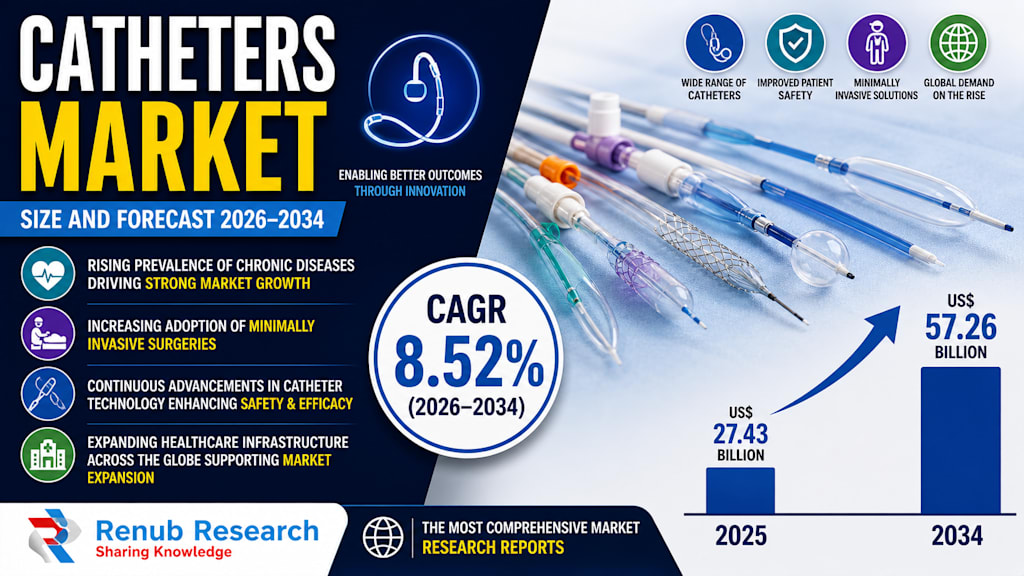
The global catheters market is expanding rapidly as healthcare systems increasingly adopt minimally invasive procedures and advanced medical technologies. According to Renub Research, the catheters market is projected to grow from US$ 27.43 Billion in 2025 to US$ 57.26 Billion by 2034, registering a CAGR of 8.52% during 2026–2034.

The healthcare industry is evolving toward faster, safer, and less invasive medical treatments, and few medical devices illustrate this transformation more clearly than catheters. Once viewed mainly as basic hospital tools, catheters have now become essential components in modern healthcare systems, supporting everything from cardiovascular procedures and dialysis to urinary care, drug delivery, and minimally invasive surgeries.
As the global burden of chronic diseases continues rising and healthcare systems increasingly prioritize patient comfort and shorter recovery times, demand for advanced catheter technologies is accelerating worldwide. Hospitals, ambulatory care centers, and specialty clinics are investing heavily in minimally invasive treatment methods that reduce surgical risks, shorten hospitalization periods, and improve patient outcomes. Catheters are central to many of these procedures.
According to Renub Research, the global catheters market is expected to grow from US$ 27.43 Billion in 2025 to US$ 57.26 Billion by 2034, expanding at a CAGR of 8.52% during the forecast period from 2026 to 2034.
The market’s strong momentum is being driven by rising chronic disease prevalence, aging populations, technological innovation, and increasing global adoption of minimally invasive medical procedures.
Catheters Have Become Essential in Modern Healthcare
Catheters are thin, flexible medical tubes inserted into the body to deliver or remove fluids, administer medications, or provide access to internal organs and blood vessels for diagnostic and therapeutic purposes. They are widely used in cardiovascular interventions, urinary drainage, dialysis, intravenous therapy, and various minimally invasive surgeries.
Modern catheters are manufactured using materials such as silicone, polyurethane, and latex, which provide flexibility, biocompatibility, and safety for both short-term and long-term medical use.
Over the past decade, catheters have become increasingly important because healthcare providers are moving away from highly invasive surgeries toward catheter-based procedures that involve smaller incisions, lower complication risks, and faster patient recovery times.
The versatility of catheter technology is also expanding rapidly. Today’s advanced catheters can include antimicrobial coatings, imaging support systems, robotic guidance, and enhanced navigation features that improve procedural precision and safety.
As healthcare systems worldwide continue modernizing, catheters are expected to remain among the most widely used medical devices across multiple specialties.
Chronic Diseases Are Driving Long-Term Demand
One of the most important factors fueling the growth of the catheters market is the rising prevalence of chronic diseases globally. Conditions such as cardiovascular disease, diabetes, kidney failure, urinary disorders, and neurological complications frequently require catheter-based treatment and monitoring.
Cardiovascular diseases alone remain one of the world’s leading causes of death, creating sustained demand for cardiac catheters used in diagnostic imaging, angioplasty, valve replacement, and other interventional procedures.
Kidney disorders and dialysis treatments also contribute significantly to catheter demand, while urinary catheters remain essential for patients experiencing incontinence, surgery recovery, or long-term mobility limitations.
The global aging population is another major contributor to market expansion. Older adults are more likely to develop chronic medical conditions requiring catheterization and ongoing medical care. According to data referenced in the Renub Research report, by 2030, one in six people globally will be aged 60 years or older, while the population aged 80 and above is expected to triple between 2020 and 2050.
This demographic shift is creating long-term demand for advanced catheter technologies across hospitals, rehabilitation centers, and home healthcare settings.
Minimally Invasive Procedures Are Transforming the Market
The growing preference for minimally invasive procedures is one of the strongest trends shaping the global catheters market. Minimally invasive therapies use catheter-based techniques to diagnose and treat diseases while reducing trauma compared to traditional open surgeries.
Patients increasingly prefer these procedures because they typically involve smaller incisions, shorter hospital stays, reduced pain, lower infection risks, and faster recovery periods. Healthcare providers also benefit from improved procedural efficiency and reduced long-term treatment costs.
Catheters are essential in procedures involving cardiovascular interventions, neurovascular therapies, valve replacement, angioplasty, and advanced diagnostic imaging.
Robotic-assisted systems are also improving precision in catheter-based treatments. In January 2025, Singapore-based Biobot Surgical received CE certification for the Mona Lisa 2.0 robotic system designed to improve accuracy in prostate biopsy and ablation therapies using minimally invasive approaches.
As technology continues advancing, catheter-based procedures are expected to replace many traditional surgical methods across multiple medical specialties.
Technological Innovation Is Expanding Clinical Capabilities
Continuous innovation in catheter technology is another major growth driver for the industry. Manufacturers are increasingly developing advanced catheters with improved flexibility, biocompatibility, antimicrobial protection, and imaging integration.
Modern catheter systems are designed not only for fluid delivery or drainage but also for highly specialized diagnostic and therapeutic functions. Some catheters now incorporate navigation systems, robotic assistance, pressure sensors, and imaging guidance technologies that improve procedural accuracy and patient safety.
Antimicrobial coatings are particularly important because they help reduce the risk of catheter-associated infections, one of the biggest concerns in long-term catheter use.
The development of specialized neurovascular and cardiovascular catheter systems is also expanding the scope of minimally invasive medicine. In February 2025, Johnson & Johnson MedTech introduced the CEREGLIDE™ 92 Catheter System, designed to support neurovascular procedures and improve access during stroke-related interventions.
Healthcare providers increasingly prioritize advanced catheter systems because they improve patient outcomes while reducing complications and procedural risks.
Infection Risks Remain a Major Industry Challenge
Despite strong market growth, catheter-associated infections remain one of the biggest challenges facing the industry. Improper insertion, prolonged use, inadequate sterilization, or poor hygiene can lead to severe complications such as catheter-associated urinary tract infections and bloodstream infections.
These infections can increase patient morbidity, prolong hospitalization, and raise healthcare costs significantly. As a result, hospitals and healthcare systems must invest heavily in infection-control measures, staff training, and monitoring systems.
Regulatory agencies also impose strict clinical guidelines regarding catheter usage, sterilization, and patient safety.
Manufacturers are responding by developing antimicrobial and biocompatible catheter materials designed to minimize infection risks. However, maintaining safety standards while controlling healthcare costs remains a major challenge for the industry.
Regulatory Complexity and Product Recalls Create Pressure
The catheter industry operates under highly strict regulatory requirements because these devices are directly involved in critical patient care. Manufacturers must comply with demanding safety, quality, and performance standards before products can receive approval for commercial use.
Regulatory compliance can be especially complex because approval requirements vary across countries and regions. Companies must conduct extensive clinical testing, documentation, and quality-control procedures to meet international standards.
Product recalls can also have serious financial and reputational consequences for manufacturers if defects or safety issues are discovered after commercialization.
Although these regulations are essential for patient safety, they can increase development costs and extend product launch timelines for catheter companies worldwide.
TMVR and Structural Heart Catheters Are Emerging Strongly
Among specialized segments, TMVR (Transcatheter Mitral Valve Replacement) catheters are gaining significant attention due to increasing adoption of minimally invasive cardiac therapies. TMVR catheters offer an alternative to traditional open-heart surgery for patients suffering from mitral valve disorders, especially elderly or high-risk individuals.
The increasing prevalence of mitral regurgitation and growing acceptance of catheter-based heart procedures are supporting strong growth within this segment.
Similarly, catheters used for treating aortic stenosis through transcatheter aortic valve replacement (TAVR) procedures are becoming increasingly important. These specialized catheters enable minimally invasive valve delivery while reducing surgical risks and recovery times.
Advances in structural heart technologies are expanding the role of catheter-based interventions across cardiovascular medicine globally.
Hospitals Continue Leading the End-User Segment
Hospitals remain the largest end-user segment within the catheters market because they perform the majority of cardiovascular, urinary, dialysis, and interventional procedures requiring catheterization.
Large hospitals typically possess advanced imaging systems, catheterization laboratories, and specialized healthcare professionals capable of performing complex minimally invasive procedures.
Hospital infrastructure expansion in emerging markets is also increasing catheter demand globally. Governments and private healthcare providers are investing heavily in advanced surgical centers and specialized medical facilities to improve healthcare accessibility and treatment quality.
Ambulatory surgical centers are also becoming increasingly important as outpatient minimally invasive procedures continue growing worldwide.
Regional Markets Continue Expanding
The United States remains one of the world’s largest catheter markets due to its advanced healthcare infrastructure, high chronic disease burden, and strong adoption of minimally invasive procedures. In March 2025, Shockwave Medical, part of Johnson & Johnson MedTech, launched the Javelin Peripheral Intravascular Lithotripsy Catheter in the U.S. for treating peripheral artery disease.
The United Kingdom market is supported by a strong public healthcare system and growing interest in minimally invasive treatments. In November 2025, Mediplus expanded its S-Cath™ suprapubic catheter product range in the UK to improve flexibility and usability for healthcare professionals.
India’s catheter market is witnessing rapid growth due to expanding healthcare infrastructure, increasing awareness of minimally invasive procedures, and rising medical tourism activity. Demand for affordable catheter solutions remains especially strong across the country.
Saudi Arabia is also emerging as an important market due to government-led healthcare modernization programs and increasing adoption of advanced cardiovascular procedures. In April 2025, King Faisal Specialist Hospital introduced a catheter-based artery stent technique for treating peripheral artery disease using minimally invasive methods.
Final Thoughts
The global catheters market is entering a period of strong and sustained growth as healthcare systems worldwide increasingly embrace minimally invasive medicine and advanced patient-care technologies. According to Renub Research, the market is projected to grow from US$ 27.43 Billion in 2025 to US$ 57.26 Billion by 2034, registering a CAGR of 8.52% during 2026–2034.
Rising chronic disease prevalence, aging populations, expanding healthcare infrastructure, and continuous technological innovation are all contributing to increased demand for catheter-based treatments and diagnostics.
Although challenges related to infection risks, regulatory complexity, and product safety remain significant, ongoing advancements in catheter design, biocompatibility, and minimally invasive technology continue strengthening the market’s long-term outlook.
As modern medicine increasingly prioritizes precision, safety, and faster recovery, catheters are expected to remain among the most essential and widely used tools in global healthcare systems for years to come.
About the Creator
Enjoyed the story? Support the Creator.
Subscribe for free to receive all their stories in your feed.
Comments
There are no comments for this story
Be the first to respond and start the conversation.