
Genetic Testing Market Expands Rapidly as Personalized Medicine and At-Home Genomics Gain Global Momentum
Advances in next-generation sequencing, wellness-focused DNA testing, and preventive healthcare are accelerating worldwide adoption of genetic testing

The global healthcare industry is entering a new era shaped by genomics, precision medicine, and preventive healthcare. Among the most transformative developments within modern medicine is the rapid rise of genetic testing, which is increasingly influencing disease detection, treatment planning, wellness management, and personalized healthcare decisions.
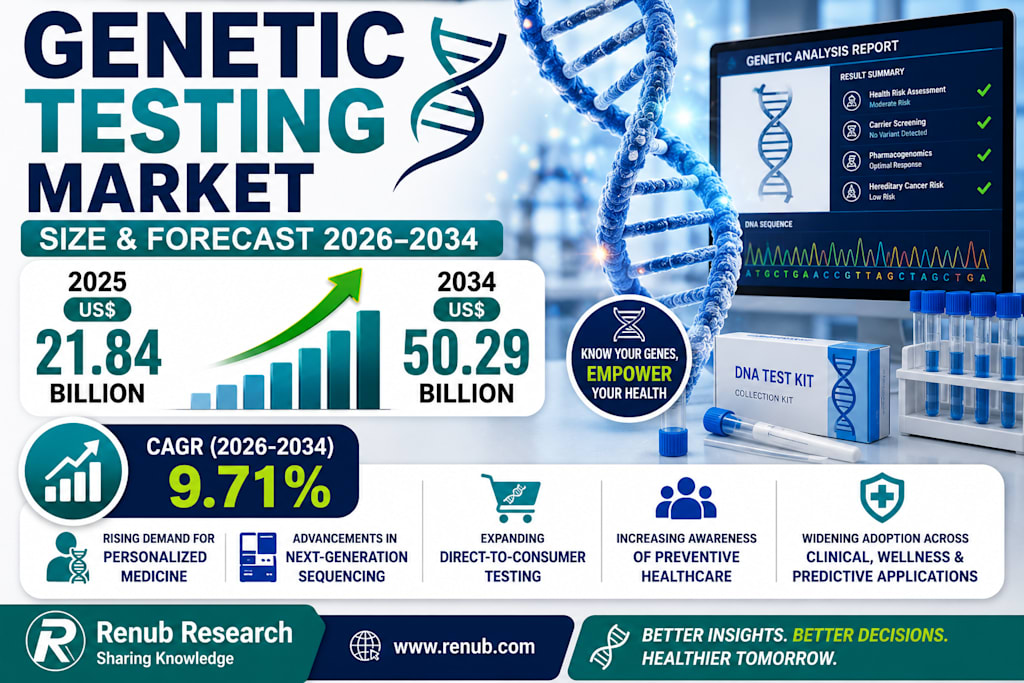
According to Renub Research, the Genetic Testing Market is projected to grow from US$ 21.84 Billion in 2025 to US$ 50.29 Billion by 2034, expanding at a Compound Annual Growth Rate (CAGR) of 9.71% during 2026–2034. Rising demand for personalized medicine, advancements in next-generation sequencing technologies, growth in direct-to-consumer testing, and increasing awareness of preventive healthcare are among the key factors driving market expansion.
As consumers and healthcare providers seek deeper biological insights, genetic testing is moving from specialized laboratories into mainstream healthcare systems, retail channels, and even everyday homes.
Genetic Testing Is Transforming Modern Healthcare
Genetic testing involves analyzing DNA, chromosomes, genes, or genetic expressions to identify variations associated with disease risks, inherited conditions, drug responses, ancestry, and wellness characteristics. These tests help clinicians and individuals better understand genetic predispositions and biological traits.
Modern technologies such as next-generation sequencing (NGS), PCR, and microarrays have dramatically improved the speed, accuracy, and accessibility of genetic analysis.
Genetic testing is now widely used for prenatal screening, cancer diagnostics, rare disease detection, pharmacogenomics, carrier screening, and personalized treatment planning.
As genomic science advances, healthcare providers increasingly rely on genetic insights to guide clinical decisions, improve outcomes, and support preventive care strategies.
Personalized Medicine Is Fueling Market Expansion
One of the strongest drivers behind the genetic testing market is the global shift toward personalized medicine. Instead of using standardized treatments for all patients, clinicians are increasingly tailoring therapies based on an individual’s genetic profile.
This approach allows physicians to predict disease risks more accurately, identify the most effective medications, and reduce adverse drug reactions.
Pharmacogenomic testing is becoming especially important because genetic variations can significantly affect how patients respond to specific medications.
Healthcare systems are also emphasizing earlier disease detection and risk assessment, encouraging broader use of predictive and preventive genetic testing.
As personalized healthcare models continue expanding, demand for genomic insights is expected to rise substantially across hospitals, clinics, and diagnostic laboratories.
Wellness and Epigenetic Testing Are Becoming Mainstream
The market is also being transformed by rising consumer interest in wellness-focused and epigenetic genetic testing. Many consumers now seek genomic insights related to aging, metabolism, stress response, fitness, sleep quality, and overall lifestyle optimization.
The report highlights EpiMedTech’s October 2024 launch of epiGeneComplete, a comprehensive wellness-focused genetic profile test that analyzes aging markers, inflammation levels, metabolic performance, and stress responses using next-generation sequencing and DNA methylation analysis.
This shift reflects a broader consumer movement toward proactive health management and longevity-focused healthcare.
Consumers increasingly want actionable insights that can help them improve diet, exercise, stress management, and long-term wellness outcomes.
The integration of genomic data with wearable technologies and digital health platforms is further accelerating adoption of wellness-oriented testing.
Direct-to-Consumer DNA Testing Is Growing Rapidly
Direct-to-consumer (D2C) testing has become one of the fastest-growing segments within the genetic testing industry. Consumers can now purchase at-home DNA testing kits without requiring physician prescriptions or hospital visits.
The report notes that in November 2024, ProPhase Labs launched DNA Complete, Inc., a subsidiary dedicated to accessible D2C DNA testing solutions.
Consumers use these tests for ancestry analysis, nutrition guidance, wellness evaluation, disease-risk assessment, and lifestyle recommendations.
The convenience of at-home sample collection, faster digital reporting, and expanding affordability are helping broaden consumer adoption significantly.
Digital health integration and mobile app support are also improving user engagement by delivering personalized reports and actionable recommendations.
As awareness increases, D2C testing is expected to remain one of the strongest contributors to market growth.
Retail Expansion Is Bringing Genetic Testing Into Mainstream Consumer Health
Another major trend reshaping the market is the increasing retail availability of genetic testing products. Pharmacies, supermarkets, online marketplaces, and health retailers are expanding genomic product offerings to everyday consumers.
The report highlights Myriad Genetics’ November 2024 launch of SneakPeek at-home gender testing across more than 8,800 U.S. retail stores.
This level of accessibility is helping normalize genetic testing as part of routine healthcare and wellness behavior.
Retail expansion improves visibility, convenience, and consumer awareness while reducing barriers to entry for first-time users.
The growing presence of genomic products in mainstream retail environments is expected to accelerate adoption among broader demographic groups worldwide.
Advances in Sequencing Technologies Continue Driving Innovation
Technological advancement remains central to the rapid growth of the genetic testing market. Next-generation sequencing technologies have dramatically reduced testing time and cost while improving accuracy and scalability.
Sequencing platforms can now analyze large amounts of genetic data quickly, enabling more comprehensive testing across oncology, rare diseases, infectious diseases, and cardiovascular conditions.
Artificial intelligence and bioinformatics are also improving interpretation of genomic data, allowing clinicians to make faster and more informed decisions.
As sequencing costs continue declining, advanced genetic testing is becoming increasingly accessible to both healthcare providers and consumers.
Data Privacy Concerns Remain a Major Challenge
Despite strong growth opportunities, data privacy remains one of the biggest concerns within the genetic testing market. Genetic information is highly personal and sensitive, raising fears about unauthorized access, insurance discrimination, and third-party data sharing.
As direct-to-consumer testing expands, consumers are increasingly questioning how genomic data is stored, protected, and potentially commercialized.
Regulations such as GDPR and HIPAA impose strict compliance requirements on genetic testing companies, increasing operational complexity and legal obligations.
Maintaining consumer trust through strong cybersecurity, transparent policies, and ethical data management will remain essential for long-term industry growth.
High Costs Continue Limiting Accessibility
Although technology costs are declining, advanced genetic testing remains expensive in many parts of the world. Specialized laboratory infrastructure, sequencing equipment, and skilled expertise contribute to high operational costs.
Limited insurance reimbursement also restricts access to predictive and preventive testing in several healthcare systems.
Developing countries often face additional barriers including limited laboratory infrastructure, lack of trained genetic counselors, and lower public awareness regarding genomic medicine.
As a result, adoption rates remain uneven across regions.
Reducing costs, improving insurance support, and expanding educational outreach will be important for increasing global accessibility.
United States Leads Global Genetic Testing Innovation
The United States remains one of the largest and most advanced genetic testing markets globally due to strong healthcare infrastructure, widespread precision medicine adoption, and high consumer awareness.
The country leads in areas such as oncology genomics, pharmacogenomics, carrier screening, and direct-to-consumer DNA testing.
Companies such as Myriad Genetics and other genomic innovators continue driving technological development and retail expansion.
Strong investment activity, digital health integration, and growing wellness-focused consumer demand continue strengthening the U.S. market position.
Germany Prioritizes Clinical Precision and Early Diagnosis
Germany’s genetic testing market is expanding steadily due to its advanced healthcare infrastructure and strong focus on early disease detection.
The country has seen rising adoption of NGS-based diagnostics, pharmacogenomics, and molecular oncology testing.
Strict regulatory standards ensure high testing accuracy and clinical reliability, while government healthcare digitization initiatives support broader integration of genomic technologies across hospitals and laboratories.
Although D2C testing remains more tightly regulated than in the United States, clinical adoption remains strong.
China Emerges as a Fast-Growing Genomics Market
China’s genetic testing market is experiencing rapid expansion driven by increasing healthcare spending, government support for precision medicine, and rising awareness of inherited disorders.
Local biotechnology firms are rapidly advancing capabilities in prenatal screening, oncology genomics, and next-generation sequencing technologies.
The country’s large population also creates strong demand for health-risk assessments and carrier screening programs.
E-commerce platforms are helping expand direct-to-consumer testing accessibility among urban consumers.
China is expected to remain one of the world’s fastest-growing genetic testing markets throughout the forecast period.
Saudi Arabia Strengthens Precision Healthcare Infrastructure
Saudi Arabia’s genetic testing market is growing steadily under the country’s Vision 2030 healthcare modernization initiatives. High prevalence of inherited disorders has increased demand for carrier screening, newborn testing, and premarital genetic programs.
Hospitals are increasingly adopting NGS-based oncology and rare disease testing platforms.
Government investment, partnerships with global diagnostics firms, and expanding healthcare infrastructure are helping improve genomic testing accessibility across the Kingdom.
Preventive healthcare awareness is also gradually increasing among the population.
Recent Developments Highlight Strong Industry Momentum
The genetic testing market continues evolving rapidly through partnerships, sequencing innovation, and personalized healthcare initiatives.
The report highlights several major recent developments:
In December 2025, Zydus Lifesciences partnered with Myriad Genetics to introduce the MyRisk hereditary cancer test and genomic assays across India.
In October 2025, Gene Solutions collaborated with AMPATH to establish a genomics laboratory in Hyderabad focused on next-generation sequencing technologies.
In September 2025, Mass General Brigham introduced a polygenic cardiovascular risk panel developed with Broad Clinical Labs for early detection of inheritable heart conditions.
In July 2025, Bupa launched Medication Check DNA services showing that 99% of participants carried genetic variations influencing medication response.
These developments demonstrate how genetic testing is becoming increasingly integrated into mainstream preventive and personalized healthcare.
Market Segmentation Reflects Broad Clinical and Consumer Applications
The genetic testing market includes predictive testing, carrier testing, prenatal and newborn testing, pharmacogenomic testing, nutrigenomic testing, and diagnostic testing.
Technologies include PCR, DNA sequencing, microarrays, and other advanced genomic platforms.
Applications span cancer, cardiovascular diseases, infectious diseases, rare diseases, and inherited genetic disorders.
Hospitals, clinics, and diagnostic laboratories remain major end users, while consumer-focused wellness applications continue expanding rapidly.
Leading Companies Continue Expanding Innovation
Several major healthcare and diagnostics companies are actively investing in genetic testing innovation and precision medicine technologies. Key players include Abbott Laboratories, Danaher Corporation, Illumina Inc., Bio-Rad Laboratories, F. Hoffmann-La Roche AG, DiaSorin, Revvity Inc., and Thermo Fisher Scientific Inc.
Competition within the market is increasingly focused on sequencing speed, data interpretation, consumer accessibility, and personalized healthcare integration.
Strategic partnerships, acquisitions, and retail expansion continue shaping the competitive landscape.
Final Thoughts
The genetic testing market is entering a transformative growth phase fueled by personalized medicine, next-generation sequencing, and rising consumer interest in preventive healthcare.
As genomic technologies become more accurate, accessible, and affordable, genetic testing is evolving into a mainstream component of modern healthcare and wellness management.
According to Renub Research, the market is projected to grow from US$ 21.84 Billion in 2025 to US$ 50.29 Billion by 2034, reflecting the increasing global importance of genomic insights in healthcare decision-making.
About the Creator
Enjoyed the story? Support the Creator.
Subscribe for free to receive all their stories in your feed.
Comments
There are no comments for this story
Be the first to respond and start the conversation.