
🧠 From "Jeopardy!" to Lifesaver: How IBM Watson Became a Digital Savior in Tokyo 🏥
When standard treatment fails, AI finds the needle in the medical haystack.

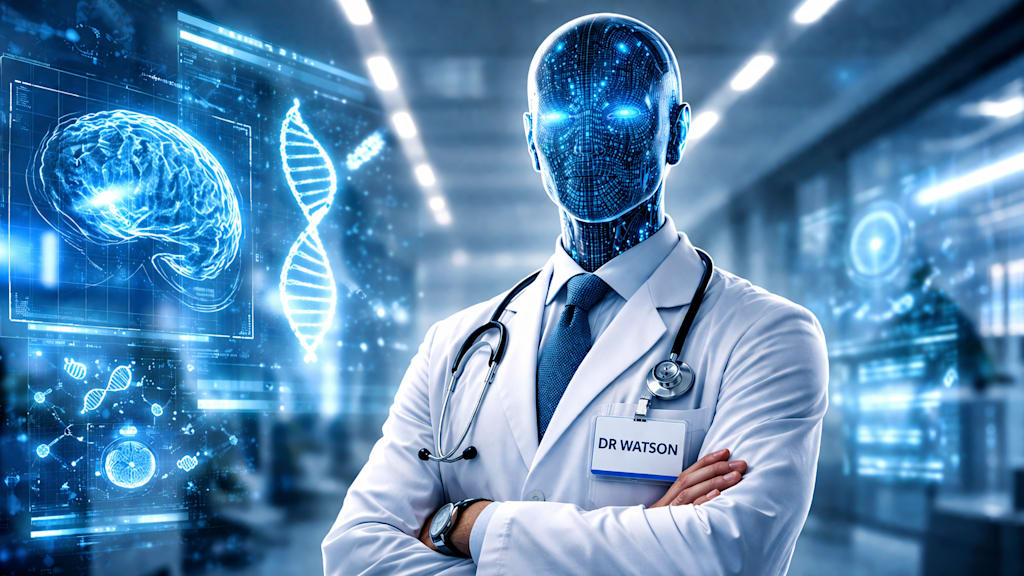
As you may recall from our previous conversations, IBM Watson didn't always spend its time saving human lives. In 2011, the world first met it as a brilliant "contestant" on the game show Jeopardy!. Back then, in front of millions of viewers, this IBM supercomputer crushed human champions, proving it could instantly associate facts and understand the nuances of human language 💰. However, what began as a spectacular marketing stunt and a display of technological prowess found its most serious and moving application years later in the halls of a Japanese clinic. There, the stakes were no longer prize money, but a specific person's life 🕊️.
🧩 A Mystery That Outpaced Human Capability
This story unfolded in 2016 at the Institute of Medical Science at the University of Tokyo. The protagonist was a 60-year-old patient diagnosed with acute myeloid leukemia (AML). For the oncologists, the situation was difficult but seemed "standard." They applied classic, aggressive treatment protocols, including intensive chemotherapy 🧪. Unfortunately, to the growing alarm of the staff, the woman's body completely failed to respond to the medication.
The patient grew weaker by the day, and the doctors felt their knowledge had hit a brick wall 🧱. The problem with cancer is that every case is a unique genetic code. Personalized medicine requires the analysis of a gargantuan amount of data, and the human brain—even one belonging to an eminent professor—has physical limits on how fast it can process the thousands of new scientific papers published every month 📚.
⚡ Machine vs. 20 Million Documents
That’s when IBM Watson for Oncology stepped in. Desperate for answers, the Japanese doctors decided to "feed" the algorithm the patient's genetic data. The system was given access to her DNA sequencing results and detailed medical records. What happened next has since become a legend in digital medicine 💻.
IBM Watson needed just 10 minutes. ⏱️
In that incredibly short window, the algorithm analyzed and compared the woman’s unique genetic code against a database of over 20 million scientific publications and millions of clinical reports. For a human, reading that much material would take hundreds of years (and that’s without any coffee breaks!). Watson didn't just "read" the data; more importantly, it connected dots that no one had seen before 🧬.
🔍 A Diagnosis Not Found in Textbooks
The result of the analysis was groundbreaking. IBM Watson discovered that the patient didn't actually have standard AML, but an extremely rare sub-type: secondary myeloid leukemia. This subtle but critical difference meant that the previous chemotherapy was not only useless but actually toxic to her already ravaged body ⚠️.
The IBM system didn't stop at the diagnosis. It suggested a change in the treatment protocol, pointing to specific drugs tailored exactly to this rare mutation. After a lightning-fast verification of the algorithm’s recommendations, the doctors switched the treatment plan. The effect was almost miraculous: the woman’s health began to improve rapidly, and she was soon able to leave the hospital under her own power 🏠✨.
⚖️ An Exoskeleton for the Mind (Candor Alert!)
While this story sounds like a triumph of technology over nature, it’s worth looking at it with a dose of "grounded reality." The IBM Watson success in Tokyo was spectacular, but this project also taught us something else: AI is not a magic wand that will replace doctors 🪄.
In the years that followed, IBM Watson Health faced significant hurdles with data integration across different hospital systems, showing just how difficult this field truly is. However, the Tokyo case remains solid evidence that AI acts as an "exoskeleton for the human mind." The doctor in Japan provided the empathy and clinical experience, but Watson provided the "absolute memory" that allowed them to win the race against time 🏃♂️💨.
🌟 Why Does It Matter?
This saved life became a symbol of a new era. It proved that in the age of the "information explosion," where more medical knowledge is published every year than we can possibly absorb, AI is the only tool capable of bridging that gap 🌉.
the story of this 60-year-old Japanese woman is proof that a system which once earned applause for knowing "who wrote Great Expectations" ultimately fulfilled a much greater mission: it provided hope where human science had reached its edge. 🎖️🩺
About the Creator
Piotr Nowak
Pole in Italy ✈️ | AI | Crypto | Online Earning | Book writer | Every read supports my work on Vocal
Enjoyed the story? Support the Creator.
Subscribe for free to receive all their stories in your feed.
Comments
There are no comments for this story
Be the first to respond and start the conversation.