
From Information to Geometry: A Systems Engineering Framework for Emergent Spacetime
A speculative interdisciplinary white paper exploring whether modern theoretical physics may be interrogating reality at the wrong abstraction layer.

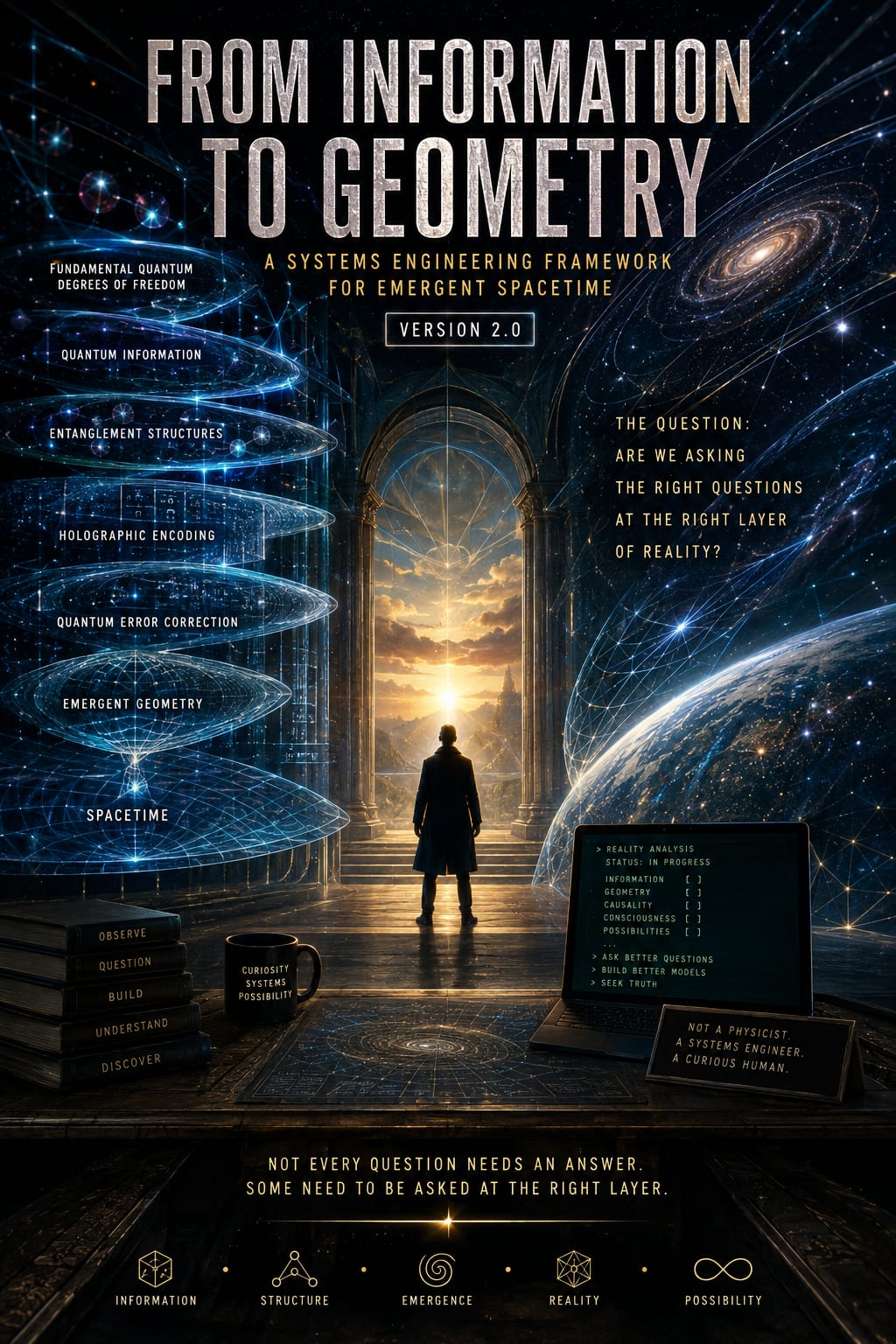
I am not a theoretical physicist. This paper is not an attempt to derive a theory of quantum gravity. It is an attempt to ask whether modern theoretical physics may be approaching one of its most fundamental questions from the wrong abstraction layer.
FROM INFORMATION TO GEOMETRY
The Architecture Hypothesis
A Systems Engineering Framework for Emergent Spacetime
Version 2.0 (White Paper Draft)
Author: Alejandro Arango Posada
Independent Researcher & Systems Engineer
Arango Systems Research Initiative
"Modern theoretical physics may be suffering from an abstraction-layer problem."
Abstract
Modern theoretical physics has achieved extraordinary success in describing the behavior of reality while remaining conspicuously silent on its underlying architecture.
General relativity describes gravity as the geometry of spacetime. Quantum mechanics describes the probabilistic behavior of physical systems. Quantum field theory successfully predicts the interactions of matter and fields to extraordinary precision. Yet despite these achievements, physics remains unable to answer one of its most fundamental questions:
What is spacetime?
This white paper proposes that contemporary approaches to quantum gravity may suffer from an abstraction-layer problem. Modern physics has become increasingly successful at describing the behavior of emergent phenomena while remaining uncertain whether spacetime itself is fundamental.
Recent developments in holography, quantum information theory, quantum error correction, emergent gravity, and the ER = EPR conjecture suggest an alternative possibility. Spacetime geometry may not be fundamental but instead emerge from deeper informational relationships that admit geometric interpretation under specific physical conditions.
This work does not propose a theory of quantum gravity, novel mathematics, or a practical mechanism for spacetime manipulation. Instead, it presents a systems engineering framework for organizing existing theoretical developments and identifying productive research questions concerning the informational architecture of emergent spacetime.
Author's Note
This work is intentionally interdisciplinary.
It is not written from the perspective of a theoretical physicist, nor does it attempt to compete with existing approaches to quantum gravity.
Systems engineers are routinely tasked with understanding architectures composed of interacting subsystems whose collective behavior cannot be understood by examining their components in isolation.
The central proposition of this paper is remarkably modest:
Perhaps reality itself possesses an architecture that has yet to be properly interrogated.
PART I
The Abstraction Layer Problem
The history of science is, in many respects, the history of discovering that nature operates at deeper levels of abstraction than originally assumed.
Temperature emerges from microscopic motion.
Fluid dynamics emerges from statistical mechanics.
Chemistry emerges from atomic interactions.
Biology emerges from chemistry.
Consciousness emerges from biology.
At each stage, phenomena once believed fundamental were revealed to be emergent properties of deeper architectures.
This paper asks a simple question:
Why should spacetime be treated differently?
Modern theoretical physics may therefore be suffering from an abstraction-layer problem.
The central question of this work is not:
How do we quantize spacetime?
Rather:
Are we correct in assuming that spacetime is fundamental at all?
If spacetime is emergent, then contemporary approaches to quantum gravity may resemble attempts to explain fluid dynamics without first discovering atoms.
PART II
The Architecture Hypothesis
This white paper proposes what will be referred to as the Architecture Hypothesis:
Reality may be hierarchically organized across multiple emergent abstraction layers, with spacetime representing an intermediate informational architecture rather than a fundamental substrate.
The proposed architecture is as follows:
Fundamental Quantum Degrees of Freedom
↓
Quantum Information
↓
Entanglement Structures
↓
Holographic Encoding
↓
Quantum Error Correction
↓
Emergent Geometry
↓
Spacetime
↓
Gravitational Dynamics
↓
Matter & Fields
↓
Complex Systems
↓
Life
↓
Consciousness
↓
Technology
↓
Understanding
This hierarchy is not presented as established physics.
Rather, it serves as a systems engineering model for organizing several active areas of theoretical research into a coherent investigative framework.
PART III
Information Before Geometry
Perhaps the greatest assumption underlying modern physics is that spacetime is the stage upon which physical processes unfold.
This paper proposes an alternative perspective:
Geometry may not be fundamental.
The holographic principle suggests that geometric properties may emerge from underlying informational structures.
Entanglement entropy has been shown to possess deep relationships with geometric quantities within holographic theories.
Quantum error correction appears intimately connected with the robustness of emergent bulk spacetime.
ER = EPR suggests that geometric connectivity and quantum entanglement may represent dual descriptions of deeper informational relationships.
Taken individually, these ideas are incomplete.
Taken collectively, they suggest that information may occupy a more fundamental role in reality's architecture than geometry itself.
PART IV
A Systems Engineering Perspective
Physicists ask extraordinarily sophisticated questions regarding the behavior of spacetime.
Systems engineers ask different questions.
For example:
What are spacetime's control variables?
Is locality an emergent runtime property?
What informational structures are necessary to admit geometric interpretation?
Does geometry possess fault tolerance?
Can spacetime be redundantly encoded?
What constitutes a geometric state transition?
What are the architectural failure modes of emergent geometry?
What observable quantities correspond to informational changes within geometric systems?
These questions are not intended to replace existing approaches to theoretical physics.
Rather, they represent an alternative framework for organizing the problem of emergent spacetime.
PART V
Supporting Frameworks
Several existing areas of theoretical physics motivate the Architecture Hypothesis:
Holographic Duality
Geometry may emerge from informational relationships encoded upon lower-dimensional boundaries.
Quantum Information Theory
Information itself may occupy a more fundamental role in physical reality than previously appreciated.
Quantum Error Correction
Bulk spacetime appears capable of robust informational encoding.
Tensor Networks
Organized entanglement structures naturally admit geometric interpretation within certain holographic models.
Emergent Gravity
Gravitational dynamics may arise as consistency conditions governing underlying informational structures.
ER = EPR
Quantum entanglement and geometric connectivity may represent dual descriptions of deeper relationships.
None of these frameworks independently establish emergent spacetime.
Collectively, however, they motivate further investigation.
PART VI
A Research Framework for Emergent Spacetime
This white paper proposes the following research program.
Information Layer
Quantum Information Theory
Complexity Theory
Entanglement Dynamics
Encoding Layer
Holographic Duality
Quantum Error Correction
Bulk Reconstruction
Geometry Layer
Emergent Locality
Gravitational Consistency Conditions
Entanglement Entropy
Experimental Layer
Quantum Simulators
Analog Gravity Systems
Vacuum Engineering
Precision Metrology
Quantum Enhanced Sensing
Control Layer
Closed Loop Control Systems
AI Assisted Parameter Optimization
Quantum State Estimation
Noise Rejection
Engineering Layer
Effective Geometry Manipulation
Emergent Spacetime Experiments
Long Horizon Spacetime Engineering
Notice what is absent from this research framework:
There is no proposal to build wormholes.
The first objective of spacetime engineering should not be to manipulate spacetime.
It should be to determine whether spacetime itself is emergent.
PART VII
Implications for Future Spacetime Engineering
Science fiction traditionally assumes that spacetime engineering begins with the direct manipulation of geometry.
This paper proposes the opposite.
Future spacetime engineering may begin with understanding the informational architectures from which geometry itself emerges.
If geometry is emergent, then future technologies may ultimately concern:
Information architectures.
Quantum state organization.
Geometric observables.
Boundary conditions.
Emergent locality.
Closed loop control of informational systems.
Spacetime manipulation, if possible at all, would therefore represent the final chapter of a much larger scientific program rather than its beginning.
PART VIII
Limitations
The Architecture Hypothesis makes no claims regarding:
A Theory of Everything.
Practical spacetime manipulation.
Traversable wormholes.
Warp drives.
The ultimate nature of consciousness.
The existence of a holographic cosmology describing our universe.
Laboratory scale manipulation of spacetime.
The hypothesis merely proposes that:
Modern theoretical physics may be interrogating the correct questions at the wrong layer of reality's architecture.
Conclusion
Modern theoretical physics has been extraordinarily successful at describing the behavior of reality.
It is possible, however, that humanity's next great scientific revolution will not arise from discovering a new force of nature or a new particle.
It may instead arise from discovering that spacetime itself was never the correct place to begin.
Perhaps spacetime is not the foundation of reality, but one of its most elegant emergent architectures.
The Architecture Hypothesis offers no final answers.
It offers something potentially more valuable:
A better question.
And perhaps the most important question of all is this:
Are we asking extraordinarily intelligent questions at the wrong layer of the stack?
About the Creator
Alejandro Arango
A theater major, a poet, and a lover of the written word. I write to the muses that they may inspire me, and to you the reader. Hopefully you can find meaning in my words or something that will lighten your heart on this journey of life
Enjoyed the story? Support the Creator.
Subscribe for free to receive all their stories in your feed.
Comments
There are no comments for this story
Be the first to respond and start the conversation.