
For nineteen days, the Sun sent an odd radio signal that would not go away.
The longest solar radio burst

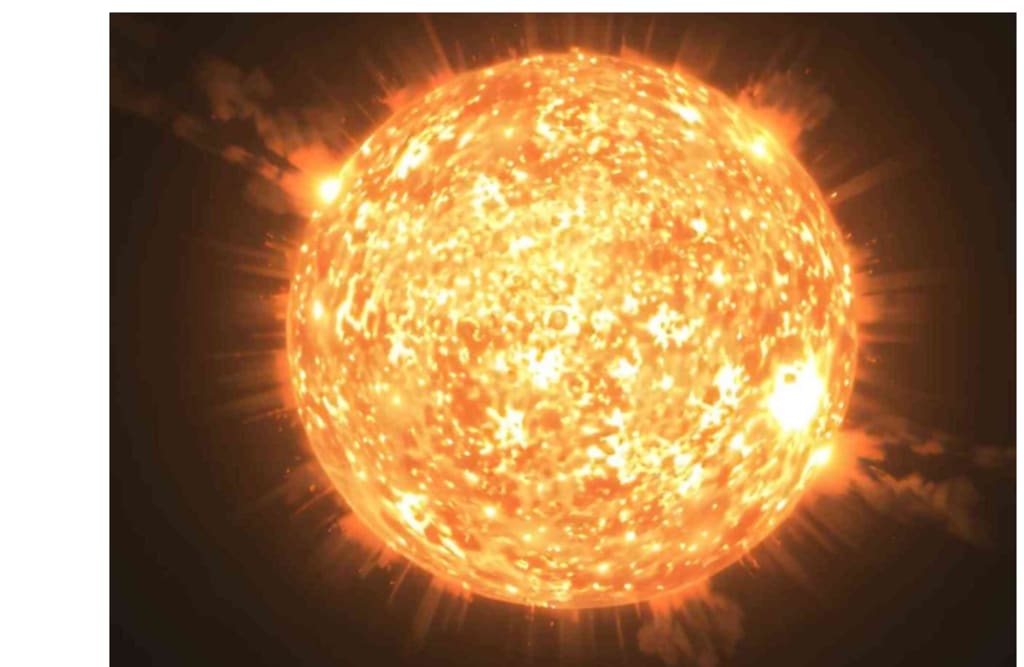
Radio noise is constantly emitted by the Sun. When charged particles become entangled in the solar magnetic field, a solar radio burst occasionally occurs; however, these signals typically fade within hours or days at most. That presumption was altered in August 2025. When the signal persisted, scientists began to wonder what in the Sun's atmosphere would be able to sustain it.
The longest solar radio burst
The signal broke the previous record for this type of solar radio burst by continuing for 19 days in a row. The previous record, which was set in 2002, was only five or six days long.
The goal of a team headed by heliophysicist Vratislav Krupar of NASA's Goddard Space Flight Center (Goddard) in Greenbelt, Maryland, was to determine what could sustain a solar radio burst for nearly three weeks.
The time was so far outside of the typical range that the standard explanations were inapplicable. A Type IV burst is the type of signal in question. These originate from electron clouds trapped in massive magnetic structures encircling the Sun.
Everyone on Earth is safe from the radio waves themselves. However, the magnetic conditions that underlie them frequently coincide with powerful eruptions that have the potential to destroy satellites.
Monitoring a moving signal
Such a long duration of a single signal presented a tracking challenge. The source continued to move in and out of view due to the Sun's rotation. The entire event could not be witnessed by a single spacecraft. The researchers combined data from a fleet of missions dispersed throughout the inner solar system, including the Solar Orbiter mission operated in collaboration with the European Space Agency (ESA), NASA's Parker Solar Probe, and the Wind and STEREO probes.
Each satellite caught a few days of the burst as it moved from one to the next as the Sun rotated. That handoff proved to be a hint in and of itself. The signal followed the Sun's rotation precisely. It was a single structure that rotated with the Sun and remained illuminated throughout, rather than a sequence of distinct flare-ups that happened to land in the same location.
Identifying the source
It is difficult to determine the source of a radio wave inside the Sun's atmosphere. The source appears much larger and more dispersed than it actually is because the corona blurs and bends radio waves as they travel. Any straightforward interpretation of the data would be disrupted by the extreme distortion.
In order to overcome it, the team developed a correction method that modifies the direction of the recorded signal to take into consideration the amount that the solar wind has caused it to veer off track.
This allowed them to locate the exact source of the explosion. They discovered a helmet streamer, a massive magnetic field loop that extends deep into the Sun's outer atmosphere and arches up from the corona.
During a total eclipse, these graceful, pointed formations can be seen spreading out from the Sun. Their tight loops are powerful enough to trap and retain solar plasma, and they are situated above the boundary between areas of opposite magnetic polarity.
It is fed by three eruptions.
How the electrons remained in place is explained by a magnetic trap. How they continued to radiate for 19 days is not explained by this. Over time, trapped particles lose energy. They would fade if left unattended.
During those weeks, nearly the same area of the Sun had three coronal mass ejections, which are massive eruptions that launch plasma and magnetic energy into space. One refill after another, each one seemed to have released a new batch of energised electrons into the streamer's field lines.
The entire system, according to the researchers, is a corotating electron reservoir, a long-lived magnetic trap that rotates with the Sun and is only visible to spacecraft when the viewing angle aligns. The supply was replenished when a fresh eruption occurred. It remains to be seen if that replenishing is the whole story. Instead than covering up the holes, the team took care to identify them.
What remained unresolved
The most important unsolved question is the easiest to state: nobody is certain of the precise cause of those electrons' 19-day confinement. The refill concept works with the schedule, but the exact process that keeps the trap stable for so long is still a mystery.
Additionally, there is a practical twist. These signals are so severely obscured by the corona that the burst seems to be around 20 degrees broad across the sky, a fuzzed-out, enlarged rendition of what was actually a compact source.
According to the team's calculations, the distortion increased the perceived size by about 60 times. Space weather forecasts could seriously underestimate the size of a source region if persistent Type IV bursts frequently appear much larger than they actually are.
Why timing is important
The Sun is moving through one of the busiest stretches of its roughly 11-year activity cycle. Currently, eruptions and tangled magnetic structures are more frequent than usual, and long-duration bursts are most likely to occur during active periods.
Nobody had seen a Type IV burst last close to 19 days before this incident. It was not believed that the magnetic structures containing these electrons could support them for such a long period of time. The discovery expands the definition of a passing solar event and provides solar physicists with an actual illustration of a magnetic trap that
The corrective technique Krupar's team created to identify this burst provides a useful tool for space weather forecasters to more precisely estimate future outbursts.
Additionally, it provides a better understanding of how the magnetic structures of the Sun can trap hazardous particles that endanger satellites, spacecraft, and the astronauts who depend on them.
About the Creator
Enjoyed the story? Support the Creator.
Subscribe for free to receive all their stories in your feed.
Comments
There are no comments for this story
Be the first to respond and start the conversation.