
Finally, a mysterious repeating radio signal from space has been recognised.
Radio transients with a long duration

For years, astronomers have been perplexed by a few deep-space signals. The cause of these long-period radio transients, which pulse, go dark, and then reappear around an hour later, was unknown.
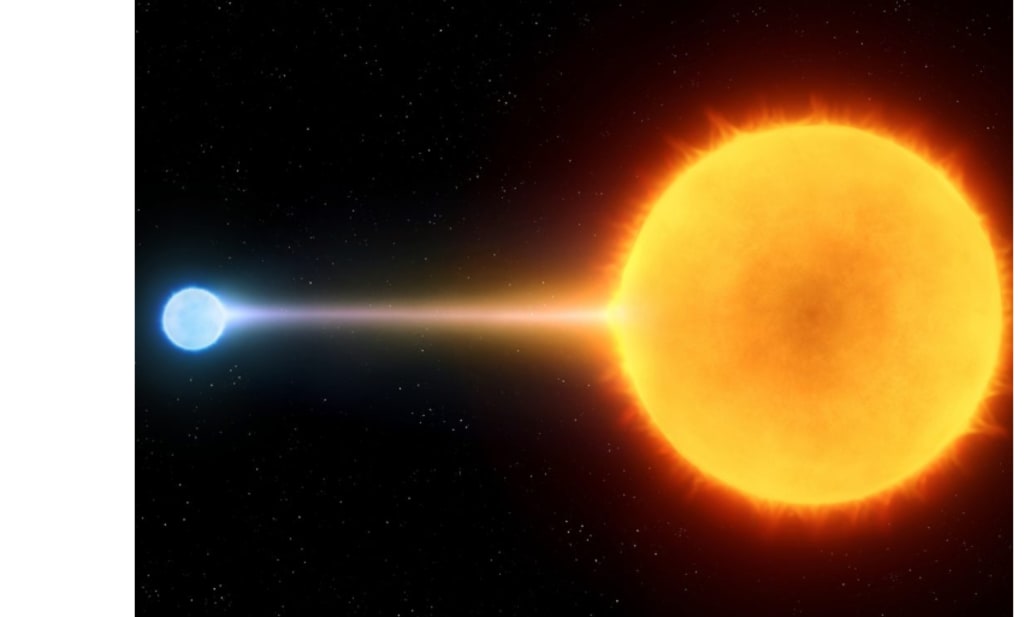
One of these now has a radically different source confirmed by new observations. It is actually two stars in a close orbit, one of which is drawing gas from the other, rather than a single rotating star.
Radio transients with a long duration
In radio waves, these long-period radio transients brighten, become silent, and then reappear minutes or hours later. Only a dozen or so have ever shown up. It's difficult to describe a signal so slow. The preferred theory blamed a dead star that was spinning, although a star rotating that slowly shouldn't create any radio pulses at all.
Nobody could determine if all of these signals had a single origin or several without knowing the real source. The field required a single system that was sufficiently transparent to disassemble.
Apprehending the offender
Kovi Rose, a PhD candidate in physics at the University of Sydney, was searching a radio survey for a type of light that was twisted and magnetic. Nothing on file matched one source.
The investigation was conducted using CSIRO's ASKAP radio telescope in Australia, which was designed to identify anomalies that others would overlook. Upon careful inspection, two stars—now identified as ASKAP J1745-5051—were found.
The two were identified by their combined luminosity as a cataclysmic variable, a dead star depriving a living partner of its gas. That star is a white dwarf, about the size of Earth but nearly as hefty as the Sun.
One orbit, two stars
A red dwarf, a tiny, cold star with 10 times the mass of the Sun, is its partner. The two are seated so close together that one By observing the starlight, astronomers were able to time that orbit. As the stars swung toward and away from Earth, lines in the spectrum moved in time with the beat of the radio pulses.
The rest is driven by gravity. Accretion is the process by which gas ripped from the red dwarf spirals toward its heavier partner and collides with the white dwarf, heating the gas until it burns.
Radio explosions and X-rays
Heat from that falling gas escapes as X-rays. The brightness swung more than tenfold, indicating that gas was piling onto the white dwarf, according to space telescopes.
The radio bursts originate from somewhere else, most likely where the gas between the two stars is captured by the collision of their magnetic fields. They reach their climax at a certain time in
Additionally, the X-rays maintain time with the orbit—a connection that was previously unknown for one of these systems. The only people who have ever been caught in X-rays are a pair.
Stripes similar to those of Jupiter
These radio bursts contain information that has never been observed in such broadcasts before. Each one has a delicate striped pattern and fluctuates in frequency over a longer period.
In all star pairs, one feature was unique. The radio light from Jupiter and its moon Io was the only other location in the sky where such striped patterns of bright and dark bands could be seen. Such stripes are created when a radio beam passes through a cloud of charged gas. In this case, the gas probably streams off the
Additionally, the signal can cut off for hours at a time. This stop-start behaviour is consistent with accreting white dwarfs, which were shown to switch on and off in a previous study.
Not a pulsar that has died
A neutron star, a massive stellar remnant that rotates quickly and emits radio waves, was initially the clear suspect. The standard source of steady pulses is one of these pulsars.
There was a catch. A neutron star should not pulse at all if it is rotating slowly enough for these lengthy beats. They could be produced by a white dwarf and a companion, according to a new article.
These signals had previously been associated with similar couples, but no one had ever been observed feeding in the open. "We can now demonstrate that one of these transients originates from a white dwarf that is actively extracting material from a companion star," Rose added.
An exceptional Rosetta stone
This system serves as an anchor for the entire class of long-period radio transients since it is finally understood. The following sluggish pulse can now be compared to it by astronomers.
According to Rose, "it could help us determine whether other long-period transients are more like pulsars or like white dwarf systems, acting like a stellar Rosetta stone." Beyond just one pair, the discovery provides a unique perspective on physics that cannot be replicated in a lab.
The paired stars' shared orbit confirms that the slow radio pulse is the result of a dead star feeding on its neighbour. Astronomers can start classifying this peculiar class now that one case has been solved.
About the Creator
Enjoyed the story? Support the Creator.
Subscribe for free to receive all their stories in your feed.
Comments
There are no comments for this story
Be the first to respond and start the conversation.