
Europe STD Diagnostics Market Set to Reach USD 15.10 Billion by 2034 as Testing Awareness and Technology Expand
Rising STI Cases, Home Testing Innovation, and Strong Healthcare Systems Are Transforming Europe’s Sexual Health Diagnostics Landscape

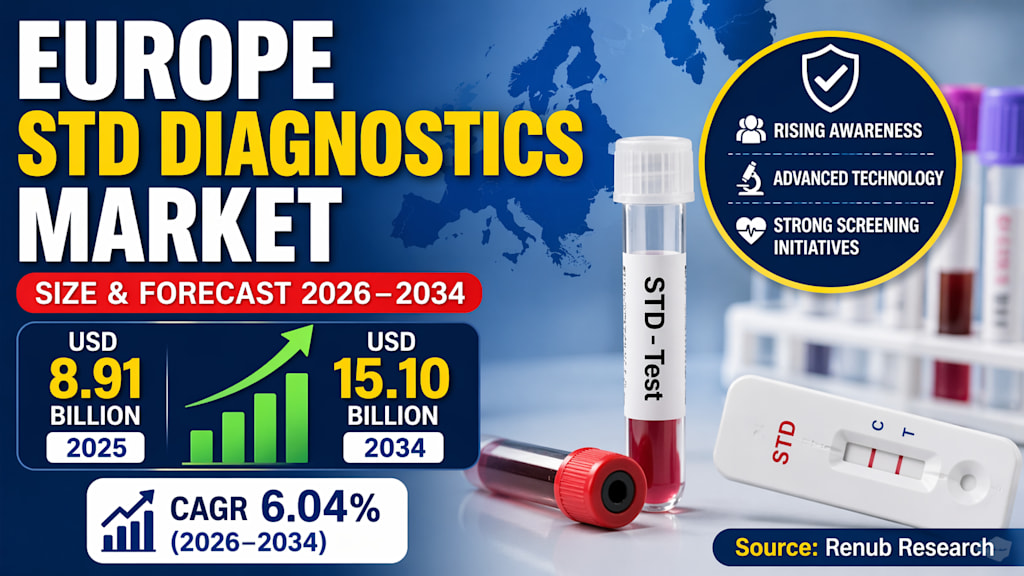
Sexual health has become one of the most important public health priorities across Europe, and that shift is creating major momentum in the diagnostics industry. According to new market insights from Renub Research, the Europe STD Diagnostics Market is projected to grow from USD 8.91 billion in 2025 to USD 15.10 billion by 2034, expanding at a CAGR of 6.04% between 2026 and 2034.
This growth reflects more than just rising infection numbers. It highlights a broader transformation in healthcare behavior, where early detection, preventive screening, digital access, privacy-focused solutions, and advanced laboratory technologies are reshaping how sexually transmitted diseases (STDs) are diagnosed and managed.
Across Europe, healthcare providers, governments, and diagnostic companies are responding to a clear reality: fast, accurate, and accessible STD testing is no longer optional—it is essential.

Why STD Diagnostics Matter More Than Ever
Sexually transmitted diseases continue to affect millions of people globally every year. In Europe, common infections such as chlamydia, gonorrhea, syphilis, herpes simplex virus (HSV), human papillomavirus (HPV), HIV, and others remain significant health concerns.
Many STDs can remain symptomless for long periods, allowing them to spread silently. If untreated, they can lead to infertility, pregnancy complications, chronic pain, immune damage, and other severe health consequences.
That is why diagnostics sit at the center of prevention. Testing helps individuals receive timely treatment while also reducing transmission within communities.
Today’s diagnostic ecosystem includes:
- Laboratory-based blood and urine testing
- PCR and molecular testing
- Rapid antigen and antibody tests
- Self-collection kits
- At-home screening services
- Multiplex tests that detect multiple infections at once
- As awareness rises, so does testing demand.
- Rising Infection Rates Driving Market Growth
One of the strongest growth drivers in Europe is the increasing number of reported STD cases.
Public health agencies across Europe have reported rising cases of gonorrhea, syphilis, and chlamydia over recent years. According to information cited in the market report, nearly 100,000 new gonorrhea cases were reported in Europe—well above prior years and four times higher than a decade ago.
Several factors are contributing to this trend:
- Urbanization and population mobility
- Increased awareness and improved reporting systems
- Changing sexual behavior patterns
- Better access to testing
- Public health campaigns encouraging regular screening
While rising case numbers are concerning, they also indicate that more people are getting diagnosed rather than remaining untreated.
Technology Is Revolutionizing STD Testing
Modern diagnostics are changing the speed, accuracy, and convenience of STD detection.
Traditional methods often required longer wait times, multiple appointments, or laboratory bottlenecks. Today, new platforms are enabling much faster and more reliable results.
Key innovations include:
1. Molecular Diagnostics
PCR-based testing offers high sensitivity and specificity, especially for infections such as chlamydia and gonorrhea.
2. Multiplex Testing
A single sample can now test for multiple pathogens at once, saving time and reducing costs.
3. Rapid Point-of-Care Testing
Results can be available during the same visit, allowing treatment decisions immediately.
4. Home Testing Kits
Consumers increasingly value privacy and convenience, making self-testing a fast-growing category.
The report notes that Roche received CE Mark approval in December 2025 for its cobas BV/CV assay, designed to identify specific bacteria or yeast infections from vaginal samples.
Such innovations show how diagnostics companies are moving beyond traditional STI testing into broader reproductive and sexual health screening.
Government Support and Preventive Screening Programs
Another major factor behind Europe’s market growth is active government involvement.
Many European countries support free or subsidized testing, particularly for:
- Young adults
- Pregnant women
- LGBTQ+ communities
- High-risk populations
- People with multiple partners
The report highlights SHIELD Joint Action, funded through the EU4Health program, involving 25 member states and running until 2028. The initiative aims to prevent infections linked to cancer and chronic disease, including HPV, hepatitis B/C, HIV, and tuberculosis.
These large-scale programs create stable demand for diagnostics while improving public health outcomes.
Home Testing: Privacy Is Becoming a Growth Engine
Many people delay STD testing because of embarrassment, stigma, or inconvenience. That is why self-testing and self-collection models are gaining popularity.
Consumers increasingly prefer:
- Ordering tests online
- Collecting samples at home
- Receiving digital results securely
- Consulting doctors remotely if needed
France has already taken a leading step. In July 2025, the country launched Europe’s first free home-order self-testing kit program for women aged 18–25 for chlamydia and gonorrhea through its national insurance system.
This move could inspire similar programs across Europe.
Country Spotlight: Key Markets in Europe
France
France benefits from strong government-backed healthcare systems and national screening programs. Demand remains steady, especially for HIV and syphilis testing. Preventive healthcare policies support routine testing rather than symptom-only testing.
Germany
Germany is one of Europe’s most advanced diagnostics markets. Strong lab infrastructure and high healthcare spending encourage adoption of automated and molecular platforms. Hospitals and private labs are key buyers.
United Kingdom
The UK market is highly aligned with public health goals. Sexual health clinics and NHS-linked screening systems support high testing volumes. Budget control remains a challenge, but innovation continues.
Russia
Russia shows uneven development, with advanced diagnostics concentrated in major cities while rural regions rely on simpler systems. However, awareness campaigns are supporting gradual market growth.
Fastest-Growing Segments in the Market
Molecular Diagnostics
This is among the fastest-growing segments because it delivers superior accuracy and efficiency. Larger hospitals and labs increasingly prefer these systems.
Rapid Point-of-Care Platforms
These tools are ideal for clinics, emergency centers, and mobile programs because they enable same-visit treatment decisions.
Home Self-Testing
As privacy concerns remain strong, home testing is expected to expand rapidly in the coming years.
Hospitals & Clinics
This remains the largest end-user category because hospitals manage complex testing while clinics handle routine screening volumes.
Challenges the Industry Still Faces
Despite strong momentum, the market is not without obstacles.
Fragmented Healthcare Systems
Each European country has its own reimbursement models, approval systems, healthcare budgets, and procurement structures. This makes expansion difficult for companies trying to scale across the continent.
Social Stigma
Although attitudes are improving, stigma still discourages testing in some communities.
Cost Pressures
Advanced molecular platforms can require significant upfront investment, which smaller clinics may struggle to afford.
Uneven Access
Urban populations typically enjoy better access than rural or remote communities.
Competitive Landscape
Several global leaders are active in Europe’s STD diagnostics market, including:
- Abbott Laboratories
- F. Hoffmann-La Roche AG
- Hologic Inc.
- Becton Dickinson and Company
- Danaher Corporation (Cepheid)
- Siemens Healthineers AG
- bioMérieux SA
- Thermo Fisher Scientific Inc.
- Qiagen N.V.
- Bio-Rad Laboratories Inc.
Competition is likely to intensify as demand rises for portable, faster, cheaper, and digitally integrated testing solutions.
What the Future Looks Like
By 2034, STD diagnostics in Europe may look very different from today.
Consumers may increasingly manage sexual health through smartphone-linked home kits. Clinics could offer instant multiplex tests during a single appointment. AI-driven systems may improve accuracy and patient routing. Public health databases may detect outbreaks earlier through real-time reporting.
Most importantly, testing could become more normalized and stigma-free.
That cultural shift would be as valuable as any technological breakthrough.
Final Thoughts
The Europe STD Diagnostics Market is no longer a niche healthcare category—it is becoming a major pillar of preventive medicine.
With the market forecast to rise from USD 8.91 billion in 2025 to USD 15.10 billion by 2034, Europe is investing in a future where sexual health testing is faster, smarter, more private, and more accessible than ever before.
About the Creator
Enjoyed the story? Support the Creator.
Subscribe for free to receive all their stories in your feed.
Comments
There are no comments for this story
Be the first to respond and start the conversation.