
Data Center Construction Market Set to Surpass US$ 103 Billion by 2033 as AI, Cloud Computing, and Digital Transformation Accelerate Worldwide
Growing investments in hyperscale facilities, sustainability-focused infrastructure, and advanced digital technologies are reshaping the future of the global data center construction industry.

The Digital Economy Is Fueling a New Era of Data Center Construction
The world is generating more data than ever before. Every online transaction, cloud-based application, AI model, streaming service, and connected device contributes to an expanding digital ecosystem that relies heavily on robust data infrastructure. At the heart of this transformation lies the data center construction industry, a market experiencing unprecedented growth as organizations race to support growing digital demands.
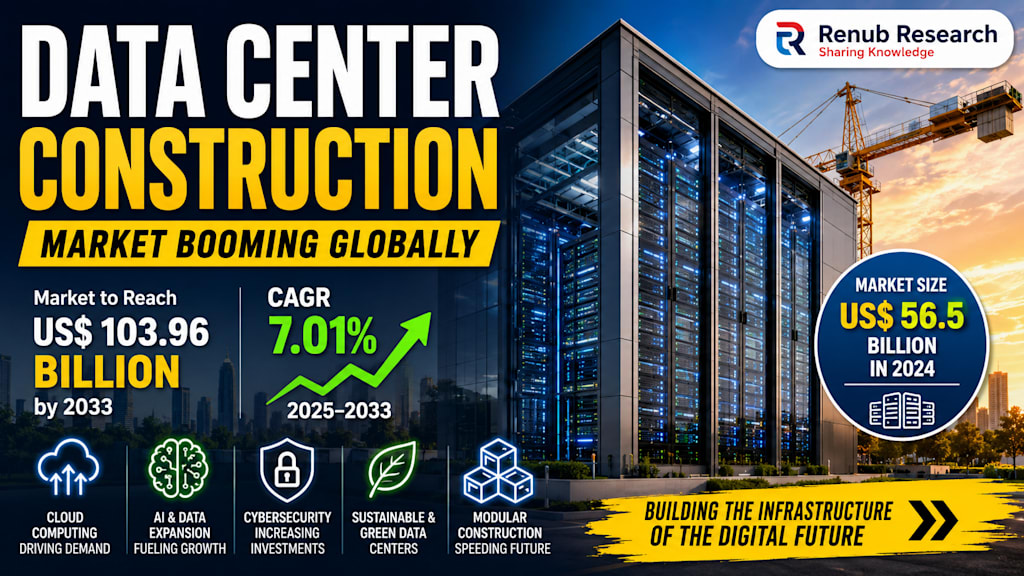
According to Renub Research, the global Data Center Construction Market is projected to grow from US$ 56.5 Billion in 2024 to US$ 103.96 Billion by 2033, expanding at a CAGR of 7.01% during the forecast period from 2025 to 2033. This growth reflects increasing investments in digital infrastructure, advanced networking capabilities, cloud computing, artificial intelligence, and sustainability-focused construction projects.
As governments, enterprises, and technology providers continue investing in digital transformation initiatives, the construction of modern, energy-efficient, and highly scalable data centers has become a strategic priority worldwide.
Why Data Centers Have Become Critical Infrastructure
Data centers are no longer viewed as simple storage facilities. They have evolved into mission-critical infrastructure supporting global business operations, public services, financial systems, healthcare networks, telecommunications, and emerging AI applications.
Modern organizations depend on real-time data processing and secure digital environments. As cloud adoption accelerates and businesses generate vast amounts of information daily, demand for reliable and resilient data center infrastructure continues to rise.
The emergence of technologies such as artificial intelligence (AI), machine learning (ML), Internet of Things (IoT), edge computing, and blockchain has further increased the need for advanced computing facilities capable of handling intensive workloads and massive datasets.
This transformation is driving substantial investment in new construction projects, upgrades of existing facilities, and deployment of hyperscale data centers across key markets.
The Rise of Hyperscale Data Centers
One of the most influential trends shaping the industry is the rapid expansion of hyperscale data centers.
Hyperscale facilities are designed to support massive computing workloads while providing scalability, operational efficiency, and enhanced performance. Global technology companies continue to invest heavily in these facilities to accommodate growing demand for cloud services and AI-driven applications.
As organizations process increasingly complex workloads, hyperscale architecture enables operators to optimize computing density, improve energy efficiency, and support future growth requirements.
These facilities are also incorporating advanced cooling technologies, intelligent power management systems, and automation capabilities to maximize operational performance while reducing costs.
Cloud Computing Continues to Drive Market Expansion
Cloud computing remains one of the strongest growth drivers for the data center construction market.
Businesses worldwide are migrating critical workloads to public, private, and hybrid cloud environments to improve flexibility, scalability, and operational efficiency. This shift has significantly increased demand for large-scale data centers capable of delivering uninterrupted services and high-performance computing resources.
Major cloud providers continue expanding their global infrastructure footprints through new construction projects and facility upgrades. These investments are helping meet the growing demand for cloud storage, SaaS applications, data analytics, and AI services.
As enterprises increasingly embrace digital-first business models, cloud-driven infrastructure expansion is expected to remain a key market catalyst throughout the forecast period.
Artificial Intelligence Is Creating New Infrastructure Requirements
Artificial intelligence is transforming nearly every industry, from healthcare and manufacturing to banking and retail. However, AI applications require enormous computational power and sophisticated infrastructure.
Training large AI models involves processing vast quantities of data, often requiring high-density computing environments supported by specialized hardware and advanced cooling systems.
As AI adoption expands, organizations are investing in data centers specifically designed to support AI workloads. These facilities often feature enhanced networking capabilities, liquid cooling technologies, and optimized power distribution systems.
The growing influence of AI is expected to create significant opportunities for data center developers, engineering firms, and infrastructure providers over the next decade.
Cybersecurity Concerns Are Increasing Investment
Cybersecurity has become a top priority for organizations worldwide.
The increasing frequency of cyberattacks, ransomware incidents, and data breaches has highlighted the need for highly secure digital infrastructure. As a result, businesses are investing heavily in data centers equipped with advanced physical and cybersecurity measures.
Modern facilities incorporate biometric access controls, surveillance systems, intrusion detection technologies, and sophisticated cybersecurity frameworks to protect sensitive information.
Industries such as healthcare, finance, government, and defense are particularly focused on secure infrastructure investments, creating strong demand for specialized data center construction projects.
Sustainability Is Reshaping the Industry
Environmental sustainability has become a defining trend within the global data center construction market.
Traditionally, data centers have been among the most energy-intensive facilities due to their continuous power and cooling requirements. Growing environmental concerns and stricter regulations have encouraged operators to adopt greener construction practices.
Today's projects increasingly prioritize:
Renewable energy integration
Energy-efficient cooling systems
Sustainable building materials
Water conservation technologies
Carbon footprint reduction initiatives
Many companies are also pursuing net-zero emissions targets and implementing environmental, social, and governance (ESG) strategies. These efforts are driving innovation in sustainable data center design and construction.
Green infrastructure is no longer optional—it is becoming a competitive necessity.
Modular and Prefabricated Construction Gains Momentum
Another significant trend transforming the market is the adoption of modular and prefabricated construction methods.
Traditional data center construction can be time-consuming and costly. Modular solutions offer a faster alternative by allowing components to be manufactured off-site and assembled quickly at the project location.
Benefits include:
Faster deployment
Lower construction costs
Improved quality control
Enhanced scalability
Reduced environmental impact
As businesses seek rapid infrastructure expansion, modular construction is becoming increasingly attractive for both hyperscale and edge data center projects.
Energy Consumption Remains a Major Challenge
Despite strong growth prospects, the industry faces several challenges.
Energy consumption remains one of the most pressing concerns. Data centers require enormous amounts of electricity to power servers, networking equipment, and cooling systems.
As demand for digital services continues to rise, operators face increasing pressure to balance performance requirements with sustainability goals.
Meeting environmental regulations while maintaining operational reliability requires substantial investments in renewable energy, efficient equipment, and advanced cooling technologies.
Organizations that successfully address these challenges will be better positioned to achieve long-term competitiveness.
Land Availability and Location Constraints
Finding suitable locations for data center construction has become increasingly difficult.
Modern facilities require:
Reliable power infrastructure
Strong network connectivity
Adequate land availability
Water resources for cooling
Regulatory compliance
In major metropolitan areas, land costs continue to rise while zoning restrictions and community concerns create additional obstacles.
To overcome these challenges, developers are exploring alternative strategies such as edge computing facilities, adaptive reuse projects, and decentralized infrastructure models.
Regional Outlook: North America Maintains Leadership
North America remains the largest market for data center construction globally.
The region benefits from:
Advanced digital infrastructure
Strong cloud adoption
Significant technology investments
Presence of major hyperscale operators
The United States continues to dominate regional activity, supported by ongoing investments from cloud providers, technology companies, and enterprise organizations.
Growing demand for AI infrastructure and cloud services is expected to sustain strong construction activity throughout the forecast period.
Asia-Pacific Emerges as a High-Growth Region
Asia-Pacific is rapidly becoming one of the most attractive markets for data center construction.
Countries such as India, China, Japan, and Australia are witnessing substantial investments driven by digital transformation initiatives, expanding internet penetration, and growing cloud adoption.
Government support, smart city projects, and rising demand for digital services are creating favorable conditions for infrastructure development.
India, in particular, is emerging as a strategic destination due to its growing digital economy, expanding technology sector, and supportive government policies.
Europe Focuses on Sustainable Infrastructure
Europe continues to prioritize sustainability in data center development.
The region's strict environmental regulations have encouraged widespread adoption of renewable energy sources and energy-efficient construction practices.
Countries such as Germany, the United Kingdom, France, and the Netherlands are investing heavily in green data center projects that align with broader climate goals.
This focus on sustainability is expected to drive innovation and long-term growth across the European market.
Competitive Landscape
The global data center construction market remains highly competitive, with leading engineering, construction, and infrastructure companies actively pursuing new opportunities.
Key companies include:
AECOM
Turner Construction Co.
Whiting-Turner Contracting Company
Jacobs Solutions Inc.
DPR Construction
Skanska USA
Balfour Beatty US
Hensel Phelps
These organizations continue investing in advanced construction methodologies, sustainability initiatives, and strategic partnerships to strengthen their market positions.
10 Recent Industry Developments Shaping the Market
1. Eaton Introduced SmartRack Modular Data Centers
Eaton unveiled SmartRack modular data center solutions designed to support AI and edge computing deployments.
2. Vertiv Launched TimberMod
Vertiv introduced TimberMod, a modular data center structure incorporating sustainable wood-based construction materials.
3. Fujitsu Advanced Green Data Center Technologies
Fujitsu continued developing energy-efficient technologies aimed at reducing future data center power consumption.
4. Increased Adoption of Liquid Cooling Solutions
Operators are deploying advanced cooling systems to support high-density AI workloads.
5. Expansion of Hyperscale Facilities Worldwide
Major cloud providers continue building hyperscale campuses to accommodate growing demand.
6. Growth of Edge Data Centers
Organizations are deploying localized facilities to reduce latency and improve user experiences.
7. Renewable Energy Integration Accelerates
Data center operators are increasingly signing renewable energy agreements.
8. Modular Construction Adoption Expands
Developers are embracing prefabricated construction to shorten project timelines.
9. Greater Investment in Cybersecurity Infrastructure
Advanced physical and digital security systems are becoming standard requirements.
10. Increased Focus on ESG Compliance
Sustainability reporting and carbon reduction targets are influencing future construction decisions.
Final Thoughts
The global data center construction market stands at the center of the digital economy's next growth phase. The explosive rise of artificial intelligence, cloud computing, cybersecurity requirements, and digital transformation initiatives is creating unprecedented demand for advanced infrastructure.
While challenges related to energy consumption, sustainability, and land availability remain significant, ongoing technological innovation is helping the industry overcome these barriers.
According to Renub Research, the market's growth from US$ 56.5 Billion in 2024 to US$ 103.96 Billion by 2033 demonstrates the critical role data centers will play in supporting the future of global connectivity, innovation, and economic development. As businesses continue embracing data-driven strategies, investment in modern, efficient, and sustainable data center infrastructure will remain a top priority for years to come.
About the Creator
Enjoyed the story? Support the Creator.
Subscribe for free to receive all their stories in your feed.
Comments
There are no comments for this story
Be the first to respond and start the conversation.