

It shouldn’t have come as a surprise to anyone, but people never pay attention until after the fact, and by then it’s always too late. The standard complaint is always, “Someone should have done something before this happened,” or “Why didn’t the government take care of this instead of doing nothing?” It’s always easier and more satisfying to blame someone else instead of accepting responsibility, but playing the blame game won’t fix what’s already broken. I know I did my part to alert the world. It’s too bad no one wanted to listen.
My name is Ben. I’ve spent my entire working life as a NASA astronomer. Looking at the universe through long tubes and eventually space telescopes has been a dream come true for me. The things I’ve had the privilege of observing over my lifetime only confirms how insignificant humans are. We may be able to influence some things on Earth, but in space, the best we can hope for is to observe what’s happening around us and try our best to survive it.
Seven years ago, while monitoring the Kuiper Belt, I noticed a strange anomaly. Meteors of various sizes were gathering together in a large flock not far from the dwarf planet Ceres. This gathering was an unusual occurrence, but I didn’t think much of it. Space is filled with strange occurrences; this was just one more example. Several weeks passed, and I noticed the flock had begun to move in Earth’s direction. Now I was intrigued.
Astronomers not only spend their time staring at celestial objects, but they also plot their paths through the cosmos, which is what I did with the flock. As the cluster of meteors got closer, it was possible to trace the individual routes of each rock to its final destination. I chose my first subject and plotted its course, factoring in time and speed, and was stunned at the result. If my calculations were correct, this meteor would collide with a communications satellite two years from today.
A pattern formed as I continued to track the individual rocks that made up the flock. Some would collide with not just communications satellites, but every satellite orbiting the Earth. The remaining rocks were destined to become meteorites and slam into communication towers positioned all around the planet. It became clear, to me at least, that this was a coordinated attack on our global communications infrastructure. It was imperative that I let those in charge know about the impending doom.
I expected the initial skepticism, but it went far beyond the old phrase trust but verify. The military brass wanted to immediately launch a counterattack, while the politicians around the globe preferred to ignore and deny the facts. The various religions told their followers that God would protect them. Besides, humans were the only intelligent life form in the universe, so none of this was true. Conspiracy theorists and internet influencers had a field day with the information. Science couldn’t be trusted; it was a far-left or far-right plot to get people to bend to their will. Humanity was about to go the way of the dinosaurs. In the end, nothing of any consequence was done to fix the problem.
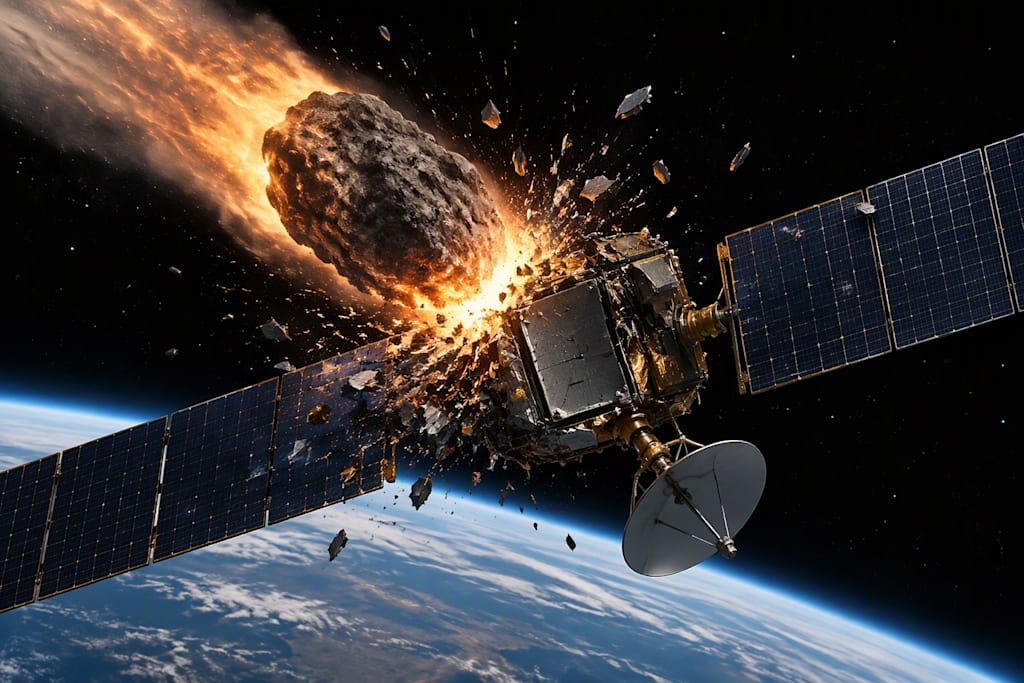
Unfortunately for humanity, my calculations were correct. The first space rock shattered its target, a Starlink Satellite, at 9 a.m. on a Monday morning. That strike was followed in rapid succession by strikes on every satellite circling the Earth. By the time the day was through, every communications tower on Earth had been destroyed. Individuals were wandering around aimlessly, tapping on a device that was no longer functional. Humanity had shifted from a high-tech communications society with cell phones and the internet to landlines, ham radios, and snail mail all in the matter of a day.
****
Back on the dwarf planet of Ceres, the inhabitants spent the day congratulating one another on a successful mission. They had long viewed humans as the biggest threat to the solar system’s stability and peace. By taking away their ability to instantly communicate with one another, the inhabitants of Ceres had slowed human advancement by hundreds of years, and along with that, the chance for interplanetary wars and brutal subjugation had been eliminated for now. True, they would attempt to rebuild, but each endeavor would be met with a similar response.
****
I still gaze at the stars most nights, but now I know that there is someone looking back.
About the Creator
Mark Gagnon
I have five published books: Mitigating Circumstances, Short Stories for Open Minds, Short Stories from an Untethered Mind, Unmitigated Greed, and Short Stories to Spark the Imagination.
Enjoyed the story? Support the Creator.
Subscribe for free to receive all their stories in your feed. You could also become a paid subscriber, letting them know you appreciate their work.
Comments
There are no comments for this story
Be the first to respond and start the conversation.